


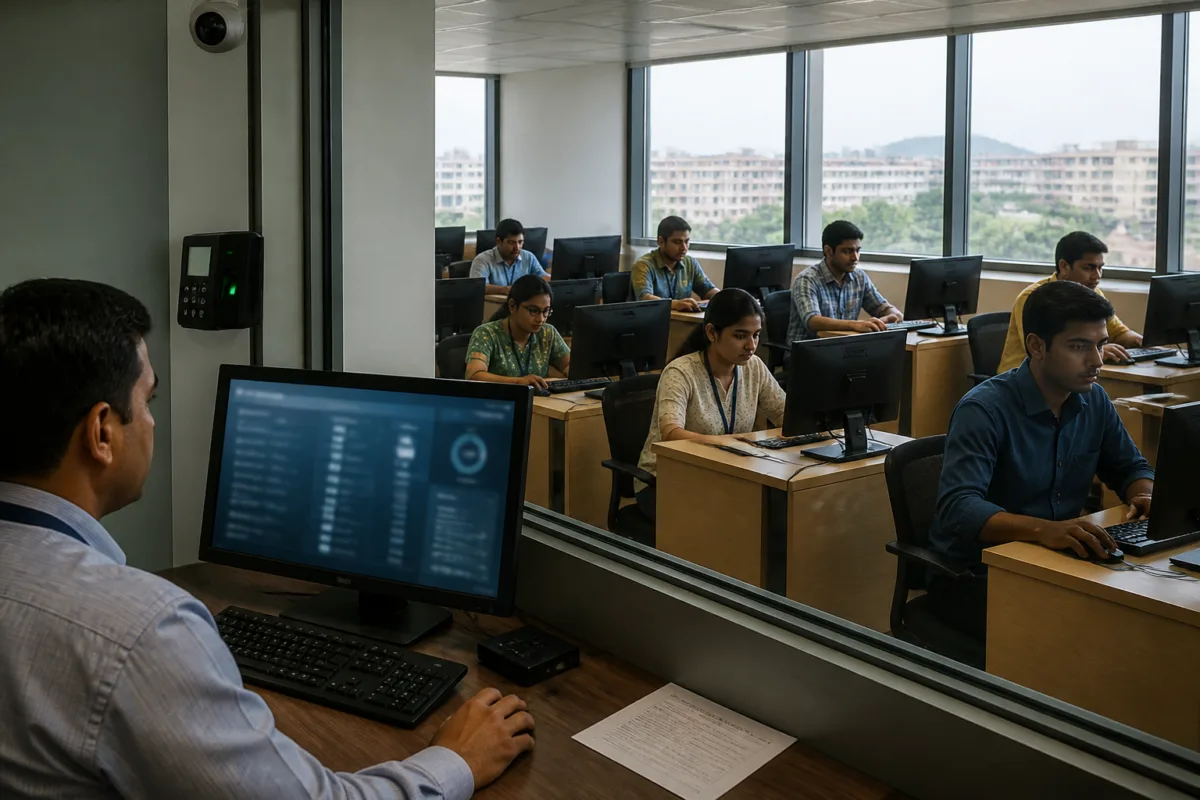
Competitive exam paper leak prevention cannot depend on shifting examinations online, Maharashtra Knowledge Corporation Limited chief mentor Vivek Sawant said at a Pune lecture, arguing that the larger weakness lies in the way question papers are created, handled and accessed before an examination begins.
Sawant proposed an examination model in which a complete question paper is never prepared or stored in advance. Instead, an extensive question bank and a predetermined blueprint would be created. Once the examination starts, one question at a time would be displayed on a candidate’s screen according to that blueprint. After answering or skipping a question, the candidate would not be allowed to return to it. Since no single person would be able to see the complete paper, Sawant said, the opportunity to leak it would be substantially reduced.
The proposal was presented during a special lecture in Pune on whether competitive-examination paper leaks can be stopped permanently. The event was organised by the Pune unit of the Maharashtra Andhashraddha Nirmoolan Samiti and Sadhana weekly to mark the 81st birth anniversary of Narendra Dabholkar. Representatives associated with the organisations, including Deepak Girme, Ganesh Chinchole, Milind Deshmukh, Vinod Shirsath, Shripal Lalwani and Nandini Jadhav, were present.
The central institutional issue raised at the event is that a paper leak is not always a visible breach that occurs immediately before an examination. Sawant described the confidential circulation of papers through people involved in preparing them as a form of “system leakage”. Such exchanges, he said, may take place through financial transactions or personal relationships and may not become public unless an incident is detected.
That distinction changes the security question. If the complete paper exists in a small number of offices, systems or personal devices before the examination, security depends on controlling every person and access point connected to its creation and movement. If the paper is generated only as the examination proceeds, the proposed model attempts to reduce the value of stealing or copying a complete document. It would not remove the need for identity checks, secure devices, protected networks or monitoring, but it would alter what an attacker is trying to obtain.
Sawant also warned that digitisation by itself does not guarantee examination integrity. Online examinations can face server failures, malware or ransomware attacks, and remote access that allows another person to answer an examination on behalf of a candidate, according to his remarks. These risks mean that a digital examination system must be treated as a wider operational and cybersecurity network rather than simply as a paper replaced by a computer screen.
He said that 15 areas of security had been identified and that 45 factors needed to be monitored across three stages: before the examination, during the examination and after it. The report does not provide the detailed list of these areas or factors, nor does it establish whether the framework has been formally adopted by an examination authority. That limitation is important because the proposal remains a set of design principles presented at a public lecture, rather than evidence of a statewide implementation programme.
The proposed system also attempts to address a different weakness in multiple-choice examinations: the possibility of reaching the correct answer through guessing. Sawant said a new system had been developed in which selecting an option would lead to follow-up questions examining the reasoning behind that choice. The stated purpose is to determine whether a candidate understands the concept or has arrived at the right answer by chance.
This would make the examination more than a sequence of fixed questions with four or more selectable options. It would seek evidence of the candidate’s thought process after an answer is chosen. However, the supplied report does not explain how the follow-up questions would be generated, how answers would be evaluated, whether the method would apply equally across subjects, or how additional time and accessibility requirements would be handled.
The design proposed in Pune therefore combines two separate objectives. The first is security: ensuring that a complete question paper does not exist in a form that can be copied and circulated before the test. The second is assessment quality: checking whether a candidate understands the underlying concept rather than merely recognising or guessing the correct option. Both objectives require examination authorities to define their rules in advance, because changes to navigation, timing and question sequencing can directly affect how candidates prepare and perform.
The institutional responsibility would also extend beyond the technology provider. An examination authority would have to decide how the question bank is created, who approves its content, how the blueprint is secured, how questions are selected, how technical failures are recorded and how complaints are investigated. The proposal, as reported, does not assign these responsibilities or specify the legal and administrative framework under which such a system would operate.
That matters because competitive examinations distribute scarce opportunities. Sawant said that when opportunities are few and demand is high, their allocation must be fair and transparent. A leak does not only compromise one examination session. It can impose financial and emotional costs on candidates who have spent months preparing, while forcing authorities to cancel tests, reschedule recruitment and rebuild confidence in the process.
The proposed “non-existent paper” model addresses the point at which a traditional paper becomes vulnerable: the period during which a complete set of questions is assembled and made available to a limited group of people. Its underlying principle is similar to reducing the concentration of risk. Instead of protecting one finished document, the system would distribute the examination across a secured question bank, a blueprint and a controlled sequence of live question displays.
That principle also creates new administrative questions. A larger question bank must be reviewed for difficulty, duplication, syllabus coverage and possible bias. A blueprint must ensure that candidates receive comparable levels of challenge. A live selection process must maintain reliability if a server fails or connectivity is disrupted. Candidate records must show what was displayed, when it was displayed and how the system responded. None of these implementation details are established in the supplied report, but they would determine whether the security gains can be achieved without creating a different set of disputes.
Candidate acceptance is another unresolved part of the proposal. Sawant acknowledged that students may initially oppose a system in which they cannot return to a previous question. He said candidates would need advance information and confidence-building before wider use. This is not a minor communication issue. Examination rules are part of the conditions under which candidates compete, and an unfamiliar interface or navigation restriction can affect performance even when the technology operates correctly.
The proposal therefore places trust alongside cybersecurity as a condition of reform. Candidates would need to know the rules before the examination, understand how questions will appear, receive clarity on technical interruptions and have access to a credible grievance process. Without these safeguards, a system designed to prevent leakage could still face allegations of unfairness if candidates do not understand how it works or cannot challenge a malfunction.
Sawant also questioned the continued reliance on a conventional model in which every candidate receives the same fixed question paper. He argued that examination systems should recognise that students may require different amounts of time to learn, while assessment results must remain fixed and comparable. The report does not set out a complete alternative assessment framework, but the argument places paper-leak prevention within a wider debate about what competitive examinations are designed to measure.
The evidence currently available confirms that a senior MKCL representative has proposed a technology-led approach based on a large question bank, a secured blueprint, sequential question delivery and reasoning-based follow-up questions. It does not confirm that the model has been tested at scale, approved by an examination authority or shown to prevent leaks in practice. It also does not establish how the system would manage accessibility, outages, appeals or differences between subjects.
The larger urban and institutional question is whether public examination systems can move from protecting documents to designing processes in which the most vulnerable document—the complete question paper—never exists in advance. Any such shift would require technical standards, administrative accountability and sustained communication with candidates. The next measure of the proposal will therefore be whether its principles are converted into a transparent, independently tested examination framework rather than remaining an idea discussed at a lecture.

