


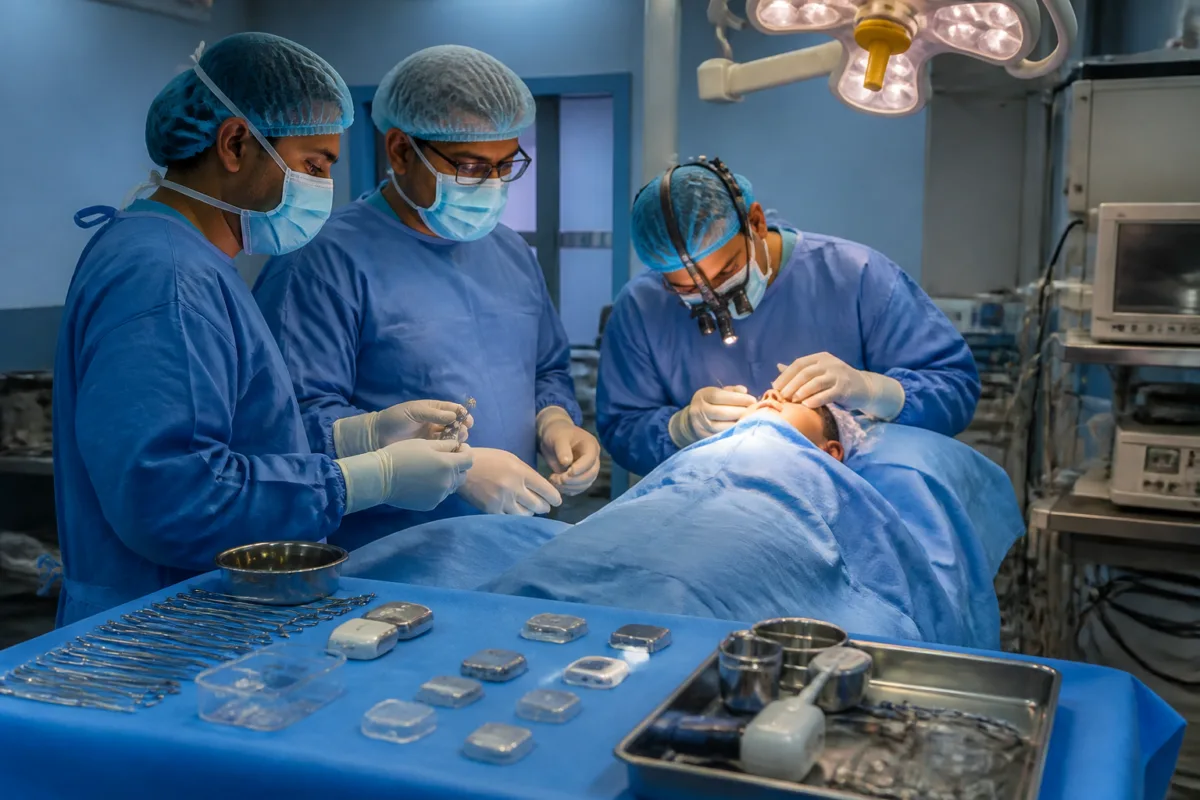
AIIMS-Patna’s latest hearing implant milestone is more than a count of procedures. It brings together three different questions that usually remain separate in public discussion: whether children with congenital hearing conditions can be identified early, whether advanced treatment can be made available through a government health programme, and whether a public medical institution has the capacity to sustain specialised care. On October 30, the institute performed three hearing implant procedures in one day, including its first bone conduction implant on a child born without both external ears. The information was shared by AIIMS-Patna on Monday and reported by the Times of India.
The child had bilateral anotia, a rare congenital condition in which the external ears are absent. In this case, doctors used a bone conduction implant, a device that transmits sound vibrations through the skull bones to the inner ear. That mechanism is relevant where hearing loss is linked to problems in the outer or middle ear. The procedure is therefore different from a cochlear implant, which converts sound into electrical signals to stimulate the auditory nerve and is used for severe hearing loss caused by damage to sensory cells in the inner ear.
The distinction matters because the intervention is not simply a technology upgrade inside an operating theatre. It reflects the need to match treatment to the anatomical and medical cause of hearing loss. For a child born without external ears, conventional pathways that depend on the outer ear or middle ear may not provide the required route for sound. A bone conduction implant offers another pathway by using the skull to carry vibrations to the inner ear, according to the explanation reported from AIIMS-Patna.
The same day, the institute’s ENT department performed two cochlear implant surgeries, one on a child and the other on an adult. Together, the three procedures illustrate the range of cases handled by a hearing implant programme. They also show why an institutional milestone should be read alongside the type of care being delivered. The headline figure is that AIIMS-Patna’s programme has crossed 400 implants. The more significant operational detail is that the department completed three advanced procedures in a single day, involving different patients and two different implant technologies.
The child’s surgery was conducted under the Rashtriya Bal Swasthya Karyakram, or RBSK. The central government programme is aimed at the early identification and treatment of health conditions among children from birth to 18 years. Within the information supplied by AIIMS-Patna, the programme’s relevance is direct: it provided the framework under which the child with bilateral anotia received the bone conduction implant.
That connection places the surgery within a public delivery chain rather than treating it only as a specialised medical achievement. A child must first come within the age range and screening framework of the programme, be identified as requiring treatment, and then reach a facility capable of providing the intervention. The supplied report does not provide the number of children screened, the time taken between identification and surgery, the cost of the procedure, or the number of beneficiaries treated through RBSK at AIIMS-Patna. Those gaps prevent a wider assessment of access, but they also identify the institutional questions behind the milestone.
Early identification is particularly important in hearing-related conditions because treatment is linked to rehabilitation and communication development. The report does not provide an outcome assessment for the child who underwent surgery, nor does it state when the implant will be activated or what rehabilitation plan has been prescribed. It therefore establishes that the operation was performed, but not the eventual hearing or developmental outcome. That distinction is important when evaluating advanced medical programmes: procedural capacity is measurable immediately, while patient outcomes require follow-up.
AIIMS-Patna’s report also links the surgeries to a continuing medical education programme on “hearing solutions”. The sessions included academic discussions by Dr Kranti Bhavana, Dr Rajesh Vishwakarma and Dr Leena Vishwakarma, with the surgeries conducted under Dr Bhavana’s leadership and guidance from senior expert Dr Rajesh Vishwakarma. The programme focused on advanced hearing technologies, implant-based treatment options and recent developments in hearing rehabilitation.
The combination of clinical procedures and continuing medical education points to two sides of specialised public healthcare. The first is the ability to perform technically demanding treatment. The second is the ability to maintain professional knowledge around patient selection, devices and rehabilitation. The supplied material does not establish whether the education programme was linked to a formal training network, a state-level referral system or a wider expansion plan. It does show that AIIMS-Patna presented clinical service delivery and professional learning as part of the same hearing-care effort.
The 400-implant figure is also best understood as an institutional capacity marker rather than a measure of population-level coverage. It indicates that the hearing implant programme has accumulated substantial procedural experience at the institute. It does not, by itself, show how many eligible patients remain untreated in Bihar, how many patients travel from outside the state, or whether the programme is meeting regional demand. No such figures are included in the supplied report.
This limitation is central to understanding the public-health significance of the announcement. A specialised service can expand inside a major public institution while access remains uneven across geography, income and referral pathways. The information available here confirms the presence of advanced treatment at AIIMS-Patna and its use under RBSK for at least one child. It does not establish the reach of the programme beyond the cases described or the distribution of similar services across other public facilities.
The institutional responsibilities are nevertheless visible. AIIMS-Patna provides the clinical setting and specialist ENT team. RBSK supplies the public programme framework for identifying and treating children from birth to 18 years. Doctors and senior experts contribute surgical and academic leadership. Rehabilitation is part of the treatment pathway because both bone conduction and cochlear implants require more than the operation itself: the devices must be managed, and patients must be supported after implantation. The report mentions hearing rehabilitation as a subject of discussion but does not specify the services available to the patients described.
The story also demonstrates why technology alone does not define the performance of a health system. Bone conduction and cochlear implants address different forms of hearing loss, and their use depends on diagnosis, clinical judgement and follow-up. A programme’s strength therefore rests not only on the availability of devices or operating rooms, but also on the ability to identify appropriate patients and connect them to continuing care. In the present case, the available evidence is strongest on the surgical event and the institute’s cumulative milestone. Evidence on long-term rehabilitation, affordability and geographic access remains absent.
For urban and regional health planning, this is a question of concentrated specialist capacity. AIIMS-Patna’s milestone shows how an institution can function as a centre for advanced treatment while also serving a public programme directed at children. The report does not describe the referral geography, but the combination of a national child-health programme and a specialised institute suggests that administrative coordination is as important as clinical expertise. Screening, referral, surgery and rehabilitation must connect for the benefit of the patient; the supplied material confirms only some parts of that chain.
The immediate significance of the October 30 procedures is therefore clear but bounded. AIIMS-Patna performed its first bone conduction implant for a child with bilateral anotia, conducted two cochlear implant surgeries on the same day, and crossed 400 implants through its hearing implant programme. These are established facts in the supplied report. What remains to be established is how the programme measures patient outcomes, how many children are reached through RBSK, and whether the institutional milestone is translating into wider access to hearing care.
Those are the developments that deserve monitoring as AIIMS-Patna continues the programme: activation and rehabilitation outcomes for implanted patients, the number of children identified and treated through RBSK, the institute’s referral and follow-up arrangements, and whether its specialist capacity expands beyond individual milestones into a sustained regional service.

