


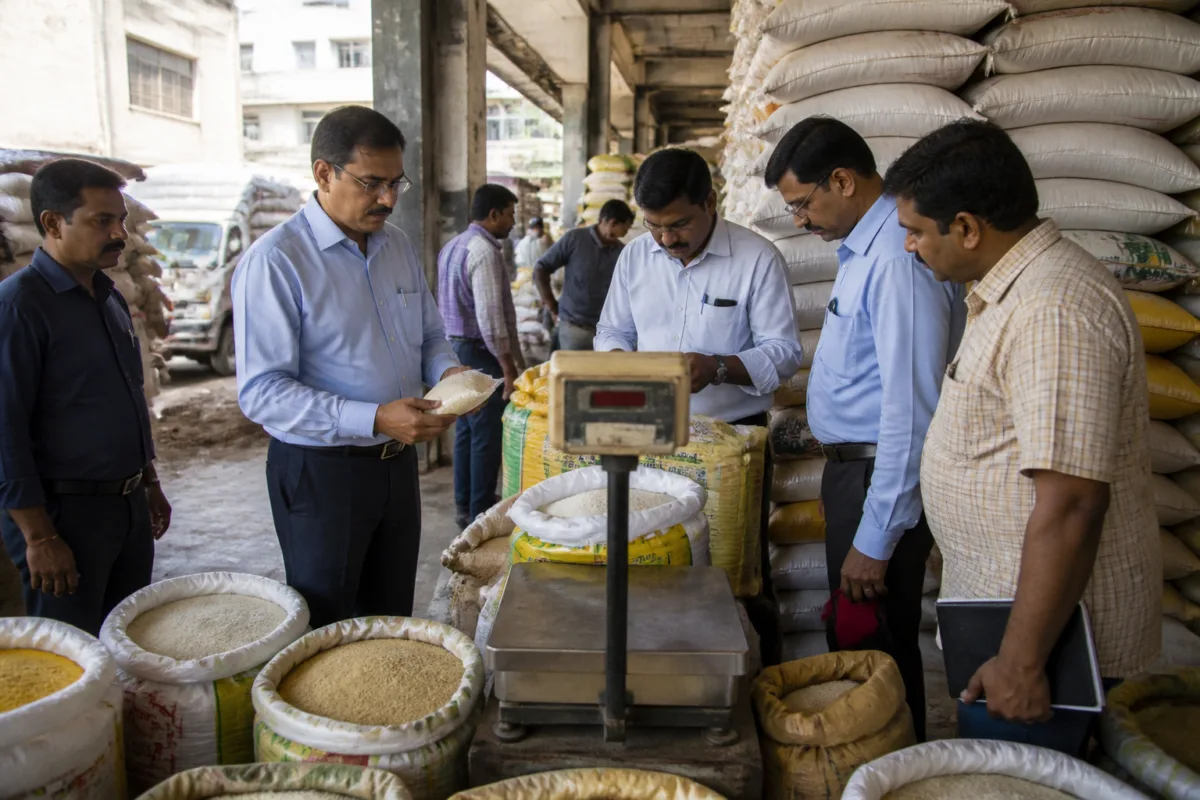
The Hyderabad rice raids conducted between October 29 and 31 have brought 11 FIRs and action against 18 trading entities, but the enforcement drive also exposes how weaknesses in weighing, pricing, licensing and supply-chain controls can converge in the city’s food market. The Civil Supplies Department said its multi-agency inspections covered retail and wholesale establishments across Hyderabad and Rangareddy districts and targeted alleged illegal trading, artificial scarcity, price manipulation and diversion of Public Distribution System rice.
According to the report by Telangana Today, the inspections found bags carrying “26-kilogram” labels that contained only 25 kilograms of rice. Officials also found traders placing higher price stickers over manufacturers’ original printed rates. These practices affect the most basic transaction between a consumer and a supplier: the quantity offered, the price displayed and the identity of the business authorised to sell the product.
The enforcement action is significant because the reported irregularities were not confined to a single type of violation. The Civil Supplies Department identified alleged manipulation of weights, inflated pricing, missing statutory licences, illegal diversion and hoarding of PDS rice. Taken together, the findings point to an oversight challenge that crosses several administrative responsibilities rather than belonging exclusively to one inspection category.
Eleven FIRs were registered at the Saroornagar, Jeedimetla and Alwal police stations against what officials described as habitual offenders. The police cases add a criminal-enforcement layer to the administrative action against the trading entities. The supplied report does not specify the names of the businesses, the quantities of rice seized, the financial penalties imposed or whether any licences have been cancelled or suspended.
That missing information matters when assessing the effect of an enforcement drive. A raid establishes that inspectors found alleged violations at particular premises. It does not, by itself, establish the scale of the wider market problem, the duration of the practices or the final legal outcome. Those questions would depend on the investigation, the evidence collected, the response of the accused entities and decisions by the relevant authorities.
The reported use of incorrect weight labels illustrates the importance of routine measurement checks in food retail. A one-kilogram difference on a bag marked as weighing 26 kilograms represents a direct gap between what a buyer is told and what the buyer receives. In a wholesale or retail system handling large volumes, such a discrepancy can affect both household purchases and the records maintained by traders. The report, however, does not provide the number of bags examined or quantify the alleged shortfall across the establishments inspected.
The pricing findings raise a separate issue. Officials said traders had pasted exorbitant price stickers over the manufacturers’ original printed rates. A printed rate provides a reference for consumers and enforcement agencies, while an altered sticker can make it more difficult to determine whether the increase is authorised or justified. The source report does not state the original and revised prices, the brands involved or the legal provisions invoked in each case. Those details would be needed to measure the financial impact on consumers.
The discovery of establishments operating without Trade, GST, Labour or FSSAI licences broadens the institutional picture. These permissions and registrations relate to different aspects of commercial operation, taxation, labour compliance and food safety. Their absence can make it harder for authorities to identify the responsible operator, trace supplies and establish whether a business is meeting the conditions attached to its activity. The report does not indicate whether all 18 trading entities lacked the same licences or whether the violations varied from one establishment to another.
PDS rice diversion and hoarding carry a distinct public-distribution concern. Public Distribution System supplies are intended to move through a regulated channel to eligible beneficiaries. When such rice is allegedly diverted into commercial trading, the issue is not only a private dispute over price or quantity. It concerns whether a publicly managed food-supply mechanism is reaching its intended users. The supplied material does not identify the source of the allegedly diverted rice, the volume involved or the distribution points connected to the cases.
The choice to conduct surprise raids across two adjoining districts also reflects the geography of urban supply chains. Hyderabad’s retail market is connected to wholesale premises, storage locations, transport routes and commercial areas that may extend beyond municipal boundaries. A district-based inspection may therefore identify violations at one point while leaving the full movement of the commodity unresolved. The report confirms inspections in Hyderabad and Rangareddy, but does not describe the supply routes or storage facilities examined.
The case locations named in the report—Saroornagar, Jeedimetla and Alwal—span different parts of the metropolitan area. Their inclusion suggests that the enforcement action was not limited to one local market. At the same time, the available information cannot establish whether the inspections were risk-based, prompted by complaints, part of a scheduled campaign or linked to earlier cases. Civil Supplies officials described the action as part of intensified multi-agency raids, but the report does not provide the operational plan behind the campaign.
The phrase “multi-agency” is important because the alleged violations require coordination. Civil Supplies officials can inspect issues connected to regulated food distribution and consumer-facing practices, while police action is required when cases are registered as FIRs. Licensing and registration concerns may involve other departments or authorities. The effectiveness of such a response depends not only on the number of raids but also on whether inspection findings are transferred accurately between departments and followed through to adjudication or prosecution.
The enforcement pattern also raises the question of continuity. A short campaign can identify violations, but sustained market compliance generally depends on what follows: inspections of repeat offenders, verification of corrective measures, action on missing registrations and tracking of cases after FIRs are filed. In this instance, officials said legal action had been initiated against 18 trading entities and that 11 FIRs had been registered. The supplied report does not state the next hearing dates, investigation status, seizure records or expected completion timelines.
For consumers, the immediate concerns are practical. They include receiving the quantity printed or represented on a package, seeing an accurate price and purchasing from a trader operating within the required regulatory framework. For PDS beneficiaries, the larger concern is whether rice assigned to the public distribution network remains within that system. The enforcement findings connect these everyday transactions to administrative systems that are often visible only when a raid, complaint or police case brings them into public view.
The Hyderabad rice raids therefore provide evidence of specific alleged violations, but not yet a complete picture of the city’s rice market. The confirmed developments in the supplied report are the inspections conducted from October 29 to 31, the registration of 11 FIRs, action against 18 trading entities and the irregularities described by Civil Supplies officials. What remains to be established is the quantity involved, the final responsibility of each entity, the penalties or prosecutions that follow and whether the department’s intensified inspections become a continuing system of market oversight.

