


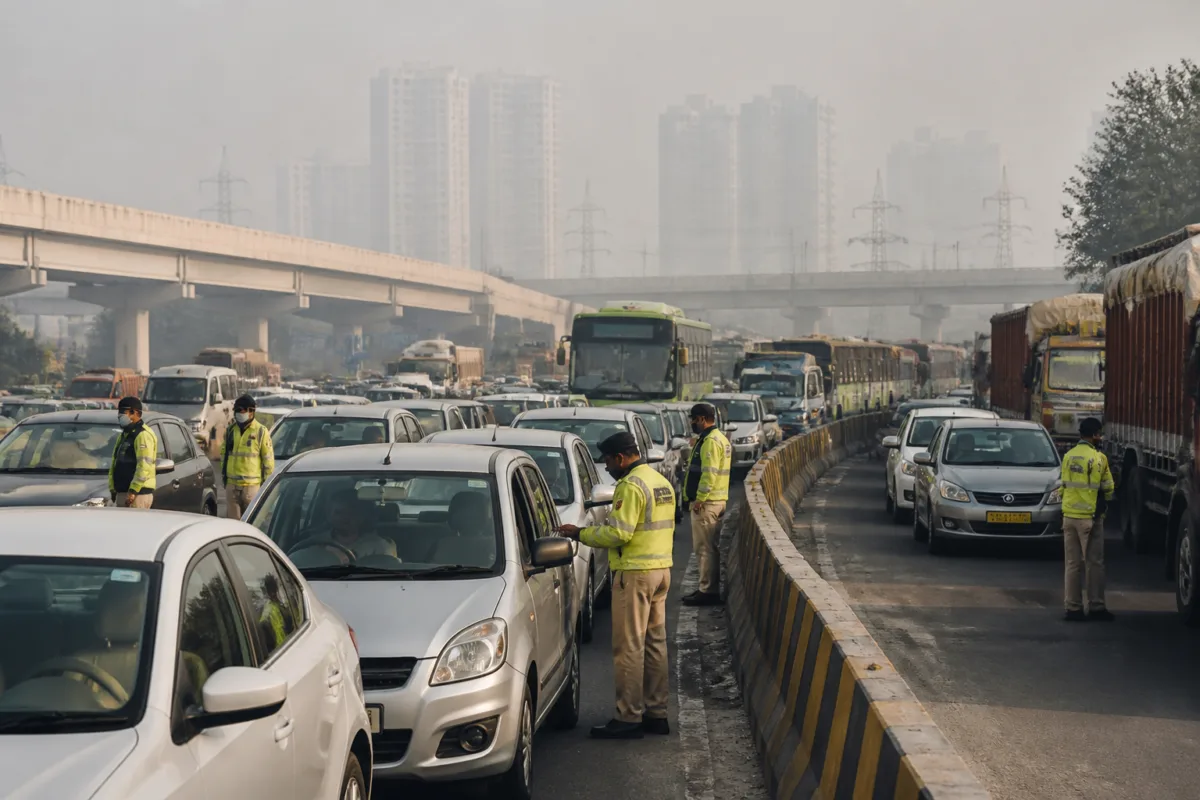
Delhi’s air quality has entered the very poor category for the first time this season, but the more consequential development is the way the response is unfolding across the National Capital Region. The Commission for Air Quality Management has invoked Stage 2 of the Graded Response Action Plan, vehicle checks have created long queues at interstate borders, the Delhi High Court has declined interim relief against entry restrictions, and the Supreme Court has permitted certified green firecrackers for a limited period. Together, these developments show an urban system attempting to manage pollution through a patchwork of emergency controls while the sources of emissions remain distributed across a city-region that does not operate within Delhi’s administrative boundary.
The immediate deterioration was sharp. Delhi’s Air Quality Index settled at 324 at 4pm on Monday, placing it in the very poor category and making it the highest reading recorded since February 4, when the AQI stood at 339. The city had moved from an AQI of 117, classified as moderate, on October 31 to 261, classified as poor, on November 1. At 4pm on Monday, three monitoring stations reported severe pollution: Jahangirpuri recorded 436, Rohini 415 and Punjabi Bagh 413. Of Delhi’s 58 monitoring stations, 37 reported very poor air quality, 17 reported poor air quality and one reported moderate air quality.
PM2.5 remained the dominant pollutant. These fine particles, measuring 2.5 micrometres or less, can penetrate deep into the lungs and enter the bloodstream. The concentration of PM2.5 makes the episode more than a matter of visibility or inconvenience. It connects the city’s pollution response to public health, daily mobility and the capacity of government agencies to enforce rules during a period when transport demand and construction activity continue across a densely connected metropolitan region.
The CAQM attributed the deterioration to unfavourable meteorological conditions and said forecasts indicated that the very poor category was likely to continue. The Air Quality Early Warning System for Delhi projected very poor air from November 3 to 5, followed by marginal improvement to the poor category over the subsequent six days. This forecast is significant because GRAP is structured around the severity of observed and expected pollution. Stage 2 applies when the AQI is between 301 and 400 and is intended to prevent further deterioration rather than permanently reduce the city’s emissions.
That distinction matters. Emergency action can restrict particular activities when pollution crosses a threshold, but the underlying emissions profile is not created by one source or one jurisdiction. The Decision Support System for Delhi estimated that transport contributed 19.2% of the city’s pollution on Monday. Industries in Delhi and peripheral areas contributed 4.2%, residential activities 4.9% and stubble burning 8.4%. Other sources accounted for 20.7%. Neighbouring NCR districts also contributed to the estimated pollution load, including Jhajjar at 6.9%, Sonipat at 5.1%, Gurgaon at 2.9%, Rohtak at 2.7%, Ghaziabad at 2.6%, Baghpat at 2.4%, Panipat and Bhiwani at 2% each, and Gautam Buddha Nagar at 1.9%.
These figures do not describe a single-cause crisis. They describe a metropolitan airshed in which pollution sources and administrative responsibilities overlap. Delhi may impose restrictions within its territory, but commuters, freight operators, industrial units and construction sites function across state borders. The response therefore depends not only on the Delhi government or the Delhi Traffic Police, but also on authorities in Haryana and Uttar Pradesh, the CAQM, pollution control agencies, municipal bodies and forecasting institutions.
The border checks have made that institutional geography visible to residents. Restrictions effective from November 1 bar petrol and diesel vehicles registered outside Delhi that do not meet BS-VI emission standards from entering the capital. Electric and CNG vehicles, as well as BS-VI-compliant vehicles, are exempt. Enforcement has been reported at Rajokri on NH-48, the DND Flyway, Ghazipur, Singhu, Tikri and Badarpur, among other entry points.
The system has produced immediate operational consequences. Long queues were reported at the Delhi-Gurgaon, Delhi-Noida, Delhi-Ghaziabad, Delhi-Sonipat and Delhi-Najafgarh borders. On NH-48, traffic backed up for several kilometres near the Sirhaul toll plaza, affecting both the main carriageway and service roads. Similar congestion was reported near Noida and Ghaziabad. At Aya Nagar, Delhi Traffic Police and Transport Department teams turned back vehicles that did not meet the prescribed standards, issued fines for violations and checked incomplete vehicle documents.
The scale of enforcement also shows the administrative burden involved. The Northern Range of Delhi Traffic Police said its teams checked 7,657 vehicles between midnight on November 1 and noon on November 2, turning back 609 vehicles. On November 1, teams checked 7,279 vehicles between midnight and 8pm, turned back 714 and impounded 38. Delhi Environment Minister Manjinder Singh Sirsa said enforcement teams had checked 14,930 vehicles on November 1, issued 566 challans for Pollution Under Control Certificate violations and inspected 300 construction sites.
The data reveals a tension at the heart of vehicle-based pollution control. The restrictions are designed to prevent higher-emitting vehicles from entering Delhi, but their enforcement is concentrated at a limited number of gateways into a region whose daily movement is highly integrated. When checks are intensified, the pollution-control measure becomes a traffic-management event. Commuters experience it through delays and diversions, while enforcement agencies must determine vehicle eligibility, verify documents and maintain traffic flow at the same time.
The Delhi High Court’s refusal to grant interim relief has kept the restrictions in force from November 1 to January 31. The petition, filed by Faridabad-based lawyer Gurmukh Dass Kohli, challenged the June 23 notification on the ground that it distinguishes between vehicles based on registration location rather than emission standards. It argued that pre-BS-VI vehicles registered in Delhi remain allowed to operate while comparable vehicles registered in Haryana are barred. The petition also questioned whether the restriction applies regardless of the AQI on a particular day and whether less restrictive measures could have been considered.
The court issued notice and listed the matter with a related case for November 27. The litigation places the NCR’s integrated labour and transport market against a regulatory framework that is implemented through state and city boundaries. The central legal question, as presented in the petition, is whether a vehicle restriction can rely on registration jurisdiction when emissions and travel patterns extend beyond that jurisdiction. The court’s interim decision does not resolve the wider issue, but it ensures that the restrictions will continue while the challenge is heard.
Firecracker regulation adds another layer to the same governance problem. The Supreme Court has allowed the sale of certified green firecrackers in Delhi-NCR from November 4 to 6 and their use between 6am and 7am and 8pm and 10pm on November 7 and 8. A complete ban is to return from November 9. Manufacturers must have valid CSIR-NEERI certification and PESO licences, and each box must carry a product- and batch-specific QR code. Firecrackers containing barium, unauthorised products and series crackers, commonly called ladis, remain prohibited.
The court has also directed authorities to designate sale locations, prohibit online sales, inspect markets, verify QR codes and confiscate illegal firecrackers. Firecrackers are not allowed within 300 metres of hospitals, healthcare centres, old-age homes, educational institutions and notified silence zones. In its October 29 order, the court said a complete ban was contributing to the illegal sale of conventional firecrackers while preventing people from buying legitimate green crackers tested at established facilities. It also noted inadequate data on whether the 2024 ban had achieved its purpose, particularly in the absence of significant improvement in AQI readings.
The court’s directions underline the importance of measurement and compliance, not merely the announcement of restrictions. The Central Pollution Control Board, in consultation with state pollution control boards, has been asked to prepare daily air-quality reports for the pre-Diwali period, Diwali, the following days and the post-festival period through November 30. Authorities have also been asked to monitor pollution, inspect non-functional monitoring stations and ensure post-festival waste clearance.
Delhi’s present episode therefore raises a structural question about how emergency pollution governance should work in a metropolitan region. GRAP provides a graded framework, but its effectiveness depends on timely forecasts, reliable monitoring stations, coordinated enforcement and compliance across multiple jurisdictions. The available data shows that the city can mobilise agencies quickly: vehicle checks, construction-site inspections and border enforcement were all expanded as the AQI worsened. It also shows the limits of an approach in which residents encounter the response mainly through traffic queues, vehicle turn-backs and temporary restrictions.
What the evidence confirms is that Delhi’s pollution problem is both local and regional. Transport is a significant estimated contributor, but it is not the only one. Pollution from neighbouring districts, industries, residential activity, stubble burning and other sources forms part of the same air-quality episode. The immediate official response is focused on preventing further deterioration, while the courts are testing the legal and operational basis of vehicle and firecracker controls. The next milestones are the expected air-quality readings through November 5, the Supreme Court’s monitoring period through November 30 and the Delhi High Court hearing scheduled for November 27.

