


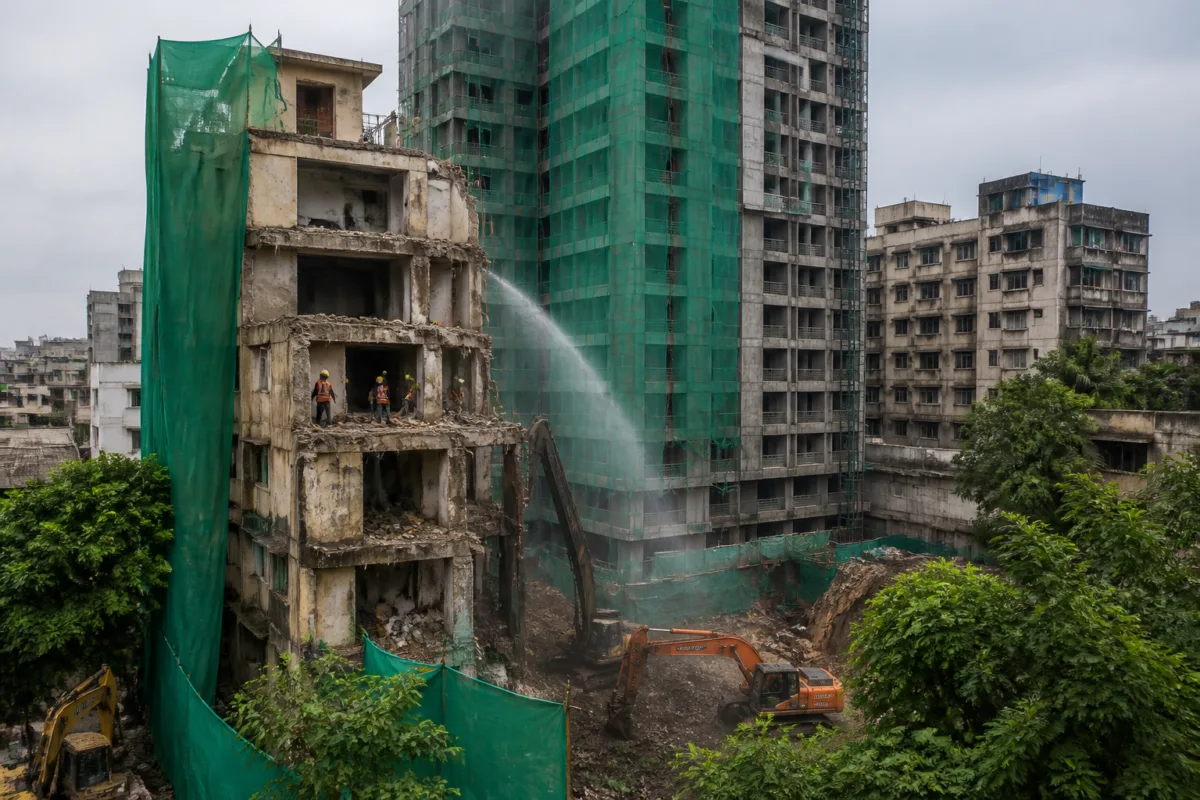
Mumbai’s construction boom is creating dust at far more stages than demolition alone, according to architects, consultants, contractors and developers quoted in a report by The Times of India. Their observations point to a wider urban management problem: the city’s redevelopment and high-rise construction model is increasing the number of activities that generate dust, while mitigation practices and incentives have not evolved at the same pace.
Dust is produced when old buildings are pulled down, foundations are excavated several floors underground, and concrete blocks are cut to install electrical conduits and plumbing. In a city where redevelopment is gathering pace and new buildings increasingly include multiple basement levels, these activities bring construction-related pollution closer to residents, pedestrians and workers. The issue is therefore not confined to a site boundary or a single phase of a project. It follows the construction cycle from demolition to excavation and internal finishing.
The evidence supplied in the report is based on observations from professionals involved in architecture, structural consultancy, construction and development. Their proposed responses differ in emphasis, but they identify the same institutional gap: dust control is still treated largely as a site-level practice, even though the volume and complexity of construction are being shaped by larger planning and redevelopment decisions.
Demolition is the first major pressure point. Manoj Daisaria, a senior architect and former president of the Practicing Engineers, Architects, and Town Planners Association, said demolition methods should move away from simply using heavy equipment to smash structures. He called for staged dismantling and greater use of cutters. Daisaria also referred to earlier demolition practices in parts of south Mumbai, where tiled roofs and brick structures were taken apart manually, with bricks and tiles removed one by one.
That approach would require more manpower and time, and would increase costs, Daisaria said. Its proposed benefit is a reduction in the amount of dust released when structures are broken apart rapidly. The comparison is significant because it shows that dust control is not only a question of installing equipment or spraying water. It can also depend on the basic sequence and technique used to take a building down.
The trade-off between speed, labour and pollution is central to Mumbai’s redevelopment environment. Faster demolition can clear a site sooner, but the report’s expert observations suggest that it may also produce more dust over a shorter period. Manual or staged dismantling may reduce the intensity of pollution, but it requires contractors and project authorities to accept a slower and more labour-intensive process. The supplied report does not establish how often such methods are currently used or quantify the difference in emissions. It does, however, identify demolition technique as a factor that existing guidelines may not address sufficiently.
Excavation creates a second major source of dust. Daisaria said foundations for skyscrapers can extend five or six floors underground, generating substantial dust. He suggested that netting should be made mandatory during excavation and that sites should use regular fogging. According to him, nets are not currently mandated during excavation, while the cost of these measures would not increase project expenses significantly, although the additional expense would ultimately have to be absorbed.
The excavation issue illustrates how high-rise construction changes the environmental profile of a site. A project is not generating dust only while its visible structure rises above the street. Deep basements extend the disturbance below ground level and can keep excavation-related activity active before the building takes shape. The report does not provide a citywide count of basement projects or a measurement of the dust generated by excavation. It does establish that practitioners see deeper excavation as an increasingly important part of the problem.
Structural consultant R C Tipnis also identified the demolition of older buildings and structures as a major source of dust. He called for curbs or restrictions on demolition, a standardised model and greater self-discipline among those involved. These suggestions point to a regulatory problem: where requirements are not standardised or consistently enforced, dust control can depend heavily on the practices of individual contractors and developers.
The problem continues after the structure is built. Former contractor Mihir Setia identified jari, or grooving, as a particularly dusty stage. Workers cut channels into walls to accommodate electrical conduits and internal plumbing. Setia said that cutting into concrete blocks can cause fly ash to spread and that the days when grooving takes place can generate significant dust. This is a practical challenge because the activity is embedded in the finishing process rather than in the visibly disruptive stages of demolition or excavation.
Jari also shows why a narrow focus on demolition sites can miss the full exposure faced by people living or working near construction. A project may appear to have moved beyond its most visibly polluting stage while internal work continues to generate dust. The report does not state what controls are routinely used during grooving or how responsibility is divided between the main contractor and specialist workers. It does show that dust mitigation must cover construction techniques inside a building, not only the perimeter of the site.
Developer Rajesh Jain proposed greater use of precast construction materials, which he said could reduce pollution at construction sites. He argued that builders have the capacity to adapt and that the additional cost would be less important over the long term. Precast systems can shift some work away from the site, but the supplied material does not establish how widely they are currently used in Mumbai, what approvals they require, or how much dust reduction they deliver. The proposal nevertheless adds a technology and procurement dimension to the debate: construction material choices can influence the amount of cutting, mixing and fabrication carried out in dense neighbourhoods.
Jain also criticised the framing of the Brihanmumbai Municipal Corporation’s dust mitigation guidelines, saying they were suited to developed cities such as New York and London. He argued that Mumbai’s conditions, including the presence of large slum settlements requiring development, make the city’s construction environment different. His comments are presented as a developer’s view and should not be treated as an independently established assessment of the BMC guidelines. They do, however, raise the question of whether a single compliance model can adequately cover high-rise redevelopment, ageing buildings, slum development and construction in tightly settled areas.
The most structural part of Jain’s argument concerns the link between dust and planning incentives. He said the government’s priority was revenue generation through the sale of additional floor space index, or FSI, and argued that this was driving the construction boom. He called instead for greater focus on the reconstruction of ageing buildings built before 1940 and on slum development, as well as an end to the sale of additional FSI. Jain described the existing approach as a revenue-based development plan rather than a density-based model.
The report does not provide figures on revenue from additional FSI, the number of projects using it, or the relative contribution of redevelopment, slum development and other construction categories to Mumbai’s dust burden. It therefore cannot establish a direct quantitative relationship between FSI sales and pollution. But the argument identifies an important governance question: if planning decisions encourage more construction activity, dust mitigation cannot be separated from the policy choices that determine where, how much and how quickly development takes place.
This is the point at which a site-management issue becomes an urban planning issue. Nets, fogging and improved demolition methods address immediate emissions. Standardised procedures can make compliance more consistent. Precast materials can reduce some work conducted at the site. Yet none of these measures, by themselves, answers how the city should manage the cumulative effect of thousands of construction activities, or how regulatory obligations should reflect the different risks associated with demolition, deep excavation and internal finishing.
The evidence also reveals a division of responsibility. Contractors control many construction techniques. Developers decide on materials and project processes. Architects and structural consultants influence design and execution choices. The BMC sets or administers municipal guidelines. The government shapes planning and revenue incentives through decisions related to redevelopment and FSI. Effective dust control therefore depends on coordination across institutions rather than on a single instruction issued to construction sites.
What remains unclear from the supplied report is the enforcement record of the BMC’s guidelines, the number of notices or penalties issued, the monitoring methods used at sites and the measured health or air-quality impact of different construction activities. There is also no independent comparison of the costs and benefits of manual dismantling, cutting equipment, netting, fogging or precast construction. Those gaps matter because policy changes require more than professional consensus; they require measurable standards and accountability for compliance.
Mumbai’s construction dust debate is consequently about more than whether a site is following a checklist. It concerns the methods used to replace old buildings, the depth of new foundations, the way internal services are installed, the materials selected by builders and the planning incentives that keep construction activity expanding. The professionals quoted in the report agree that current practices need to change, but the available evidence does not yet show which combination of measures will deliver the greatest reduction or how implementation should be monitored.
The immediate policy question is whether dust control will remain a project-level obligation or become part of a broader framework covering demolition, excavation, structural work and finishing. The next developments to watch are any changes to BMC guidelines, the adoption of standardised demolition procedures, requirements for excavation netting, wider use of precast materials and clearer evidence on how planning and redevelopment decisions affect construction-related pollution.

