


Vimag Labs’ plan to scale rare-earth-free electric motors from its manufacturing facility in Haryana is more than a company expansion story. It reflects a wider industrial challenge for India: how to build electric mobility, defence and advanced manufacturing systems without leaving critical parts of their technology and material supply chains exposed to external price and geopolitical risks.
The company is targeting revenue of ₹100 crore in the 2027-28 financial year as it moves from technology development to commercial deployment. Its first manufacturing facility has been established at MET City in Jhajjar, Haryana, and the company plans to expand across electric mobility, industrial equipment, commercial vehicles, defence and aerospace applications.
The immediate significance lies in the technology Vimag is attempting to commercialise. Its patented Virtual Magnet Synchronous Motor, or VMSM, is designed to replace physical permanent magnets with electronically controlled, software-defined magnetic fields. According to CEO and co-founder Manish Seth, the system is intended to eliminate the requirement for rare-earth permanent magnets while delivering comparable or superior performance in efficiency, power density and overall motor performance.
That proposition addresses a vulnerability that sits beneath the rapid growth of electric vehicles and industrial electrification. Electric motors are central to electric two-wheelers, three-wheelers, buses, trucks, industrial equipment and other electromechanical systems. When their production depends on materials whose extraction and processing are geographically concentrated, manufacturers face risks beyond the ordinary cost of components. Price volatility, supply interruptions and geopolitical uncertainty can all affect the ability to scale domestic production.
For India, this issue is closely connected to the ambition to develop a deeper electric-vehicle ecosystem. Manufacturing vehicles domestically is only one part of that effort. Motors, controllers, inverters, charging systems, power-distribution equipment and semiconductor technologies determine how much of the value chain is actually located within the country. A company developing an alternative motor architecture is therefore operating at the intersection of vehicle manufacturing and industrial technology ownership.
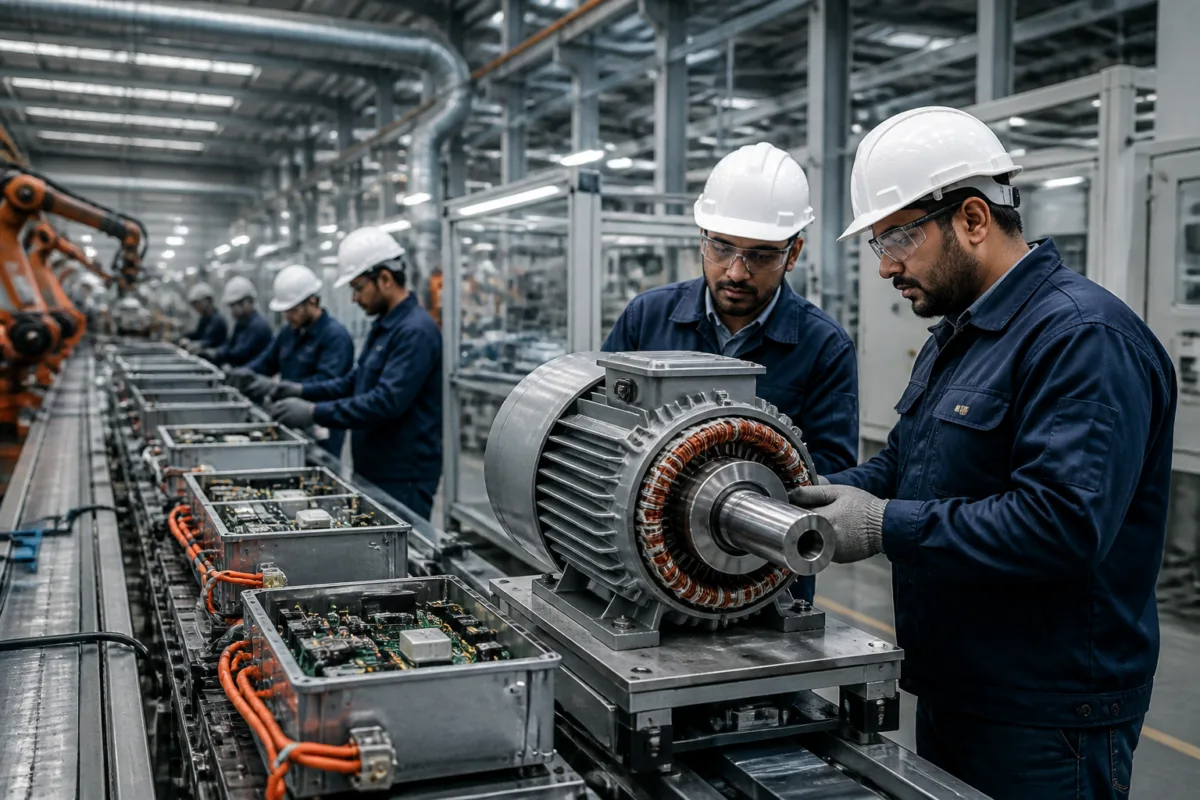
Vimag says its technology has been developed and validated in India, and that production has commenced. Its 10,000-square-foot facility is designed to manufacture motors and associated control systems through automated, digitally connected and quality-controlled processes. The facility can be expanded to 20,000 square feet, while the company plans to invest ₹50 crore in phases.
The distinction between a functioning production line and a commercially scalable industrial platform is important. The available information establishes that Vimag has begun production and exported its first batch of controllers to the United States and Germany. It does not establish the volume of motors currently being produced, the number of customers using the technology, or the performance of the products in long-term commercial operation. Those measures will determine whether the company can move from an engineering achievement to a durable manufacturing business.
The export of controllers is nevertheless an early indication of the company’s intended market. Vimag is not positioning its products solely for India’s smaller electric-mobility segment. Its immediate mobility focus includes two-wheelers, three-wheelers, electric buses and trucks, while its broader product strategy includes industrial equipment and high-power propulsion systems.
The company also plans to develop motors and propulsion systems exceeding 570 kilowatts in the coming months. Such applications would sit above the requirements of many smaller electric vehicles and would bring the technology closer to commercial vehicles, industrial machinery and other high-power systems. The supplied information does not confirm specific customers or deployment timelines for these products, but the proposed expansion shows how Vimag is attempting to address several markets simultaneously.
This strategy creates both opportunity and execution pressure. Smaller electric vehicles can offer a route to early adoption, but high-power systems demand different levels of engineering, testing, reliability and manufacturing capability. A motor architecture that performs effectively in one power segment cannot automatically be assumed to meet the requirements of buses, trucks, industrial machinery or strategic applications. Commercialisation across these segments will depend on whether the company can maintain performance and quality while increasing production volumes.
Vimag’s approach also extends beyond the motor itself. The company has entered an exclusive technology licensing, manufacturing and commercialisation agreement for a high-voltage power-electronics platform developed in the United States. The platform includes inverters, charging systems and power-distribution capabilities and supports an architecture of up to 1,200 volts.
This agreement indicates that the company’s intended product is a wider propulsion and power-management system rather than an isolated motor component. It also shows that domestic technology development and international engineering collaboration are being pursued together. The rare-earth-free motor is being developed in India, while part of the supporting high-voltage platform is sourced through an overseas licensing arrangement.
That combination complicates the idea of self-reliance. Reducing dependence on rare-earth permanent magnets can strengthen one part of the supply chain, but it does not remove the need to secure other inputs, technologies and production capabilities. The company’s own plans point to this interconnected structure: motor technology is being developed alongside controllers, power electronics and semiconductor technologies for drones, industrial applications and high-performance electromechanical systems.
The recently announced $5 million Series A investment led by Accel, with participation from Chakra Growth Fund and Thinkuvate, is intended to support this expansion. The funding figure provides evidence of investor backing, but it does not by itself establish commercial success. The next test will be how the capital is converted into production capacity, customer deployments, product certification, engineering talent and repeat revenue.
The policy significance of the business lies in the type of capability it is trying to build. Electric mobility programmes are often assessed through vehicle sales, charging infrastructure and battery manufacturing. Motors receive less public attention, even though they are essential to vehicle performance and are also used in industrial and strategic applications. A domestic motor platform could potentially give manufacturers greater control over product design and reduce exposure to selected imported materials.
However, the evidence supplied on Vimag does not yet establish that its technology will eliminate all supply-chain dependencies or become a mainstream alternative. It establishes a company objective, a patented architecture, a production facility, an initial export milestone, a funding round and plans for higher-power systems. It does not provide independent comparative test results, commercial production volumes, customer names, unit economics or evidence of widespread deployment.
Those gaps matter because the strategic value of a new motor technology depends on more than its laboratory or prototype performance. Manufacturers need confidence in reliability, maintenance, thermal management, software controls, supply continuity and total cost over the operating life of the vehicle or machine. For buses, trucks, defence systems and industrial equipment, downtime and replacement costs can be as important as headline efficiency or power density.
The geography of the investment is also relevant. Vimag’s facility at MET City in Jhajjar places advanced motor manufacturing within an industrial development context rather than a purely research setting. The proposed expansion from 10,000 square feet to 20,000 square feet suggests a phased approach in which manufacturing capacity grows alongside commercial demand. The available information does not specify employment numbers, local supplier participation or the facility’s production capacity, so its broader regional economic impact remains unestablished.
India’s larger challenge is to convert isolated technology successes into an ecosystem. That requires companies capable of developing foundational components, manufacturers willing to adopt them, financing that supports long commercialisation cycles and institutional systems that can evaluate new technologies without compromising safety or reliability. Vimag’s plans touch each of these requirements, but do not yet demonstrate that the wider ecosystem is in place.
The company’s stated ambition is to make rare-earth-free electric propulsion mainstream and position India as a contributor to globally competitive foundational technologies. The immediate evidence shows movement from development towards production, supported by private capital, international collaboration and an industrial facility in Haryana. What remains to be established is whether the VMSM platform can achieve sustained commercial deployment across the varied markets Vimag is targeting.
The next developments to watch are the company’s planned higher-power motor and propulsion systems, the scale of manufacturing at Jhajjar, additional customer deployments and the conversion of exported controllers into recurring international business. Together, these milestones will indicate whether rare-earth-free motors can become a meaningful industrial capability or remain a promising but limited technology proposition.

