


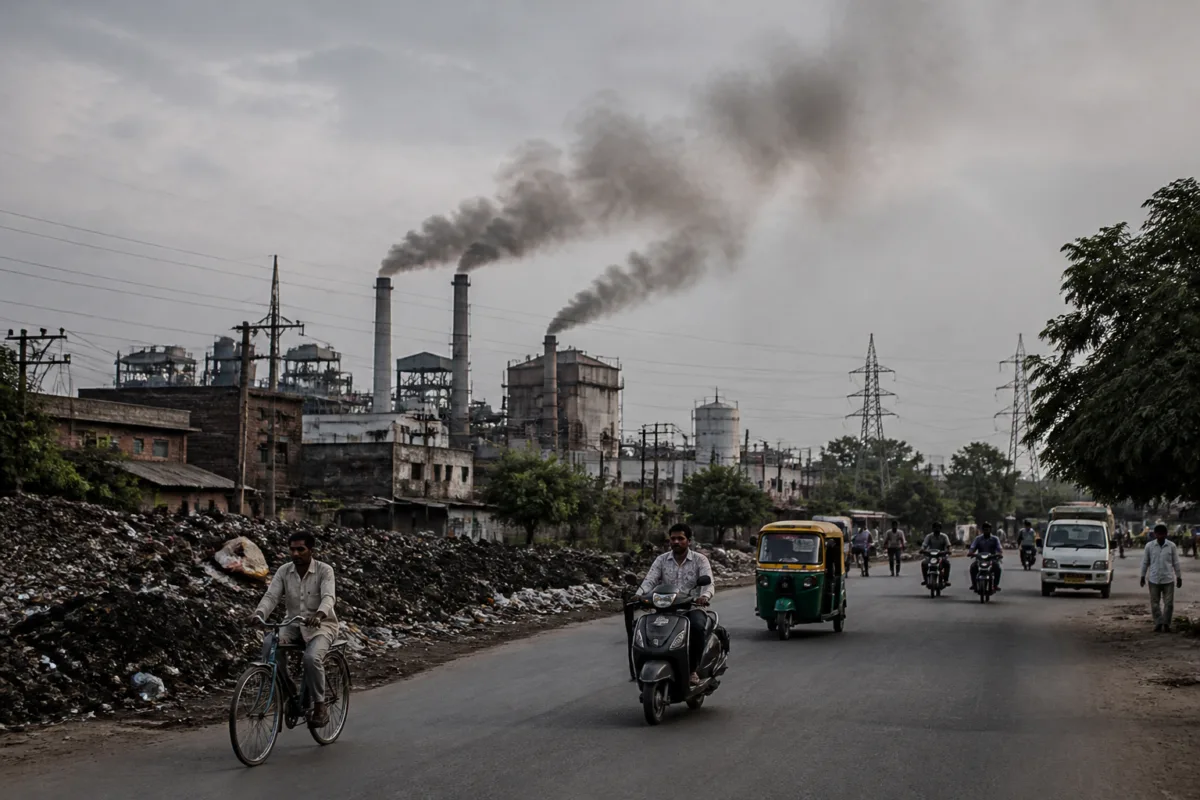
Ahmedabad industrial pollution is not only a question of factory emissions. The account of action taken by the Ahmedabad Municipal Corporation (AMC) over ten months points to a deeper urban governance problem: pollution is being detected across industrial and waste-processing zones, but enforcement remains divided among municipal departments, the Gujarat Pollution Control Board (GPCB), the police and industrial-estate institutions.
A report by Divya Bhaskar says AMC sealed 12 factories during the ten-month period from 1 January to 31 October 2026, while issuing closure notices and taking legal action against units accused of causing pollution. The report describes black smoke from factory chimneys, strong chemical odours, open dumping and waste burning in and around Pirana, Behrampura, Narol village, Gyaspur, Odhav GIDC, Piplaj, Danilimda and Vatva GIDC, among other industrial areas.
The significance of the report lies in the gap between the scale of the problem described at street level and the enforcement response recorded by the municipal administration. AMC says it has been investigating industrial units through its Air Quality Management Cell and taking action under environmental laws. Yet the same account records allegations that illegal units continue oil burning, tyre burning, chemical discharge and uncontrolled smoke emissions.
That gap matters because industrial pollution is rarely contained within an industrial estate. Industrial clusters sit alongside roads, informal settlements, waste facilities, housing and employment areas. Air emissions, odour, dust and smoke therefore become a neighbourhood-level problem, even when the activity causing them is located inside a designated industrial zone.
The administrative structure makes the problem harder to resolve. AMC departments mentioned in the report include health, solid waste management, estate and air-quality management. GPCB is responsible for pollution-control regulation at the state level, while police action may be required when activities are illegal or when closure orders are violated. The report also refers to separate associations representing industrial units in Odhav, Vatva, Kathwada and Naroda GIDCs.
This creates a system in which responsibility is distributed, but accountability can become difficult to locate. AMC may identify an odour or smoke complaint, GPCB may regulate emissions and consent conditions, the solid-waste department may address dumping or burning, and the police may be involved in enforcement. Unless these agencies share inspections, evidence and follow-up responsibilities, action can remain episodic rather than continuous.
The report says no joint operation involving GPCB, AMC and the police was visible despite the alleged pollution activities. That is an important institutional detail. A closure notice is not the same as sustained compliance. Industrial pollution control requires inspection, sampling, documentation, enforcement, follow-up and, where necessary, prosecution or closure. It also requires checking whether a sealed or penalised unit resumes operations through another entity or at another location.
AMC’s stated position is that strict action is being taken against illegally operated industrial units and activities damaging the environment. The civic body also says that regular monitoring and coordination are being used to prevent affected units from restarting the same activities. The report, however, does not establish how many inspections were conducted, how many units were found compliant after notices, how many cases resulted in penalties or prosecution, or whether any sealed factory resumed operations.
These missing figures are central to understanding enforcement performance. The number of factories sealed is a visible administrative output, but it does not by itself show the extent of pollution reduction. A stronger public record would connect inspections to violations, notices to compliance, closures to duration, and enforcement to measured changes in local air quality.
The report also highlights the difference between pollution monitoring and pollution control. AMC is implementing a Smart Sensing and Digital Intelligence Project with the Indian Institute of Technology, Kanpur. The project uses a mobile real-time source-apportionment laboratory to assess pollution sources scientifically and continuously. According to the report, the system is intended to identify pollution hotspots and estimate the contribution of sources such as vehicles, road dust, construction, industries and biomass burning to PM2.5 and other air pollution.
Source apportionment is important because a city’s overall air-quality reading cannot by itself identify who or what is responsible for a local pollution event. A high reading may reflect several sources operating at the same time. A mobile laboratory and hyper-local monitoring network can help distinguish a persistent industrial emission from road dust, traffic or waste burning, provided the measurements are regularly published and linked to enforcement decisions.
The available report does not provide the project’s monitoring results, the number of hotspots identified, the measured contribution of industrial sources, or the action plans prepared from the data. That limits what can be concluded about the success of the technology. It does establish, however, that Ahmedabad is attempting to move towards a more data-led air-quality management system while continuing to face allegations of basic compliance failures such as open waste burning and visible smoke.
This contrast is a recurring challenge in urban environmental administration. Cities may invest in sensors, laboratories and digital dashboards while residents continue to experience pollution through smell, soot and smoke. Technology can improve diagnosis, but it does not substitute for inspections, staffing, inter-agency authority and timely penalties. The value of real-time data depends on whether a responsible agency can act on it and whether the action is recorded publicly.
The industrial geography described in the report also raises a planning question. Odhav, Vatva, Kathwada and Naroda are established industrial areas, while Pirana and nearby locations combine waste infrastructure, transport movement and industrial activity. These areas are not isolated from the rest of Ahmedabad. Workers, residents, waste handlers, truck drivers and nearby communities may all be exposed to the same environmental conditions, but they may not have equal access to complaint systems, medical information or regulatory records.
The report does not provide health data linking specific illnesses to the cited units, and no such connection should be inferred from the pollution allegations alone. It does, however, describe conditions that make consistent monitoring and enforcement a public-interest requirement. Chemical odours, black smoke, open dumping and burning are not merely aesthetic concerns when they occur repeatedly near homes, workplaces and roads.
The role of industrial associations is another unresolved part of the enforcement chain. The report says associations exist in the major GIDC areas but suggests that some factory operators may not be following pollution-control rules and that association office-bearers may not be ensuring compliance. The supplied material does not include responses from these associations, so their position and the extent of any self-regulatory activity remain unconfirmed.
The GPCB’s response is also incomplete in the account. Divya Bhaskar reported that it contacted GPCB East officer Rahul Kanojia, who did not answer the call. The report alleges that GPCB had not taken action against factories, but the supplied material does not include GPCB records, inspection data or an official explanation. That distinction matters: the reported absence of a response is not proof that no regulatory action occurred.
What the evidence does show is a fragmented enforcement picture. AMC reports action over ten months, while the report describes continuing pollution complaints and alleged illegal activity. AMC says monitoring and departmental coordination are under way, while the report says no joint action involving the main enforcement agencies was visible. AMC and IIT Kanpur are developing scientific tools, but the available account does not yet show how the resulting data has changed factory-level enforcement.
The next stage for Ahmedabad’s air-quality governance is therefore not only the expansion of monitoring. It is the publication of a traceable enforcement record: inspections by area, violations identified, notices issued, factories sealed, compliance verified, repeat violations recorded and responsibilities assigned between AMC, GPCB and the police. Without that chain, residents may know that pollution exists but remain unable to determine which authority is responsible for stopping it.
Ahmedabad’s industrial pollution problem, as presented in the report, is consequently both an emissions issue and an administrative one. The city has identified industrial and waste-related hotspots, begun using scientific source-apportionment tools and reported action against a limited number of units. What remains unclear is whether these measures are reducing exposure on the ground, whether enforcement is coordinated across agencies and whether the city can convert real-time pollution evidence into consistent and publicly verifiable action.

