


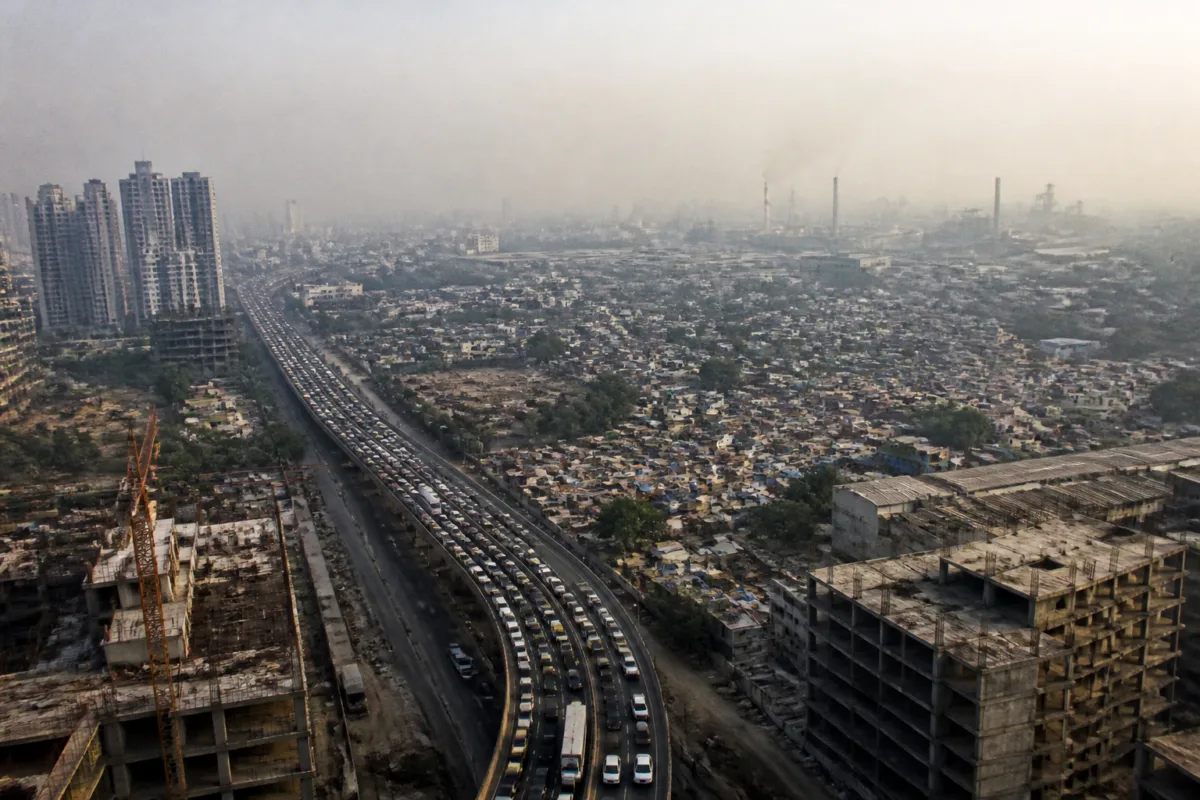
Mumbai’s air pollution is often treated as a problem within the Brihanmumbai Municipal Corporation’s boundaries. The evidence presented by Chandra Bhushan, CEO of environmental research body iFOREST, points to a larger administrative reality: the city’s air is shaped by an airshed covering the Mumbai Metropolitan Region and surrounding industrial belts, while BMC controls only a small part of that geography.
That mismatch between the scale of the pollution and the scale of governance is central to understanding why Mumbai’s air remains unhealthy despite an improvement in annual pollution levels since 2018. The city’s annual average PM10 concentration was 88 micrograms per cubic metre in 2025, according to the figures cited in the report. That is 1.5 times India’s national standard. Seasonal peaks are considerably worse, with PM10 levels during the high-pollution period from October to March reaching three to four times the national standard, while winter concentrations can be 10 to 15 times the level considered safe by the World Health Organization.
The long-term trend also complicates the idea that Mumbai’s air quality problem is temporary. Until 2006, annual average PM10 levels reportedly remained between 60 and 80 micrograms per cubic metre. They rose sharply after that, reaching 166 micrograms per cubic metre in 2018. The subsequent decline is significant, but it does not mean the pollution problem has been resolved. Annual averages also conceal the exposure experienced during the months when pollution accumulates and the monsoon is no longer clearing the air.
The physical geography of the region helps explain why localised action has limited reach. The airshed is described as covering at least 7,000 square kilometres, bounded by the Arabian Sea to the west and the Western Ghats to the east. During winter, the hills can partly restrict the movement of polluted air, allowing emissions to remain within the basin. Pollution generated in one municipality can therefore affect residents in another, regardless of administrative borders.
The region’s growth has also been concentrated outside BMC. Since 2011, the Mumbai Metropolitan Region has added at least 3.9 million people, with 3.2 million settling outside the municipal corporation’s limits. In 2011, more people lived within Mumbai than outside it. By 2025, that relationship had reversed. This shift matters because the surrounding municipalities are no longer peripheral to Mumbai’s urban system. They are now major centres of housing, employment, construction, transport and industrial activity.
The built environment reflects the same change. Since 2017, BMC is reported to have added approximately 10.5 square kilometres of new roads, bridges, buildings and other built-up areas. The rest of the MMR added around 270 square kilometres during the same period—an area comparable to Nashik Municipality, according to the report. Much of the region’s recent physical expansion has therefore occurred outside the agency that receives the greatest attention during Mumbai’s winter pollution episodes.
Motorisation has expanded alongside urbanisation. Registered vehicles in the MMR increased from 4.36 million in 2011 to 12.31 million in 2025, nearly tripling in 14 years. Six in 10 of those vehicles are now registered outside BMC. Industrial activity is similarly distributed: of approximately 33,700 industrial units monitored by the Maharashtra Pollution Control Board in the MMR, only 25% are located in Mumbai, while 75% are outside the city.
These figures do not establish that every source outside BMC contributes equally to Mumbai’s pollution. They do, however, show why a city-only response is structurally incomplete. Population, construction, vehicle ownership and industrial activity have expanded across a region whose air moves through a connected atmospheric system.
The available emissions evidence also points to a multi-source problem. The latest BMC inventory, which the report says can be used broadly for the MMR, attributes 26% of the PM10 load to road and construction dust, 23% to industries, 20% to transport, 14% to waste burning and 14% to cooking fuels in homes and eateries. Together, these sources account for about 96% of the estimated PM10 load. No single intervention can address such a diverse emissions profile.
The absence of a pollution inventory specifically for the MMR is itself an institutional limitation. Without a region-wide source inventory, authorities have less certainty about where emissions originate, how they move and which interventions should be prioritised. The report argues that monitoring must be designed to identify hotspots and guide action rather than simply produce city-level readings.
Monitoring capacity is currently uneven. About 70% of continuous monitoring stations are located in Mumbai and Navi Mumbai, leaving large parts of the MMR less observed. The proposed response is a combination of evenly distributed continuous monitors, low-cost sensors and satellite monitoring. Triangulating these sources could help authorities identify patterns across municipal boundaries, although the report does not provide a detailed implementation framework or cost for such a system.
The governance challenge is equally significant. Mumbai, Navi Mumbai, Thane, Vasai-Virar, Ulhasnagar and Badlapur have individual clean-air plans, but the report describes them as having vague actions and responsibilities, insufficient targets and unrealistic timelines. A regional plan would need to specify which authority is responsible for each intervention, how much it will cost, what deadline applies and how compliance will be measured.
Unlike Delhi’s airshed, which spans multiple states and requires intergovernmental coordination, the MMR’s regional clean-air response lies within Maharashtra. This could simplify coordination in principle, but the region still contains multiple municipal corporations, planning authorities, infrastructure agencies, industrial regulators and local administrations. The concentration of authority within one state does not automatically resolve the problem of fragmented implementation.
Industrial pollution is one area where this institutional arrangement would be tested. The report estimates that the MMR has about 19,000 polluting industries, accounting for roughly one-third of the region’s pollution. It identifies small industrial boilers as a particular concern, saying they burn about two million tonnes of coal each year. The proposed shift towards gas or electricity, including shared boiler facilities, would require both infrastructure and regulatory enforcement.
Continuous emissions monitoring systems are already used by many industries, but the report says the systems are poorly operated. Its proposed enforcement approach would require the Maharashtra Pollution Control Board to verify the quality of the data, use it in compliance checks and take action when industries do not meet requirements. The critical issue is therefore not only whether monitoring equipment exists, but whether its readings are reliable and linked to consequences.
Construction presents a parallel challenge. With more than 10,000 construction sites across the MMR, dust control cannot depend only on periodic inspections. The report calls for dust management plans to be incorporated into project designs and approved by authorities, alongside online monitoring and independent third-party audits. This would move dust control from an afterthought at individual sites to a formal part of project approval and compliance.
Transport policy also illustrates the gap between mobility demand and pollution control. Nearly 65% of all trips in the MMR are already made by public transport, described in the report as the highest share in India. Yet vehicle registrations have almost tripled since 2011. The region’s challenge is therefore not simply to provide public transport, but to prevent growth in private vehicle use from overwhelming the benefits of existing mass mobility.
The report proposes increasing public transport use and electrifying the remaining vehicle fleet, including a possible ban on new petrol or diesel vehicle registrations from 2031. That proposal is presented as a recommendation rather than an announced policy. Its feasibility would depend on the availability of charging infrastructure, the affordability of electric vehicles, the capacity of public transport and the regulatory decisions of the state government and regional authorities.
Waste burning and household fuel use add a ground-level dimension to the regional problem. Burning of municipal waste and plastic is reported around Deonar, Dharavi and other areas, particularly where informal recycling takes place. About 45% of the MMR’s population lives in slums and rural settlements, where solid fuels continue to be used alongside LPG. Bakeries and eateries also burn wood and coal. These sources connect air pollution to waste systems, energy access, livelihoods and the cost of cleaner fuels.
Fire activity is another regional factor. Satellite fire detections in the MMR rose from 5,716 in 2022 to 7,810 in 2025, according to the figures cited in the report. The source does not specify the proportion attributable to forest fires, farm fires or other types of burning, but the increase supports the case for a dedicated fire-control plan rather than treating every pollution episode as a traffic or construction problem.
The evidence therefore points towards an airshed-based policy architecture rather than a collection of disconnected municipal measures. A regional authority could coordinate monitoring, industrial regulation, construction compliance, waste burning controls, transport planning, clean cooking programmes and greening. The effectiveness of such an authority would depend on its legal powers, budget, data access and ability to hold multiple agencies accountable.
The central urban question is not whether Mumbai can reduce pollution within its municipal limits. The available evidence suggests that it can make progress, as shown by the decline from the 2018 peak. The harder question is whether the region can govern air quality at the scale at which the problem is produced and experienced. Population growth, new construction, vehicle ownership and industrial activity have increasingly shifted beyond BMC, while the public conversation continues to focus on Mumbai city.
A region-wide plan would not remove the need for local action. Road dust, construction, waste burning and transport emissions still require interventions within neighbourhoods and municipalities. But the data cited in the report indicate that local measures will have limited effect if they are not connected to a common MMR framework with shared targets, consistent enforcement and broader monitoring.
What the evidence confirms is a mismatch: Mumbai’s pollution is regional, but much of the response remains municipal. What remains unclear is how Maharashtra would structure a single authority, finance the proposed interventions and measure reductions across the entire airshed. Those questions will determine whether the region’s reported potential to more than halve pollution in five years becomes an implementable programme or remains an untested target.

