


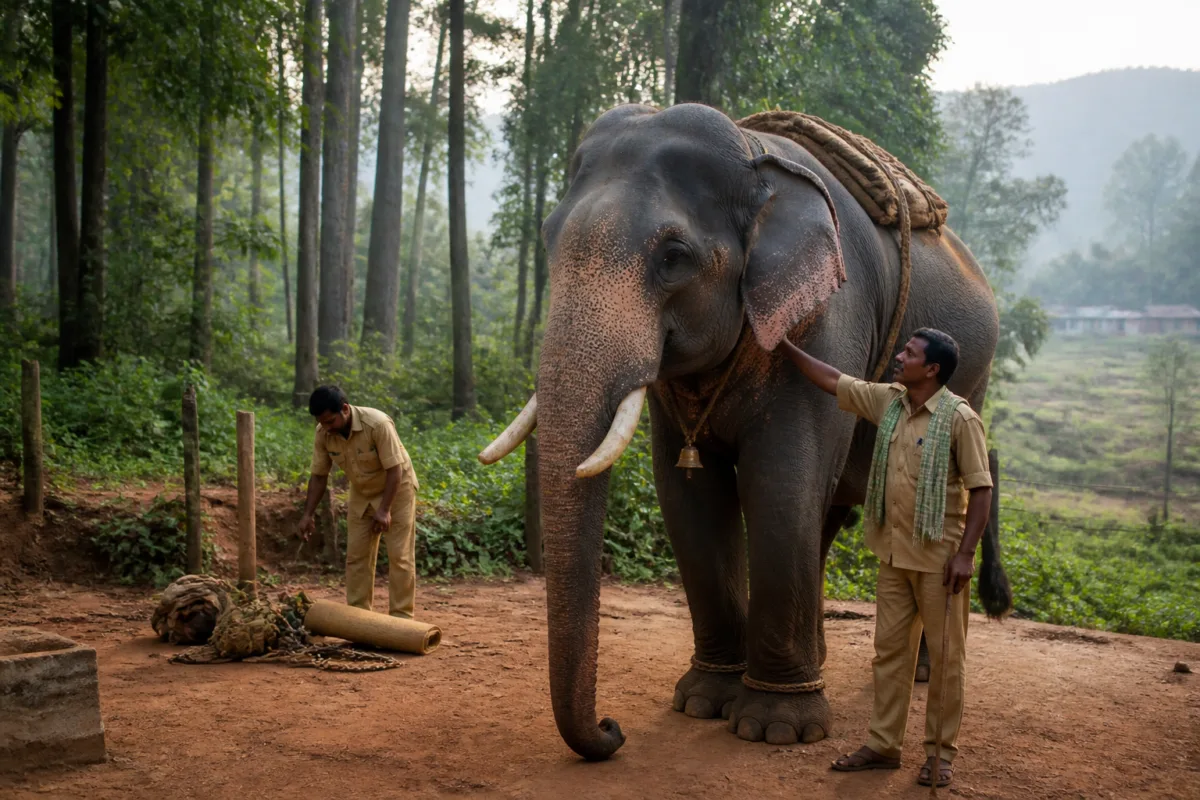
Kumki elephants have become an important tool in Karnataka’s response to human-elephant conflict, but their growing demand across India also exposes the limits of treating conflict as an animal-control problem. The state’s experience shows that trained elephants, skilled mahouts and scientific camp management can reduce immediate danger. It also shows that lasting safety for people and elephants depends on protecting forests and corridors, improving early-warning systems and compensating farmers for crop losses.
Karnataka is described in the source as one of India’s leading states for wild elephants, with more than 6,000 animals in its forests according to censuses cited in the article. Nagarahole, Bandipur, Bhadra and the Biligiriranga Hills are identified as important habitats. Together with forest landscapes extending from the Western Ghats towards the Eastern Ghats, these areas provide the corridors through which elephants move.
That geography is central to understanding why conflict occurs. Elephants do not recognise administrative boundaries, village limits or farm plots in the way people do. As forest edges meet cultivated land and settlements, elephants may enter fields and villages, creating risks for residents and damage to crops. The source does not present kumki elephants as a permanent solution to this underlying spatial conflict. Instead, it describes them as a specialised response used when wild elephants must be driven back into forests, captured for treatment, fitted with radio collars or monitored during patrols.
The distinction matters for public administration. A kumki operation can address an immediate incident, but it cannot restore a fragmented habitat, prevent every crop raid or remove the pressures that bring elephants and communities into repeated contact. The source therefore places habitat and corridor protection, crop-loss compensation and warning systems alongside the deployment of trained elephants. Conflict management becomes a combination of emergency response and landscape governance rather than a single departmental operation.
Karnataka’s capacity in this field has developed over a long period. Elephant camps at Dubare, Mattigodu, Sakrebailu and Balle are presented as living institutions within that history. The source links the state’s captive-elephant tradition to the period of the Mysore rulers, when elephants were maintained and trained for the Dasara festival and other ceremonial purposes. Knowledge was passed from one generation to another, creating an institutional memory that now supports conservation and conflict-response work.
The methods, however, have changed. The source notes that elephants were once captured through khedda operations, a practice that has since stopped. The present system is based on elephants born in camps and animals rescued during conflict situations. This shift is significant because it places greater emphasis on long-term care, behavioural assessment and the relationship between elephants and their handlers rather than on capture alone.
Training a kumki elephant is described as a relationship-building process, not simply an exercise in physical control. The required qualities include a calm temperament, the ability to respond promptly to a mahout’s commands and composure amid crowds, firecrackers and vehicle noise. An elephant must also remain steady when facing a wild elephant. These requirements explain why the system cannot be quickly replicated by acquiring an animal or transferring it between states without its handlers.
The source places particular emphasis on mahouts and kavadis from forest-linked communities, including the Jenu Kuruba, Soliga and Yerava communities. Their knowledge is based on reading an elephant’s ear movements, trunk position and breathing rhythm to understand its state of mind. In this account, that experience is not a cultural detail added to a technical system; it is one of the system’s core operational assets.
The relationship between an elephant and its mahout may develop over many years. A change of mahout can alter an elephant’s behaviour, which is why the traditional practice of a mahout’s son growing into the role of kavadi alongside the same elephant became established. The source also points to a modern transition: positive reinforcement is increasingly preferred to force, while camp management now includes veterinary supervision, balanced diets, foot care, parasite control and testing for tuberculosis and other diseases.
The health of captive elephants is directly connected to their suitability for difficult field operations. An animal that is unhealthy or under stress cannot be expected to work safely during a conflict response. The source also highlights awareness and research around elephant endotheliotropic herpesvirus, particularly because calves can be vulnerable to the disease. This expands the meaning of operational readiness. It includes preventive care, disease surveillance and welfare, not merely obedience during an intervention.
The demand from other states is linked to the spread of human-elephant conflict. According to the source, several states are seeking Karnataka’s assistance with kumki elephants and mahout training. The demand reflects the value of Karnataka’s accumulated experience, but it also raises questions about how this expertise should be shared. Transferring elephants without transferring trained handlers, care systems and institutional knowledge could weaken the effectiveness of the intervention and create welfare risks.
Legal safeguards reinforce that concern. Elephants are protected under Schedule I of the Wildlife Protection Act, 1972. Their transfer requires permission from the relevant authorities, health certification and assurance that the receiving state has suitable arrangements. The source argues that the mahout and kavadi should travel with the elephant because a familiar human presence helps the animal adjust to a new environment, language, climate and diet.
This arrangement also has a labour and governance dimension. Receiving states are expected to provide mahouts with accommodation, fair wages and respect. The people who operate the system are not interchangeable support staff; their judgement is part of the safety infrastructure. Yet the source argues that the future of this knowledge cannot depend only on informal succession. Training, healthcare, housing, education for mahout families and social security are presented as necessary conditions for preserving the tradition.
The call to document knowledge is equally important. Senior mahouts hold practical information about elephant behaviour, commands, traditional treatments and forest plants. Recording this knowledge in Kannada and English could help create a durable institutional archive. Without such documentation, the source warns, knowledge may disappear as older practitioners retire or die. The proposal to train personnel from other states in Karnataka’s camps similarly prioritises knowledge transfer over the simple movement of animals.
The evidence supplied in the source does not establish how many kumki elephants are currently available for transfer, how many conflict incidents they have resolved, or whether a particular state has formally requested a specific animal or training programme. Those details would be necessary to assess the scale and measurable effectiveness of inter-state cooperation. What the source does establish is the structure of the challenge: Karnataka has a large elephant population, an established camp network and specialised human expertise, while conflict is increasing the demand for trained intervention.
The larger policy question is whether emergency tools can be allowed to substitute for prevention. Kumki elephants can help move a wild elephant away from a settlement, support treatment and assist with monitoring. They cannot by themselves secure a corridor, redesign a settlement edge, compensate a farmer or warn a village before an animal arrives. Those responsibilities involve forest departments, local administration, veterinary services, disaster-response systems and communities living near elephant habitats.
Karnataka’s experience therefore has two distinct lessons. One is operational: skilled elephants and mahouts can provide a specialised response in dangerous situations. The other is institutional: the knowledge behind that response must be protected through welfare standards, documentation and fair treatment of handlers. The source’s central conclusion is that kumki elephants may temporarily reduce conflict, but coexistence depends on maintaining a balance between forests and people. That balance, rather than the transfer of elephants alone, is the issue that governments and communities will need to monitor.

