


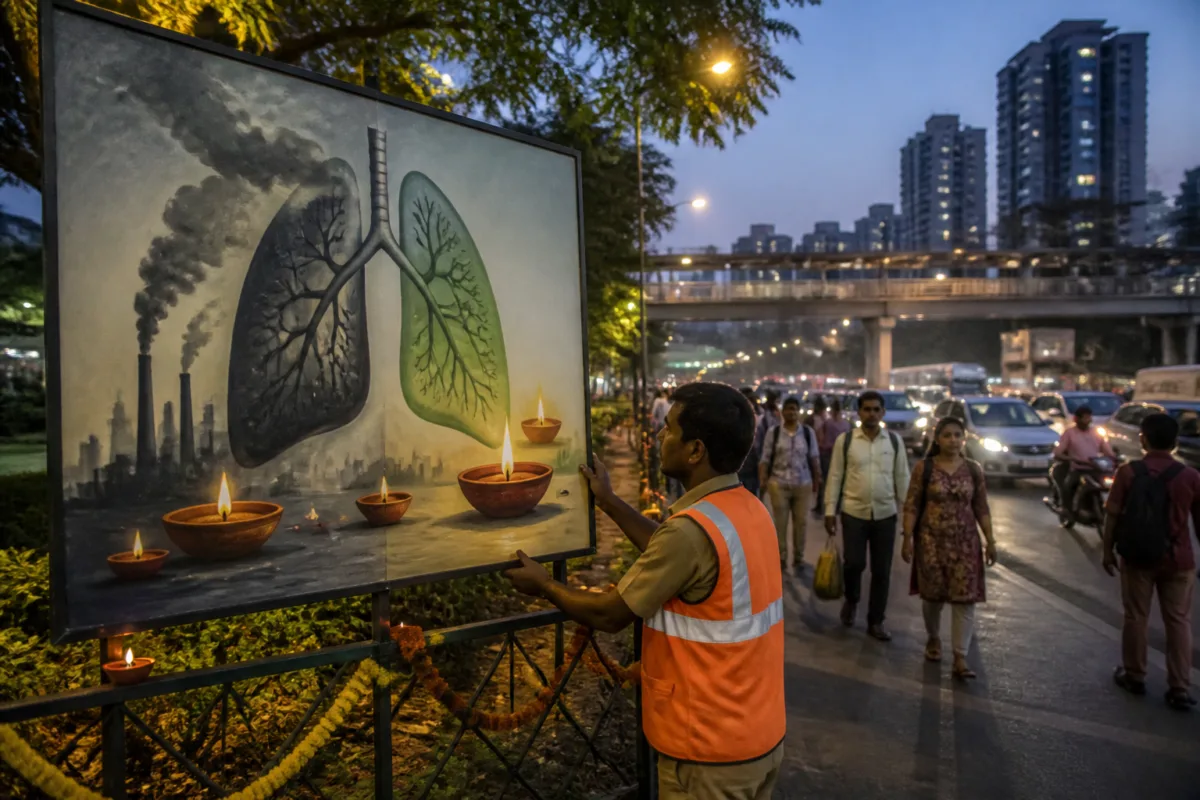
The Brihanmumbai Municipal Corporation’s decision to remove actor Dia Mirza’s video from its pollution-free Diwali campaign after objections from Mumbai BJP chief Ameet Satam has turned a public-health communication exercise into a test of civic autonomy. The immediate dispute concerns one campaign participant. The larger issue is whether a municipal body can communicate court-backed pollution controls consistently when its messaging becomes politically contested.
The BMC had launched the campaign to encourage an environment-friendly Diwali and to remind citizens that bursting firecrackers on public roads, lanes and footpaths was prohibited in accordance with Bombay High Court directives. The civic body used several public figures for the campaign, including Mirza, actors Madhuri Dixit and Nishigandha Wad, and cricketer Ajinkya Rahane. Mirza’s video asked citizens to avoid firecrackers and reduce pollution.
That message was not presented as a private opinion by the actor. The video was part of a BMC campaign linked to a public-health concern and the court’s directions. Mirza told ANI that the video had been recorded in the public interest and argued that efforts to reduce air pollution should be welcomed because pollution affects public health. Her response placed the dispute in the institutional context in which the video had originally been produced: a civic authority using public communication to support compliance with restrictions.
The clip was removed from the BMC’s social media pages after Satam objected to Mirza’s inclusion in a post on X. “We don’t need lessons on how to celebrate Diwali from @deespeak. Our traditions are deeply rooted in our culture,” he wrote while tagging the BMC’s official account. The videos featuring Dixit, Wad and Rahane remained available on the civic body’s X and Instagram pages.
The sequence is significant because it suggests that the BMC’s campaign did not have a clearly protected institutional position once a political objection was raised. The supplied report does not indicate that the court directive was withdrawn, that the pollution concern had changed, or that the BMC issued a public explanation for removing only Mirza’s video. The absence of such an explanation leaves the central administrative question unresolved: was the video removed because it failed to meet a civic communication standard, or because of the identity and past public positions of the person featured in it?
Mayor Ritu Tawde defended the removal and made personal political remarks about Mirza. She said the actor had “always sided with divisive forces”, referred to her earlier criticism of Prime Minister Narendra Modi over the NEET examination issue, and called her “anti-Hindu”. Tawde also said Mirza had been blacklisted. These statements, as reported, shifted the controversy from the content of a pollution-control message to the political identity attributed to the campaign participant.
That shift matters for municipal administration. A civic campaign is ordinarily expected to communicate a rule, service, risk or public-health objective. Its credibility depends on whether the public can distinguish the authority’s message from the political preferences of individual office-holders. When the messenger becomes the issue, the underlying instruction can lose clarity. In this case, the BMC’s message about pollution and restrictions was overtaken by a dispute over whether Mirza should have been allowed to deliver it.
The response from opposition leaders reinforced that institutional concern. Shiv Sena (UBT) spokesperson and former Mumbai mayor Kishori Pednekar questioned whether the civic administration had acted under political pressure and alleged that the influence of the BJP’s Mumbai president over the BMC’s day-to-day functioning was increasing. MNS corporator Yashwant Killedar also criticised Satam’s intervention and questioned whether supporting firecrackers in the name of religion was compatible with the civic campaign’s pollution message.
The BMC’s administrative structure makes the episode more consequential than a disagreement between politicians and a celebrity. The report identifies Municipal Commissioner Ashwini Bhide as the official leading the civic body when the video was removed. It does not establish who formally authorised the takedown, what internal process was followed, or whether the decision was based on a written policy. Those details are important because they determine whether the episode was an ordinary campaign-editing decision or an instance of political influence over municipal communication.
The campaign itself was responding to two overlapping obligations. The first was the BMC’s public-health responsibility in a city facing air-pollution concerns during Diwali. The second was the need to communicate restrictions connected to Bombay High Court directives. The reported BMC post stated that bursting firecrackers on public roads, lanes and footpaths was strictly prohibited. The civic body therefore had a practical enforcement and compliance task: tell residents what conduct was restricted and why reducing pollution mattered.
The controversy illustrates the difficulty of communicating risk when the behaviour involved is also associated with cultural and religious practice. Nitesh Rane questioned why Mirza had spoken about pollution during Diwali but had not offered similar advice during Eid, Muharram or Bakri Eid. Shiv Sena spokesperson Shaina NC said Mirza should understand the significance of Diwali while also acknowledging the need to be mindful of pollution. Union minister Ramdas Athawale, by contrast, said the issue should not be linked to any particular community and argued that all religions have the right to celebrate their festivals, while also recognising the need to address excessive pollution.
These competing responses show how a general public-health message can be reframed as a question of cultural legitimacy. The source material does not provide comparative pollution data for different festivals, nor does it establish whether the BMC runs equivalent campaigns for other religious occasions. As a result, claims about unequal messaging remain political assertions rather than demonstrated findings. What is established is that the BMC campaign was presented as a pollution-control effort and that the public dispute rapidly acquired a communal and political dimension.
Mirza’s own response further highlighted the gap between the campaign’s stated public purpose and the controversy surrounding her participation. She said she had not charged the BMC any fee for the video and questioned why anyone would object to a message made in the public interest. Her position was that reducing air pollution was a matter of public health, not a criticism of Diwali itself.
For the BMC, the immediate consequence is a loss of message discipline. Multiple campaign videos were released to support the same broad objective, but the selective removal of one video makes the campaign appear less like a uniform institutional communication and more like a collection of individually negotiable endorsements. Residents are left with the restrictions stated in the campaign, but without a clear explanation of whether the BMC still stands behind all the material it commissioned.
The episode also exposes a transparency gap. A public authority can change or remove campaign material for legitimate reasons, including factual inaccuracy, legal concerns, consent issues or a revised communications strategy. However, the supplied report records no such explanation from the BMC. Without one, the public cannot assess the administrative basis of the decision. That uncertainty is especially relevant when the campaign is connected to a court directive and a public-health objective rather than a commercial promotion.
The central urban question is therefore not whether a particular actor should have appeared in a Diwali video. It is whether municipal institutions can maintain evidence-based, non-discriminatory and consistent public communication when a campaign touches culture, politics and everyday behaviour. Pollution-control rules require public cooperation. Cooperation is harder to secure when citizens see the authority’s message changing after political pressure, or when the messenger’s identity appears to matter more than the content of the instruction.
The reported facts establish that the BMC removed Mirza’s video after Satam objected, that other campaign videos remained online, and that political leaders offered sharply different interpretations of the decision. They do not establish the formal decision-making process, the BMC’s written justification, or whether Mirza’s video breached any campaign rule. Those unanswered points will determine whether the controversy remains a political dispute or becomes a broader case study in municipal accountability.
The next relevant development is whether the BMC explains the removal and clarifies how it will implement and communicate the Bombay High Court-linked restrictions during Diwali. Until then, the civic body’s pollution message remains present, but its institutional independence has become the issue that the campaign itself failed to address.

