


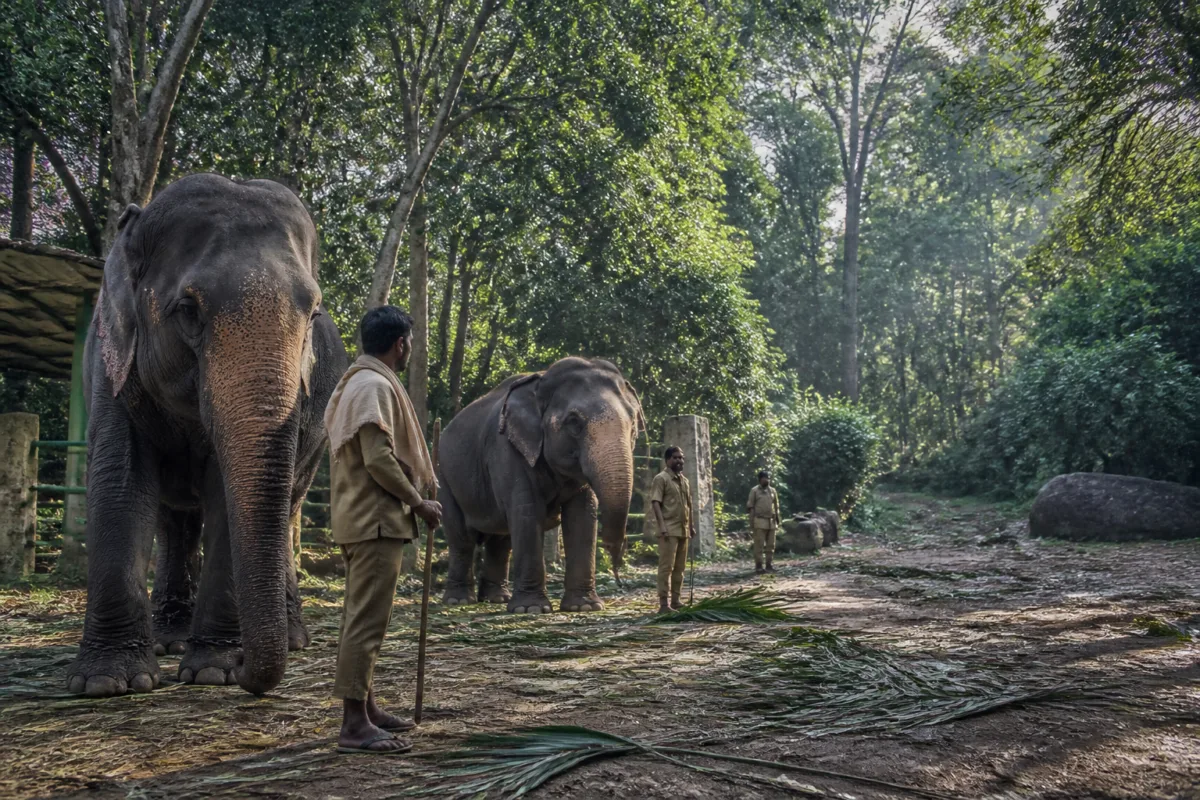
Kumki elephants have made Karnataka an important source of expertise for states struggling with human-elephant conflict, but the state’s own experience shows that trained elephants can only manage the symptoms of a deeper land-use problem. The durable challenge lies in keeping wildlife corridors functional, reducing crop losses and building systems in which forest communities and elephants can coexist with less risk.
The issue has gained renewed relevance as demand grows for Karnataka’s trained elephants and mahouts. According to an article published by Prajavani and authored by the Deputy Director of Animal Husbandry and Veterinary Services at Bannerghatta Biological Park, states are seeking help from Karnataka not only for kumki elephants but also for the training of the personnel who work with them.
The demand is linked to the spread of human-elephant conflict. Wild elephants entering farms and settlements can damage crops, threaten residents and require forest departments to respond quickly. Trained kumki elephants are used to help drive wild elephants back into forests, assist in capturing elephants that are injured or involved in repeated conflict, support treatment and radio-collaring operations, and participate in patrols.
But this work is not simply a matter of deploying a larger or stronger animal. The source describes the qualities required of a kumki elephant: a calm temperament, the ability to respond immediately to a mahout’s commands, tolerance of crowds, firecrackers and vehicle noise, and the confidence to remain steady near a wild elephant. These qualities are developed over time in forest camps and through close relationships between elephants and their handlers.
## Karnataka’s long institutional memory
Karnataka’s position is rooted in both its forest landscape and its long history of managing captive elephants. The state is described as having more than 6,000 elephants in its forests, with Nagarahole, Bandipur, Bhadra and Biligiriranga Hills identified as major habitats. These forests form part of a wider landscape extending from the Western Ghats towards the Eastern Ghats, with corridors that allow elephants to move between habitats.
The state’s elephant camps at Dubare, Mathigodu, Sakrebailu and Balle are presented as living institutions within this system. Karnataka’s experience also extends back to the period of the Mysore rulers, when elephants were maintained and trained for the Dasara festival and other public events. Knowledge was passed from one generation to another through mahouts and kavadi, the handlers who assist in caring for elephants.
The methods, however, have changed. The traditional khedda system of capturing wild elephants has stopped. The current system is based on elephants born in camps and elephants rescued during conflict situations. This shift matters because it places greater emphasis on long-term care, behavioural suitability and the welfare of elephants already under human management rather than on repeatedly capturing animals from the wild.
The source presents elephant training as a relationship-building process rather than an exercise in force. Historically, a captured elephant was kept in a wooden enclosure known as a kraal and gradually accustomed to human presence. The experience of mahouts and kavadi from the Jenu Kuruba, Soliga and Yerava communities has been central to this work. Their familiarity with forest environments and elephant behaviour allows them to read cues such as ear movement, trunk position and breathing patterns.
That knowledge is difficult to replace with a manual alone. The relationship between a mahout and an elephant may develop over several years, and a change in handler can alter the animal’s behaviour. The practice of a mahout’s son growing up as a kavadi alongside the same elephant reflects how skills were historically transferred through families.
## From inherited knowledge to managed welfare
Karnataka’s elephant-management system is also incorporating more formal veterinary practices. The source refers to positive reinforcement, in which desired behaviour is rewarded instead of relying on force. It also identifies regular health examinations, balanced diets, foot care, testing for tuberculosis and other diseases, parasite control, and continuing veterinary supervision as components of camp management.
The health of captive elephants is directly connected to their suitability for conflict-response work. An elephant that is ill or under stress cannot be expected to perform safely in difficult conditions. The source also highlights awareness and research related to elephant endotheliotropic herpesvirus, which can affect calves. These details show that the kumki system is not only about field deployment; it depends on a broader institutional structure of veterinary care, nutrition and monitoring.
This has implications for any state seeking assistance from Karnataka. An elephant cannot simply be treated as equipment that can be moved from one location to another. Under the Wildlife (Protection) Act, 1972, elephants are protected under Schedule I. Their transfer requires the permission of the relevant authorities, health certification and assurance that the receiving state has appropriate arrangements.
The movement of the mahout and kavadi is equally important. A familiar handler can help an elephant adapt to a new environment, including changes in language, climate and food. The article argues that receiving states must also provide housing, fair wages and dignity for handlers. In practical terms, this makes elephant transfers a question of labour conditions and institutional continuity as much as wildlife administration.
## The limits of a highly visible response
Kumki elephants are highly visible during conflict operations, but their role should not obscure the land-use conditions that bring elephants and people into contact. The source makes a clear distinction between temporary conflict management and a permanent solution. Kumkis can help push elephants away from settlements or assist in rescue and capture operations, but they cannot substitute for the protection of habitats and corridors.
The numbers and locations cited in the article underline the scale of the landscape involved. More than 6,000 elephants are spread across major forest areas, while their movement depends on continuity between habitats. Where corridors are disrupted, elephants are more likely to encounter farms, roads and settlements. The source does not provide a detailed map of these disruptions or a quantified assessment of crop losses, but it identifies corridor conservation as a necessary part of any serious conflict strategy.
The same applies to people living near forests. Crop-loss compensation and early-warning systems are identified alongside corridor protection as essential measures. This is a governance issue because the costs of conservation are often experienced locally, while the benefits of protecting wildlife are understood at a wider public level. Without timely warnings and credible compensation, residents near forest boundaries bear a disproportionate share of the conflict.
The article also points to the importance of preserving the knowledge held by senior mahouts. Their understanding of elephant behaviour, commands, traditional treatments and forest plants remains largely practical and orally transmitted. The proposed response is to document this knowledge in Kannada and English. That would create a record for future training, while also recognising that technical expertise exists within communities and frontline institutions, not only in formal offices.
## Why knowledge transfer may matter more than elephant transfer
For states facing rising human-elephant conflict, Karnataka’s most valuable contribution may not be the movement of individual kumki elephants. It may be the transfer of training systems, veterinary protocols and field knowledge. The source suggests that personnel from other states could be trained in Karnataka’s camps, allowing expertise to travel without making elephant transfers the sole solution.
This approach would also require attention to the working conditions of mahouts and kavadi. Their children’s education, secure housing, health and livelihood protection are presented as necessary to sustain the tradition. If the system depends on specialised knowledge but does not provide stable conditions for the people who hold it, the institutional memory could weaken even while demand for it increases.
The larger urban and built-environment question is how settlements, farms, roads and forest corridors are arranged in relation to one another. Human-elephant conflict is not confined to a forest boundary. It emerges where mobility networks, agricultural land, habitation and wildlife movement overlap. That makes it relevant to planning and governance, even when the immediate response is led by a forest department.
Karnataka’s experience confirms the value of trained elephants, skilled handlers and scientific veterinary care. It also establishes their limits. The evidence supplied by Prajavani supports a layered approach: maintain healthy and well-trained kumki elephants, protect habitats and corridors, improve early-warning systems, compensate affected farmers, and preserve the knowledge of mahouts and kavadi. What remains unestablished in the supplied material is the scale of demand from individual states, the number of elephants transferred and the measurable success rate of kumki deployments. Those are the indicators that would show whether expertise is being shared as a durable public system or only used for emergency response.

