


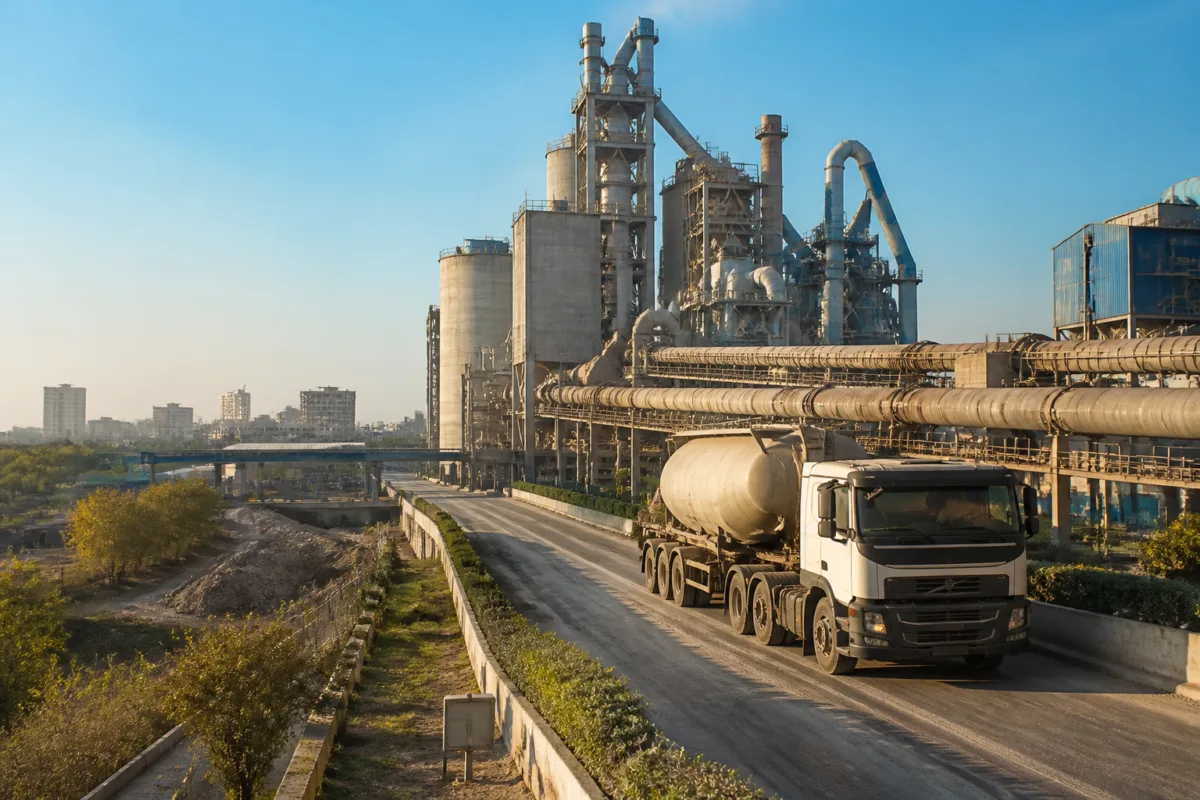
Ambuja Cements’ plan to invest ₹14,500 crore and raise cement capacity to 155 million metric tons per annum by fiscal 2030 is more than a company expansion announcement. It is a signal of how India’s infrastructure and housing cycle is reshaping the geography of cement production, while also exposing the cost pressures that can weaken profitability even when long-term demand remains strong.
The company said it currently has cement capacity of 113.5 million tons per annum and expects that figure to reach 119 MTPA by March 2027. By fiscal 2030, the planned capacity is 155 MTPA. The expansion will add capacity across Assam, Bihar, Jharkhand, Gujarat, Maharashtra and Uttar Pradesh, strengthening Ambuja’s manufacturing footprint across eastern, western and northern India, according to the Reuters report published by Business Standard.
The scale of the proposed increase is significant within the information supplied by the company. Moving from 113.5 MTPA to 155 MTPA would represent an increase of 41.5 MTPA, or roughly 36.6 per cent over the current capacity. The first stated milestone, 119 MTPA by March 2027, is more limited: an addition of 5.5 MTPA, or about 4.8 per cent from the current base. The gap between the near-term milestone and the fiscal 2030 target indicates that a substantial part of the planned build-out is scheduled for the years after March 2027.
That timing matters because cement capacity is not simply a matter of adding factories. It involves manufacturing plants, grinding units, raw-material access, energy supply, transport links and distribution networks. The company’s decision to expand in six states suggests an effort to position production closer to several regional markets rather than rely on a single concentrated manufacturing base. The supplied report does not specify the plant locations, project-level investment split, commissioning schedule or the precise mix between new integrated plants and grinding capacity. Those details will be important for understanding how quickly the additional capacity can reach consumers and how much transport distance it may remove.
The geographic spread also places the announcement within the wider structure of India’s construction economy. Cement is a basic input for roads, bridges, housing, industrial facilities and urban development. The report describes Indian cement makers as expanding capacity to meet expected growth in infrastructure and housing demand. That demand is not confined to the largest metropolitan regions. The states named in the plan include large urban and industrial markets as well as areas where infrastructure and housing construction can require new regional supply networks.
For cities, the relevance is straightforward but often overlooked. Urban growth depends not only on planning permissions, land and finance, but also on the availability and movement of materials. Cement travels through a chain that connects mines and plants to grinding units, warehouses, dealers, contractors and construction sites. A change in manufacturing geography can therefore affect how building materials move through regions, although the supplied report does not establish whether Ambuja’s investment will lower prices, reduce delivery times or alter market shares.
The announcement comes days after Ambuja reported a 34.7 per cent fall in quarterly net profit. Reuters attributed the decline to higher fuel and freight costs. This contrast is central to understanding the company’s strategy. Ambuja is committing to a large long-term capacity increase at a time when the operating cost of serving the current network has already put pressure on earnings. The expansion therefore reflects a distinction between expected future demand and present operating performance. The company appears to be building for a larger market while facing immediate costs in producing and moving cement, but the available report does not provide management’s detailed explanation of the investment decision or its expected returns.
Fuel and freight costs are particularly important in cement because the material is heavy and distribution is geographically sensitive. A plant can have adequate nominal capacity and still face commercial constraints if production is far from demand centres or if transport costs rise. The report does not provide the company’s freight mix, fuel-cost increase, plant utilisation rates or regional sales figures. Without those numbers, it is not possible to determine whether the new capacity is primarily intended to support demand growth, replace older capacity, improve regional positioning or protect the company from logistics volatility.
The stated investment of ₹14,500 crore also raises a financing and execution question, although the supplied material does not identify the funding structure. The report gives no breakdown between internal accruals, debt or other sources of capital, and it does not provide a project-wise schedule. Nor does it state whether the entire amount will be spent evenly through fiscal 2030. These omissions do not undermine the central announcement, but they limit what can be concluded about the speed, cost and financial risk of the expansion.
The capacity milestones provide the clearest measurable framework currently available. Ambuja’s existing capacity is reported at 113.5 MTPA, the March 2027 target is 119 MTPA, and the fiscal 2030 target is 155 MTPA. The planned endpoint is 35 per cent above the March 2027 milestone. That means the company’s most substantial expansion phase, based on the figures supplied, lies beyond the immediate horizon. Whether the additional 36 MTPA between 119 MTPA and 155 MTPA is delivered on schedule will depend on approvals, construction, equipment procurement, commissioning and market conditions, none of which are detailed in the report.
The announcement also illustrates the difference between industry capacity and construction activity on the ground. A larger installed capacity does not automatically translate into more homes, faster infrastructure delivery or lower building costs. It creates the potential for greater supply, but the outcome depends on demand, utilisation, distribution and pricing. The source material identifies expected infrastructure and housing growth as the demand rationale, but it does not provide forecasts for housing starts, public works, cement consumption or regional demand. Those figures would be necessary to assess whether the planned capacity could result in oversupply in particular markets.
For state governments and urban administrations, the location of new cement capacity can matter even when the projects are privately funded. Large industrial expansions require land, environmental and construction approvals, power and water arrangements, transport access and coordination with local authorities. The report confirms the states where Ambuja plans to add capacity but does not identify the responsible agencies, approval status or local infrastructure requirements. It is therefore too early to assess the public cost or administrative burden of individual projects.
There is also a sustainability dimension, although no emissions, energy-efficiency or alternative-fuel targets are included in the supplied report. Cement manufacturing is an energy-intensive industrial activity, and the choice of plant technology, fuel mix, raw-material sources and logistics will shape the environmental profile of the expansion. However, the available information does not establish whether the proposed facilities will use specific efficiency systems, renewable power, waste-derived fuels or lower-emission production methods. Those details should be treated as an open reporting requirement rather than assumed benefits.
The company’s wider manufacturing footprint across eastern, western and northern India suggests that the investment is designed around regional presence as well as aggregate capacity. The report does not state how the expansion will affect Ambuja’s share in each region or whether it will involve acquisitions, greenfield projects, brownfield additions or grinding units. That distinction is important because the construction time, capital intensity and logistics profile can differ substantially between project types.
The bigger urban question is whether India’s material-supply networks are expanding in step with the country’s infrastructure and housing ambitions. Cement capacity is one part of that system. Roads, rail links, power supply, land approvals, labour, finance and contractor capacity must also align for construction demand to become completed urban infrastructure or housing. Ambuja’s announcement confirms that a major producer is preparing for a larger market, but it does not by itself establish that the wider construction system has overcome its execution constraints.
What the evidence confirms is clear: Ambuja Cements plans to invest ₹14,500 crore, increase capacity from 113.5 MTPA to 119 MTPA by March 2027, and target 155 MTPA by fiscal 2030 across six states. What remains unclear is the project-wise timetable, funding structure, utilisation outlook, environmental design and effect on regional prices and freight. Those will be the key indicators for judging whether the expansion becomes productive urban capacity or simply a larger installed base. The next milestones are the company’s progress towards the March 2027 capacity target and the disclosure of more detailed project and investment plans.

