


The US midterms could reshape the conditions under which Indian exporters, technology companies and infrastructure-linked industries operate in the global economy. The elections will determine whether President Donald Trump retains congressional support or faces a legislature more willing to challenge his economic agenda, with consequences that may reach from tariffs and interest rates to ports, power supply, technology manufacturing and urban employment.
The immediate political contest is domestic, but the economic transmission channels are international. Congressional control can influence tax policy, public spending, regulation, military funding, sanctions and clean-energy incentives. It can also affect the credibility of fiscal decisions that shape US borrowing costs and, through the dollar, the cost of capital for companies and countries across the world.
For India, the significance lies in its exposure to the American market. Commerce Ministry figures cited in the report put India’s merchandise exports to the United States at approximately $92.3 billion in calendar 2025, or 20.75 per cent of the country’s total goods exports. That share gives US trade policy importance well beyond individual exporters. It affects industrial production, logistics demand, foreign-currency exposure and the availability of jobs connected to export-oriented sectors.
The central issue is not simply whether Democrats or Republicans control Congress. It is whether the resulting political balance makes American economic policy more predictable or embeds uncertainty more deeply into business decisions. A Republican victory in both chambers could give the administration greater room to pursue tax, spending and regulatory changes. A Democratic takeover of either chamber could intensify oversight, complicate budget negotiations and create obstacles to new legislation.
Neither outcome would automatically erase existing executive powers. The President would retain substantial authority, including the veto, while an opposition-controlled Congress could find it difficult to reverse policies that have already been implemented. A divided government could therefore constrain new action without necessarily restoring certainty for companies planning trade, production or investment decisions.
### Why US midterms matter for trade-linked infrastructure
Tariffs are one of the clearest channels through which political uncertainty can reach the real economy. The report notes that the Supreme Court’s February ruling curtailed the use of emergency powers for the challenged tariffs, but other statutory authorities remain available to the administration. For businesses, this means that the legal limits on one route to tariff action do not eliminate the possibility of future trade restrictions through other mechanisms.
That uncertainty has an infrastructure consequence. A manufacturer considering a new factory must assess not only land, labour and power availability but also whether future access to the US market will remain commercially viable. If market access is unclear, investment may be delayed. Exporters may need additional working capital to manage disrupted orders, while manufacturers dependent on imported components could face higher production costs.
The impact is likely to be uneven. Protected US producers may gain from reduced competition, while manufacturers that rely on imported inputs may lose competitiveness. Overseas suppliers could face pressure on prices, margins and contractual terms. The report also points to a structural limitation of tariff policy: restricting imports from a particular country may redirect sourcing without necessarily correcting the United States’ overall external deficit, which is also linked to the relationship between national savings and investment.
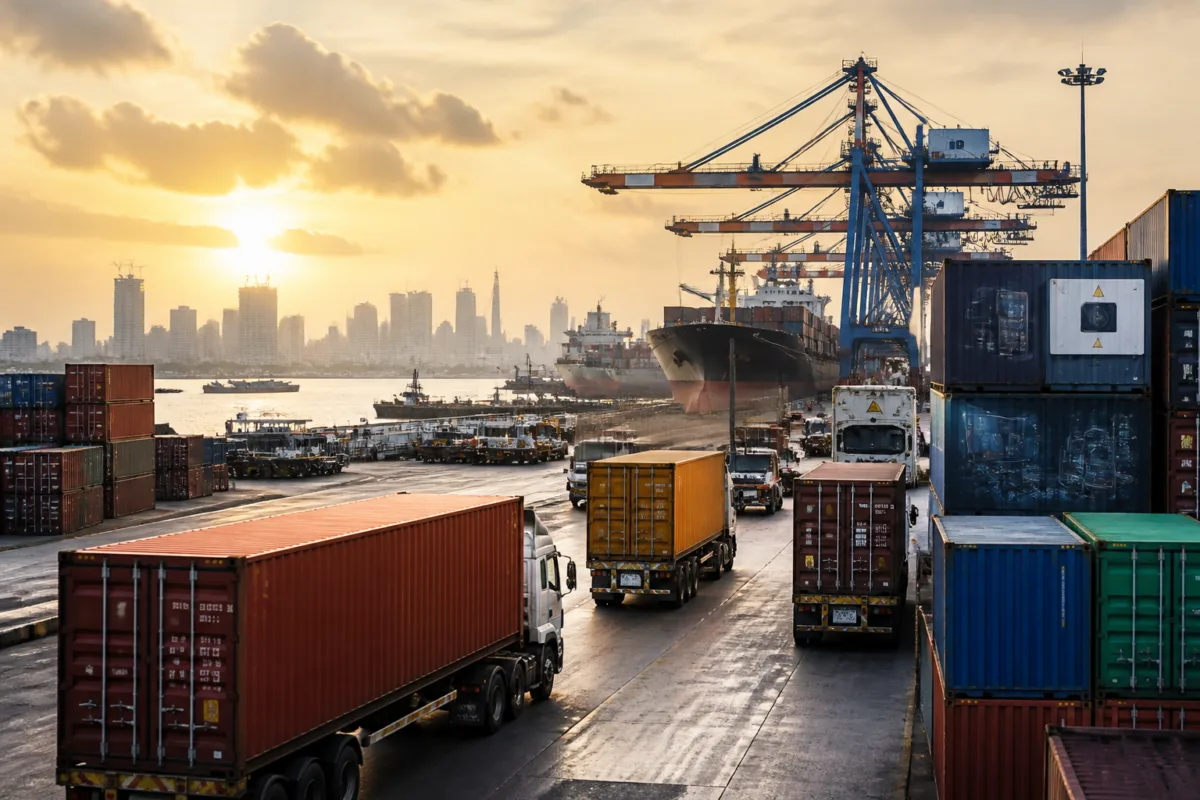
For India, the practical question is whether its export infrastructure can support diversification quickly enough if global companies seek alternative suppliers. The report identifies reliable power, efficient ports, predictable customs procedures and credible origin documentation as important conditions for converting supply-chain diversification into competitive production. These are not only trade facilitation issues. They are basic urban and regional infrastructure requirements that determine whether industrial clusters can operate consistently.
### Fiscal decisions can travel through the cost of capital
The larger global effects may emerge from US fiscal policy. The Congressional Budget Office estimates the US federal deficit at around $2 trillion in fiscal 2026. Additional borrowing-financed stimulus could support American consumption and increase demand for imports, potentially benefiting exporters in Asia and Europe. But greater borrowing could also place pressure on Treasury yields and increase financing costs across international markets.
This matters for companies building factories, expanding logistics networks or financing equipment. Countries and firms dependent on dollar borrowing could face more expensive debt servicing. Higher US yields can attract international capital towards American assets, placing pressure on emerging-market currencies and making dollar-denominated loans costlier.
Congress does not directly determine monetary policy. The Federal Reserve maintained its policy-rate range at 3.75-4 per cent on October 28. However, fiscal decisions influence the economic conditions confronting the central bank. The relationship between congressional action, federal borrowing, interest rates and capital flows therefore extends beyond Washington’s political institutions.
The dollar’s role reinforces this exposure. It accounted for 56.7 per cent of global foreign-exchange reserves in the second quarter of 2026. For India, a weaker rupee could improve export competitiveness in some sectors, but that benefit may be offset by more expensive imported oil, machinery and foreign-currency liabilities. Export performance cannot therefore be assessed by exchange rates alone. It also depends on input costs, energy prices, financing conditions and the reliability of trade infrastructure.
### Technology supply chains are becoming an urban infrastructure question
Technology policy adds another layer of uncertainty. The World Trade Organization reported that AI-enabling goods accounted for 47 per cent of the increase in merchandise trade value in the first half of 2026. This makes decisions on semiconductor access, research funding, technology partnerships and corporate tax incentives increasingly relevant to the location of factories and data centres.
For cities and industrial regions, the competition is not limited to attracting a company with land subsidies. Technology-linked investment requires dependable electricity, communications networks, transport connections, skilled labour and policy continuity. The report says India could benefit from supply-chain diversification and increased demand for technology services, but that result would depend on these underlying conditions rather than political developments alone.
A change in US technology policy could produce both opportunities and risks. Tighter restrictions may limit access to products, partnerships or markets. At the same time, companies seeking to reduce dependence on a narrow set of suppliers or customers could look for alternative production locations. Whether India captures that investment depends on its ability to provide reliable operating conditions and demonstrate compliance with origin and trade requirements.
These pressures are spatial as well as financial. New factories and data centres require power, land, workers and logistics systems. Their arrival can affect surrounding housing demand, commuting patterns and municipal service requirements, although the supplied report does not establish the scale or location of any such future investment. What it does establish is that trade policy and technology decisions increasingly shape the infrastructure conditions under which urban economies compete.
### India’s exposure is sector-specific
Indian exporters will not experience the US midterms uniformly. Labour-intensive industries could face pressure through narrower margins and less favourable payment terms. Information technology and professional services are more closely connected to American corporate spending and skilled-worker mobility. Pharmaceuticals and electronics require sector-specific assessment because their supply chains, regulatory exposure and market conditions differ.
Migration policy could affect the availability of skilled workers and international mobility, particularly in technology and professional services. Energy policy, sanctions and military spending could influence global economic conditions, while any increase in oil prices or freight costs would place pressure on importing economies and household purchasing power.
The report’s analysis also underlines why a weaker rupee may not provide a complete solution for exporters. Higher energy costs, imported inputs and foreign-currency liabilities can offset gains from currency depreciation. Indian companies would therefore need to assess margins under different tariff scenarios and review their contractual exposure, while policymakers would need to focus on market access and the operating systems that support production.
The wider institutional question is whether uncertainty becomes a temporary cost of political transition or a persistent feature of global trade. Sohom Banerjee, a senior economic and AI expert quoted by NDTV, said the midterms would influence the predictability of trade policy, the credibility of fiscal commitments and the allocation of international capital. That framing places congressional control within a larger system rather than treating the elections as an isolated political event.
For India, the evidence points to exposure but not a predetermined outcome. American demand could support exporters, while supply-chain diversification could create opportunities in technology and manufacturing. At the same time, tariffs, higher borrowing costs, energy prices, currency movements and labour restrictions could reduce those gains. The developments that require monitoring are the congressional balance after the November 2026 elections, subsequent tariff and fiscal decisions, US interest-rate conditions, technology restrictions and the ability of Indian infrastructure systems to support dependable, cost-competitive exports.

