


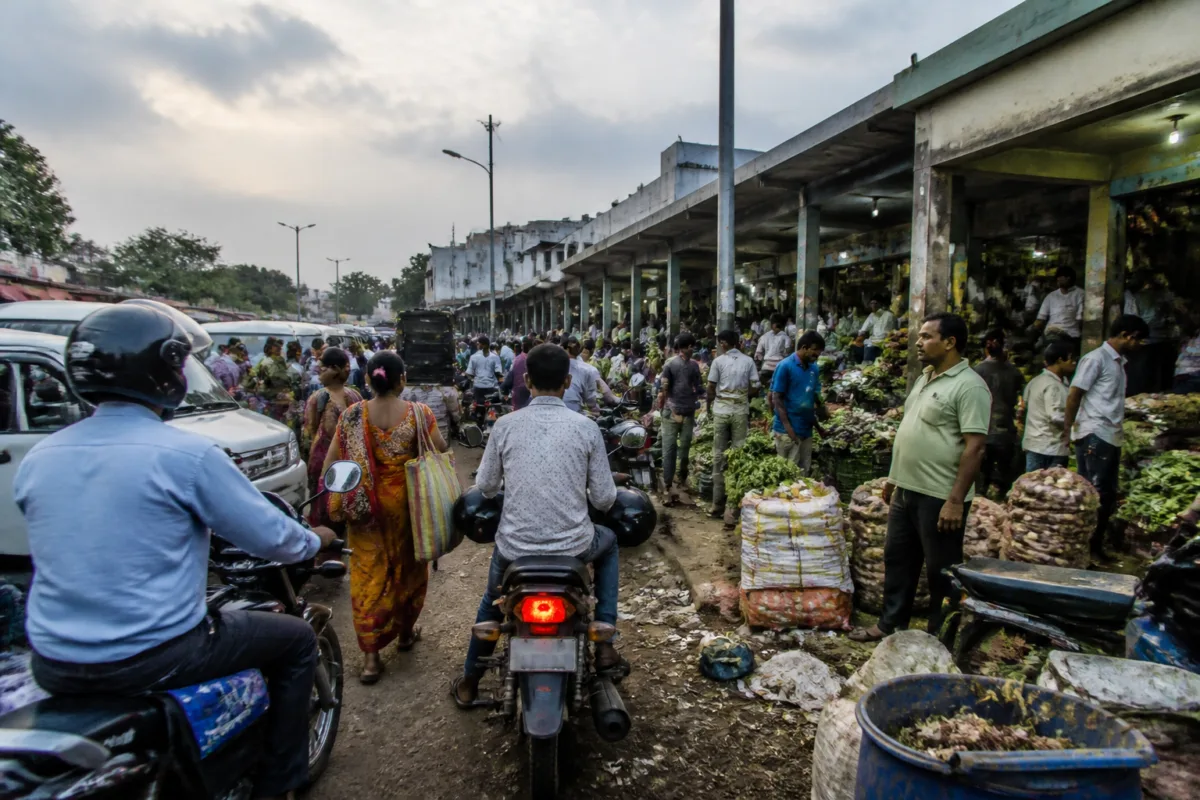
Bhubaneswar’s Unit-4 Market is not simply a place where vegetables, meat, fish and groceries are sold. Spread across nearly eight acres, the market supports around 1,200 traders and draws customers from several parts of the capital and nearby areas. Yet the same market, which generates lakhs of rupees in monthly revenue for the Bhubaneswar Municipal Corporation (BMC), reportedly lacks basic public facilities such as proper toilets, reliable waste management, designated parking, security systems and fire-safety arrangements.
That contrast makes the Bhoumanagar Haat, popularly known as Unit-4 Market, a useful window into a wider urban governance question: whether municipal markets are being managed merely as revenue-generating properties or as essential public infrastructure. The market’s importance is not limited to its commercial turnover. It is also a daily service point, a workplace for traders, a source of food and household supplies, and a high-footfall public space in the heart of Bhubaneswar.
The details reported by Odisha Post show how this role has developed over time. The market was inaugurated on October 2, 1974, by then Odisha Chief Minister Nandini Satpathy. It was initially administered by the Department of Animal Husbandry before the BMC took over management in 1983. A traders’ association was later formed to represent the interests of businesses operating within the market.
More than five decades later, the market contains over 300 vegetable shops, 38 grocery stores, 42 rice warehouses, 10 eateries, 39 wholesale non-vegetarian outlets and around 300 retail meat and fish shops. It also includes businesses selling puja materials, salons and other commodities. Traders arrive from areas including Keshura, Nakhara, Athagarh and Cuttack, as well as from different parts of Bhubaneswar.
This scale matters because municipal markets perform functions that are often divided across several policy areas. They are commercial zones, food-supply nodes, employment centres, public-health environments and transport destinations at the same time. A failure in one system can therefore affect the others. Poor waste collection can create hygiene concerns; inadequate parking can obstruct movement; the absence of fire protection can increase risk in a crowded built environment; and insufficient lighting or security can affect how safely traders and customers use the market.
## A market that functions beyond its formal boundaries
Unit-4 Market is open daily from 6 am to around 10 pm, except on the last Tuesday of every month. Its operating hours make it part of the city’s everyday rhythm rather than an occasional shopping destination. Early-morning wholesale and retail activity overlaps with regular household shopping, while the non-vegetarian section experiences particularly heavy crowds on busy days.
The market serves residents of Shastri Nagar, Nayapalli, Acharya Vihar, Saheed Nagar, Unit-2, IRC Village and Laxmisagar, according to the report. Its location in the capital’s central area gives it a catchment that extends well beyond the immediate market premises. This also means that the quality of its internal infrastructure has consequences for surrounding neighbourhoods and for the movement of people and vehicles through the area.
A market of this size cannot be assessed only by counting shops or measuring municipal collections. Its performance depends on the supporting infrastructure that allows commercial activity to take place safely and efficiently. Toilets, drainage, lighting, waste storage, circulation space, parking, emergency access and security are not optional additions to a market. They are part of the operating system of the marketplace.
The reported absence of a proper public toilet is therefore more than a missing amenity. The market reportedly has only two urinals, which traders say are not cleaned regularly. For a facility open for approximately 16 hours a day and used by thousands of traders and customers, sanitation is directly connected to dignity, public health and the basic usability of the site. The supplied report does not provide footfall figures, sanitation audits or water and drainage data, but the mismatch between operating scale and available toilet infrastructure is clear from the account.
## Revenue without corresponding facilities
The history of charges collected from traders illustrates the market’s formal relationship with the municipality. When the BMC first took over management, it collected a monthly tax of Rs 7 from each trader. The current charges are reported to be Rs 250 per month for vendors operating from designated vending spaces and open areas, while shop owners pay between Rs 1,500 and Rs 2,000 per month.
The report does not provide a precise monthly revenue figure or a public expenditure statement for Unit-4 Market. It does, however, state that the BMC collects lakhs of rupees every month. That creates an accountability question: what portion of the revenue is reinvested in the market, and which agency is responsible for each facility?
This distinction is important because municipal markets often involve several layers of responsibility. The BMC manages the market today, while the traders’ association represents the occupants. Individual traders may occupy designated platforms, shop units or open spaces, and some are alleged to have extended beyond their allotted areas. Once space, licensing, maintenance and enforcement are handled through separate processes, accountability can become unclear.
The Bhouma Nagar Haat Traders’ Association has reportedly submitted written complaints and demands to the BMC seeking improvements. Traders claim that concrete action has not followed. The supplied report does not include the BMC’s response, a recent inspection document, an approved improvement plan or a timeline for remedial work. Those missing documents are significant because they would show whether the infrastructure deficit is a budget problem, a maintenance failure, an enforcement issue or a combination of these.
## Congestion reveals the limits of the market layout
Parking and circulation problems are another sign that the market’s physical arrangement may not have kept pace with its commercial use. The market reportedly has no designated parking facility, forcing customers to bring vehicles inside the premises. On busy days, particularly near the non-vegetarian section, heavy crowds create congestion for both traders and customers.
The problem is not simply that vehicles occupy space. When parking, loading, unloading, vending and pedestrian movement compete for the same area, the market loses the separation needed for safe and efficient functioning. The source material does not establish the exact layout, road widths or traffic volumes, so the operational consequences cannot be quantified. But the reported conflict between customers, vehicles and traders points to a circulation problem within a high-density public facility.
Encroachment adds another layer. Some traders are alleged to occupy more space than officially allotted. Without a current site plan, allotment register or enforcement record, it is not possible to determine the scale of the issue. However, unauthorised expansion can narrow movement corridors, obstruct emergency access and make the boundary between public circulation space and private commercial space difficult to enforce.
A functioning market therefore requires more than collecting charges from occupants. It requires periodic remeasurement of space, transparent allotment records, clearly marked circulation routes and consistent enforcement. These are administrative tasks, but they have direct consequences for the built environment and for public safety.
## Safety systems are part of market infrastructure
The report also identifies a lack of security guards and CCTV cameras, along with the absence of proper fire-safety arrangements. These gaps are particularly relevant in a market that combines crowded retail spaces, food-related activity, storage, electrical systems and long operating hours.
The source does not report a specific fire or security incident at Unit-4 Market. The concern is instead one of preparedness. Fire safety is not measured only by whether an emergency has already occurred. It also involves access for emergency vehicles, clear exits, extinguishers, electrical maintenance, evacuation procedures and the ability to alert people quickly. None of these details is provided in the supplied material, so the condition of individual installations remains unverified.
The same principle applies to surveillance and security. CCTV cameras do not replace on-site management, but their absence can limit monitoring in a crowded commercial environment. The report’s account indicates that traders and customers are using a large public market without the security infrastructure they say is necessary.
## The market’s social identity adds another layer
Unit-4 Market is also distinguished by its religious and community spaces. It houses three Trinath temples, along with temples dedicated to Lord Hanuman, Lord Shani and Goddess Tarini. Ganesh Puja, Makar Mela and temple foundation-day events are celebrated at the market.
These activities show that the market is not only an economic facility. It is also a social space with an established cultural identity. That makes the quality of public infrastructure even more consequential. Festivals and gatherings can increase footfall and intensify the demand for sanitation, waste removal, crowd management, lighting and emergency access. The supplied report does not quantify festival attendance or document special arrangements, but the presence of regular celebrations indicates that market management must account for uses beyond routine trading.
The traders’ association conducts elections every two years, beginning with a general body meeting and preparation of a voters’ list. This provides an organised channel through which traders can raise collective concerns. However, representation within a market does not substitute for municipal responsibility. The association can submit demands and coordinate occupants, while the civic body remains the authority identified in the report as responsible for management and collection.
## What the evidence establishes—and what remains unclear
The evidence presented in the report establishes four central facts. First, Unit-4 Market is a long-standing and large commercial centre with a history dating to 1974. Second, it supports around 1,200 traders across a diverse range of businesses. Third, it serves a broad urban catchment in Bhubaneswar and nearby areas. Fourth, traders report serious deficiencies in sanitation, waste management, lighting, parking, security, fire safety and space control despite the BMC collecting monthly charges.
The evidence does not establish the market’s exact daily footfall, annual municipal revenue, maintenance expenditure, structural condition, fire-risk assessment or approved redevelopment plan. It also does not include the BMC’s response to the traders’ complaints. These are not minor details. They would determine whether the market requires routine maintenance, a phased upgrade, a redesign of circulation and services, or a larger redevelopment programme.
That information gap is itself an institutional issue. Public markets are often visible in daily life but less visible in municipal budgeting and performance reporting. A clear public record of collections, spending, facility audits and complaint resolution would help traders, customers and administrators assess whether the market is being managed effectively.
Unit-4 Market’s condition therefore raises a larger question about how Bhubaneswar treats its established commercial spaces. A market that has survived for 52 years and remains central to food and retail activity is not an obsolete land use simply because its infrastructure is old. Nor can its age alone justify unplanned growth, poor sanitation or weak safety systems.
The immediate urban challenge is to align management with actual use. That means recognising the market as a complex public facility rather than a collection of individual shops. The next meaningful developments to monitor are the BMC’s response to the traders’ written complaints, any inspection of sanitation and fire safety, clarification of responsibility for maintenance, and evidence of a funded plan to address parking, waste, lighting, security and circulation. Until those steps are documented, Unit-4 Market will continue to represent the gap between a city’s commercial importance and the infrastructure provided to sustain it.

