


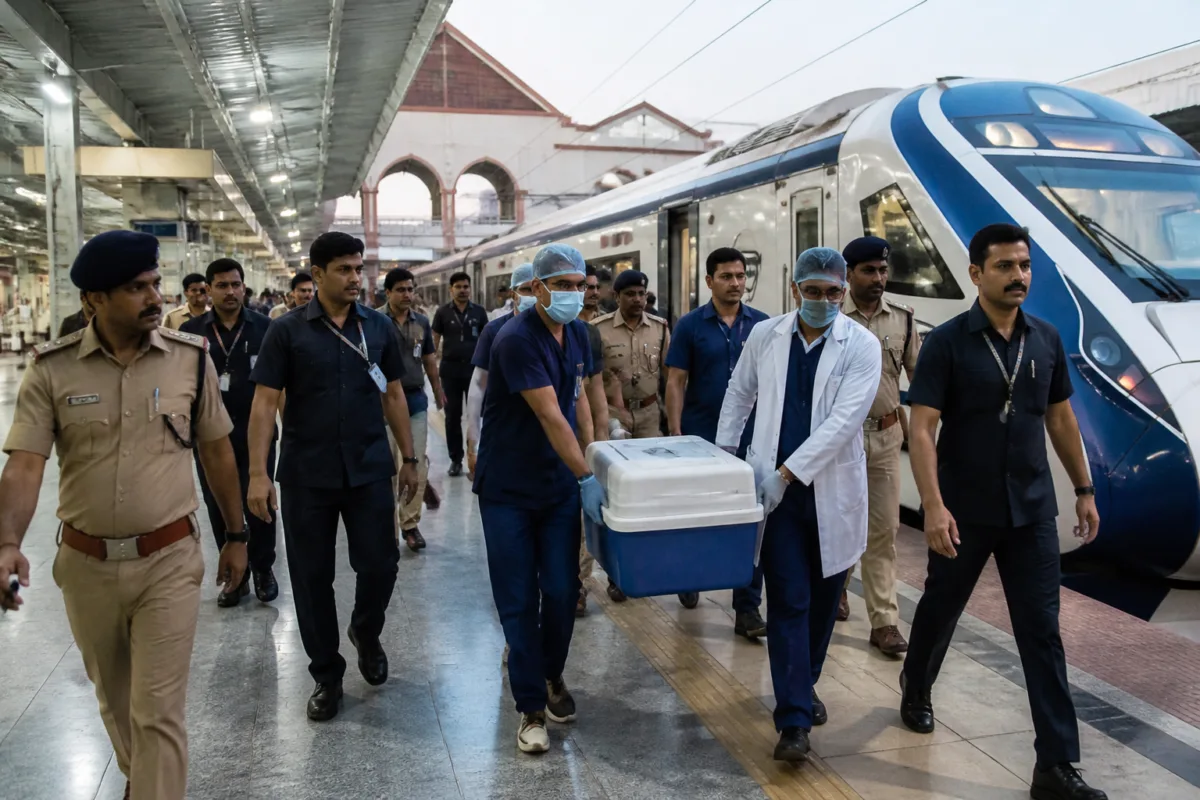
A live human heart was transported from Surat to Ahmedabad on November 1 aboard the Mumbai Central–Gandhinagar Capital Vande Bharat Express, before being moved through a coordinated railway and police green corridor to the UN Mehta Institute of Cardiology and Research Centre.
The heart was brought from Surat’s New Civil Hospital and loaded at Surat railway station into coach C-12 of train number 20901 at the designated time. The operation involved railway officials, medical teams and police authorities to reduce delays during the time-sensitive journey.
At Ahmedabad railway station, a special green corridor was arranged on platform number 1 with the support of the railway commercial department, the Railway Protection Force, the Government Railway Police and the state police. The arrangement enabled the heart to be transferred from the station to the UN Mehta hospital in the shortest possible time, according to the report.
The medical team at the Ahmedabad-based UN Mehta Institute of Cardiology and Research Centre is scheduled to carry out the transplant. The report does not provide further details about the recipient or the medical outcome of the procedure.
The Ahmedabad Divisional Railway Manager said this was the third occasion on which the Vande Bharat Express had been used to transport a live heart. The railway’s role in the operation extended beyond carrying the organ between two cities: it required a timed handover at Surat, coordination during the train journey and a rapid transfer through Ahmedabad station.
Such transfers depend on the coordination of several institutions operating within different administrative systems. Hospitals are responsible for preparing and handing over the organ, railway personnel manage access and movement through the station, and the RPF, GRP and state police help secure the route. The operation described in the report shows how an ordinary passenger rail service can be integrated into an emergency medical movement when timing and inter-agency communication are planned in advance.
Western Railway said it ensured coordination among the hospitals concerned, the state police, medical teams and railway officers and employees to complete the operation. The use of a scheduled train also placed the transport within an existing inter-city rail connection rather than requiring a separate rail movement.
The Ahmedabad operation highlights the importance of station-level planning in time-sensitive healthcare logistics. A green corridor is not limited to clearing roads; in this case, it included a controlled movement from a railway coach to the station exit and onward to the hospital. The report identifies platform number 1 as the receiving point in Ahmedabad but does not provide the journey time or the distance covered by the road transfer.
The next stated step is the transplant by specialists at the UN Mehta Institute of Cardiology and Research Centre. The report does not state the outcome of that procedure.

