


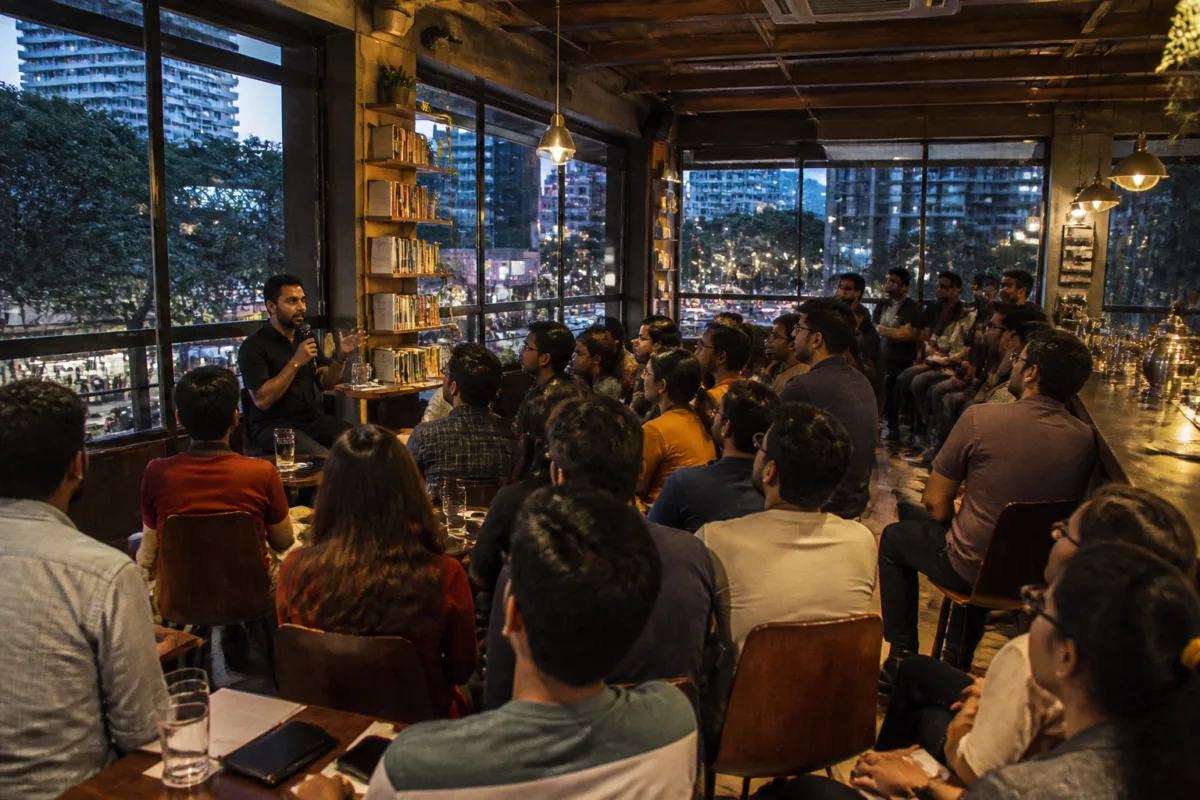
Bengaluru’s bars and pubs are increasingly being used for lectures, debates and discussions, revealing a citywide demand for accessible places where people can learn and exchange ideas outside formal institutions. The events are small in scale compared with the city’s universities, offices and cultural venues, but they point to a larger urban problem: residents may have institutions that produce knowledge without having enough open, convenient and informal spaces in which to access it.
The trend is being driven by organisers who are taking lectures and debates into venues more commonly associated with nightlife. Pint of View, founded by Shruti Sah and Harsh Sne Hanshu, organises lectures over drinks. Bydge runs Intellect on Ice, a gathering that has expanded from Mumbai to Bengaluru, Delhi and Pune. The Contrarian Debate Club, co-founded by Sudarshan Senthil Kumar and Srinthan Hampi, uses venues including Woodside Inn and Big Pitcher for public discussions.
Their formats differ, but the underlying proposition is similar. A bar can function as a third space: neither home nor workplace, but a relatively accessible setting where people can spend time with others. In Bengaluru, where workdays, commuting and limited personal time shape the rhythm of urban life, these spaces are being adapted to host activities that would traditionally be associated with universities, lecture halls or cultural institutions.
The organisers of Pint of View describe bars and parks as some of the few third spaces available to the city. Their argument is not that bars are naturally public institutions. Rather, it is that they are among the places that already have a location, a room, a social atmosphere and operating hours suited to bringing people together. In a city where much of residents’ remaining time can be consumed by travel between work and home, the value of a venue close to existing daily routes becomes significant.
This is also a question of access. Bengaluru has institutions known for work in science, the arts and public policy, but the founders of Pint of View say these institutions can feel gatekept to people outside their formal networks. Entry requirements, affiliations and institutional cultures can make it difficult for a member of the public to attend a lecture simply because they are interested in the subject.
Commercial venues offer a different entry point. People can attend after work, pay for a ticket and participate without needing an academic identity. At these events, the subject may be artificial intelligence, geopolitics, the human brain, philosophy or another specialised topic. The setting changes the relationship between speaker and audience: the event is not presented as a compulsory class, and attendees are not necessarily there to earn a qualification.
That distinction matters in a country where learning is often linked to examinations, grades, cut-offs and employment. The organisers describe their events as learning pursued for its own sake. In practice, that means the audience is assembled around curiosity rather than a common course, profession or institutional affiliation.
The experience also depends on physical presence. Ronit, an independent filmmaker who attended lectures over drinks, told the Times of India that online videos can provide information but that offline events allow attendees to ask questions, receive responses and form connections during the session. Another attendee, Aditi, said speakers at these gatherings participate because they want to, and that they prepare for questions from people with different backgrounds.
These observations show why the venue is only one part of the model. The event works because it creates a temporary social arrangement: a speaker, a mixed audience, a common subject and enough time for conversation. A recorded lecture can distribute knowledge widely, but it does not automatically create the same setting for questioning or interaction. The bar becomes useful not because it replaces a classroom, but because it supplies a room in which a less formal kind of classroom can happen.
Intellect on Ice illustrates the organisers’ attempt to design that informality. Siya Pravin Sarnaik and Atharva Atul Rampure said they were influenced by gatherings around niche interests in the United Kingdom, including food and books. Their events do not follow a fixed format. The team chooses a topic, researches it and approaches people who can contribute expertise and ideas.
The absence of a fixed format is part of the attraction, but it also creates an operational challenge. These events require what Sarnaik describes as infrastructure for an experiential economy. That infrastructure is not limited to buildings or transport networks. It includes venues willing to host unfamiliar formats, organisers able to curate content, speakers prepared to engage with a mixed audience, and business models that allow the event to continue.
The commercial logic is visible in the relationship between organisers and bars. Big Pitcher’s Indiranagar general manager, Shane Mannas, said such events help the brand attract new and repeat customers. The venue charges a cover fee that attendees can redeem on food and drinks, while also using its spaces for kitty parties and corporate events. Ticket prices for the wider events described in the report range from early-bird rates of Rs 599 to Rs 1,299.
This arrangement means public learning is not entirely separate from consumption. The venue earns from food, drinks, cover charges and potential repeat visits. Organisers gain a place to hold an event, while participants gain access to a social and intellectual experience. The model can make use of existing commercial space, but it also places a price on participation.
That price shapes who can enter these new third spaces. The report identifies attendees between 25 and 40, including academics, working professionals, venture capitalists, founders, doctors, lawyers and engineers. The audience is therefore not a random cross-section of Bengaluru. It is a group with the time, money and interest to attend ticketed events in bars and pubs. The format expands access beyond formal institutions, but it does not remove the barriers created by cost, location, alcohol-centred settings or social familiarity.
The debate club’s experience shows how demand can develop quickly when a venue and format are available. What began as a proposed gathering of seven or eight friends needed a larger crowd to become viable for the venue. After the founders invited people through social media at short notice, the event received more than 100 entries. The number suggests interest in structured discussion, but it does not establish how often such audiences can be assembled or whether the model can be sustained across the city.
Scale is already producing different choices among organisers. Pint of View plans lectures for audiences of between 100 and 300 people and has announced a two-day lecture festival at Jayamahal Palace Grounds on December 19 and 20, with an expected audience of up to 5,000. Intellect on Ice plans to remain more intimate, with between 40 and 60 participants. One model treats scale as a way to create a larger public platform; the other treats small size as essential to the experience.
These choices reflect two different interpretations of a third space. A large festival can make ideas visible to more people and test whether public learning can draw a mass audience. A smaller gathering can preserve the direct exchange that participants value. Neither format automatically resolves the question of accessibility. A bigger audience may require a larger and more expensive venue, while an intimate event may remain limited to people already connected to similar cultural and professional networks.
The Bengaluru example also shows how the city’s existing infrastructure influences cultural life. The source report links the growth of these events to commuting pressures and the time spent travelling between work and home. It does not provide transport data or a citywide inventory of public meeting spaces, so it cannot establish how many residents lack alternatives. It does, however, document organisers’ view that limited time and space are influencing the demand for venues that combine convenience, social contact and informal learning.
The institutional question is equally important. Universities and research institutions may produce knowledge, but their buildings and programmes are not always experienced as open civic spaces. Bars and pubs may be easier to enter, but they are private commercial venues operating according to business needs. Bengaluru’s emerging lecture and debate circuit sits between these two systems: it borrows the intellectual purpose of an institution while relying on the commercial capacity of hospitality businesses.
That arrangement is both the strength and the limit of the model. It activates underused or differently used venues and gives residents a reason to gather around subjects beyond work and entertainment. At the same time, it makes access dependent on ticket prices, venue policies and the commercial viability of the event. It creates a new kind of urban room, but not necessarily a universally public one.
The evidence currently supports a modest but significant conclusion. Bengaluru’s bars and pubs are becoming platforms for public learning because organisers see a gap between the city’s knowledge institutions and its everyday social life. Residents are responding to events that offer conversation, questions and connection in spaces that fit around working lives. What remains uncertain is whether this will develop into a durable civic network or remain a niche cultural economy. The next indicators will be the organisers’ ability to sustain attendance, the venues’ willingness to host the events and the extent to which these gatherings can reach people beyond the professional audiences already drawn to them.

