


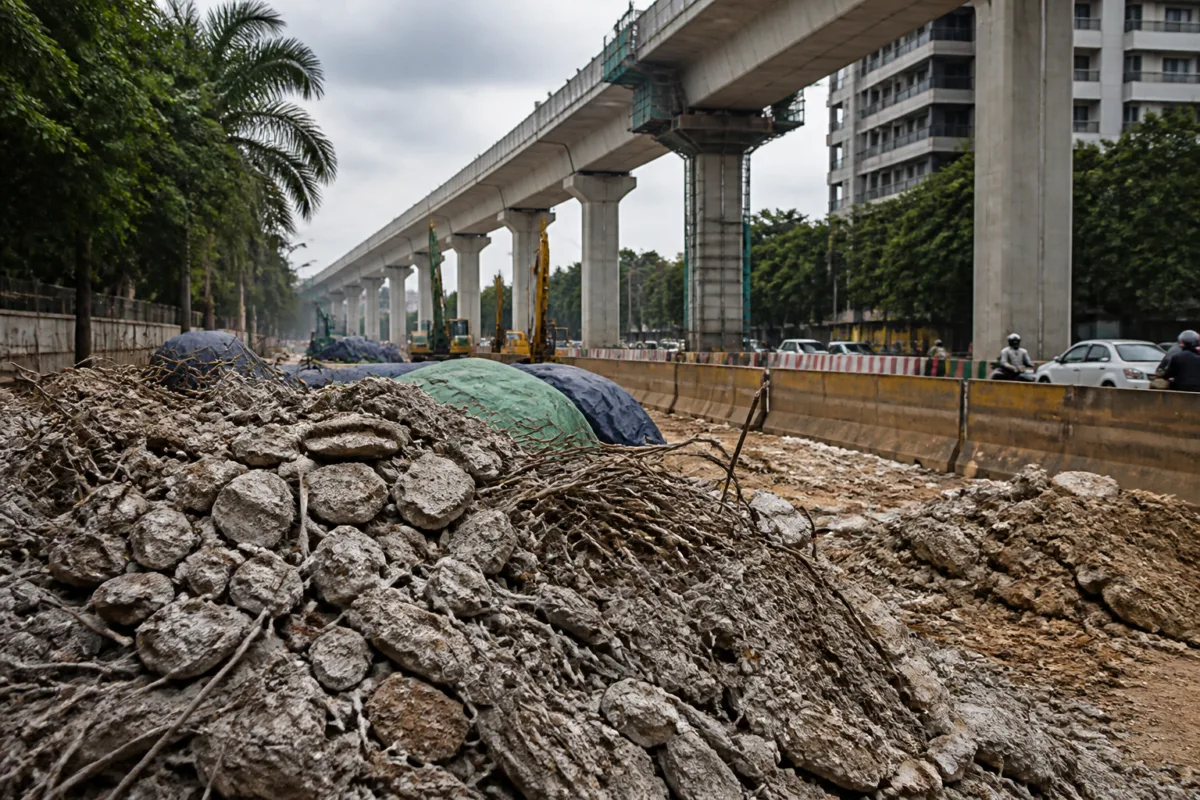
Bengaluru Metro construction waste has become a governance blind spot after the Karnataka State Pollution Control Board (KSPCB) said it did not have records showing how much construction and demolition waste was generated by Bangalore Metro Rail Corporation Limited (BMRCL), or how much was sent to authorised processing facilities. The disclosure, made in response to a Right to Information query, raises a question larger than the accounting of debris: whether the city’s infrastructure agencies can demonstrate where the physical by-products of expansion go.
The RTI application sought year-wise information for the financial years 2019–20 to 2025–26. It asked for the quantity of construction and demolition waste generated by BMRCL, the amount sent to authorised processing facilities and the quantity received by each facility. It also sought annual returns, compliance reports, details of authorised processing units, and records of inspections or enforcement action related to waste management.
The KSPCB did not provide those records. Its response stated: “The information sought in the application is not in the office.” The board transferred the request to BMRCL. That response does not establish that the waste was improperly disposed of, nor does it show that no records exist anywhere. It does establish that the state pollution regulator did not have the requested information available in its office when the RTI application was answered.
That distinction is important. Construction waste governance depends not only on physical processing capacity but also on a chain of records connecting the project generating the waste, the transporter carrying it, and the facility receiving it. Without that chain, the regulator’s ability to assess compliance is limited even if individual agencies or facilities hold parts of the information separately.
The material supplied in the RTI application covers six financial years, from 2019–20 through 2025–26. That period captures a substantial span of BMRCL’s construction activity, but the available report does not provide the total quantity of waste generated, the number of facilities involved, or the volume processed. The absence of those figures means the public cannot use the response to measure the scale of the waste problem or compare generation with processing.
The reported regulatory framework places responsibilities on several institutions. According to the expert cited in the report, operators of construction and demolition waste processing and recycling facilities are required to submit annual reports and obtain operating authorisation from the pollution board. Facilities are also legally required to weigh incoming waste and maintain regular, auditable records.
The same expert said project proponents, whether public or private, must submit a waste management plan to the local authority before construction begins. Records of waste generated and disposed of are required to be maintained. The KSPCB is expected to compile information from waste processing units into a state-level inventory, while the municipal body is also required to inform the board about construction and demolition waste generated in the city and update it with relevant records.
This arrangement creates a distributed accountability model. BMRCL, as the project proponent, is expected to maintain information about waste generated by its works. Processing facilities are expected to record incoming material and report their operations. The municipal body is expected to maintain or transmit city-level information. The KSPCB is expected to use these records for regulatory oversight and compilation.
The RTI response indicates that this information was not available at the KSPCB in a form that could answer the request. It does not, on its own, reveal whether the problem lies in non-submission by BMRCL, incomplete reporting by processing facilities, weak coordination with the municipal body, inadequate record management within the board, or a combination of these issues. The available report does not include BMRCL’s response to the transferred application and therefore does not resolve that question.
The institutional issue is more consequential than a missing spreadsheet. A regulator cannot effectively monitor a waste stream that it cannot quantify. Without year-wise records, it becomes difficult to establish whether waste was sent to authorised facilities, whether the quantities recorded by project agencies match the quantities received by processors, and whether inspections were targeted at the locations or operators carrying the greatest compliance risk.
The system also depends on reconciliation between records held by different actors. A project-level dispatch record should be capable of being compared with a facility-level receipt record. Those records should, in turn, be usable by the regulator and municipal authority to build a city-level picture. The supplied material does not show whether such reconciliation takes place for BMRCL’s projects. It only shows that the KSPCB did not have the requested information in its office.
That gap matters particularly for metro construction because the waste is generated across multiple work sites and project components rather than at one fixed industrial location. The report does not provide a detailed breakdown of BMRCL’s works or the routes used for disposal. It does, however, identify BMRCL as a public infrastructure project proponent whose waste records were specifically sought for a multi-year period.
The disclosure therefore places public infrastructure within the same compliance framework that applies to other construction activity. The scale or public purpose of a metro project does not remove the need for waste management plans, auditable records and authorised processing. In fact, a project with multiple sites and contractors requires a clear record system if the regulator is to verify compliance across the construction chain.
The evidence currently supports a narrower conclusion than a claim of illegal dumping. The KSPCB’s response confirms an information and oversight gap. The expert’s comments explain why that gap raises concerns about the board’s monitoring function. But the supplied report does not establish that BMRCL failed to prepare waste records, that any processing facility operated without authorisation, or that construction debris was dumped illegally.
What remains unresolved is where the missing information sits and whether the records, if held by BMRCL or other institutions, are complete and internally consistent. The RTI request was transferred to BMRCL, making its response the next relevant part of the public record. Further clarity would also require information from authorised processing facilities and the municipal body, since the reported compliance structure assigns responsibilities across all three levels of the waste chain.
For Bengaluru, the larger urban question is whether infrastructure expansion is being measured only through visible assets such as stations, viaducts and corridors, or also through the material flows created while those assets are built. Construction and demolition waste is an operational consequence of urban growth. If its movement cannot be tracked, the city’s understanding of the environmental and administrative cost of expansion remains incomplete.
The available evidence confirms that the KSPCB could not provide the requested BMRCL waste data for 2019–20 to 2025–26 and transferred the application to the metro corporation. It does not yet establish the fate of the waste or identify the precise institutional point at which records were lost, withheld or not integrated. The next meaningful development is BMRCL’s response to the transferred RTI request, alongside any records from the municipal body, processing facilities and the pollution board that can show whether project-level and facility-level data are being reconciled.

