


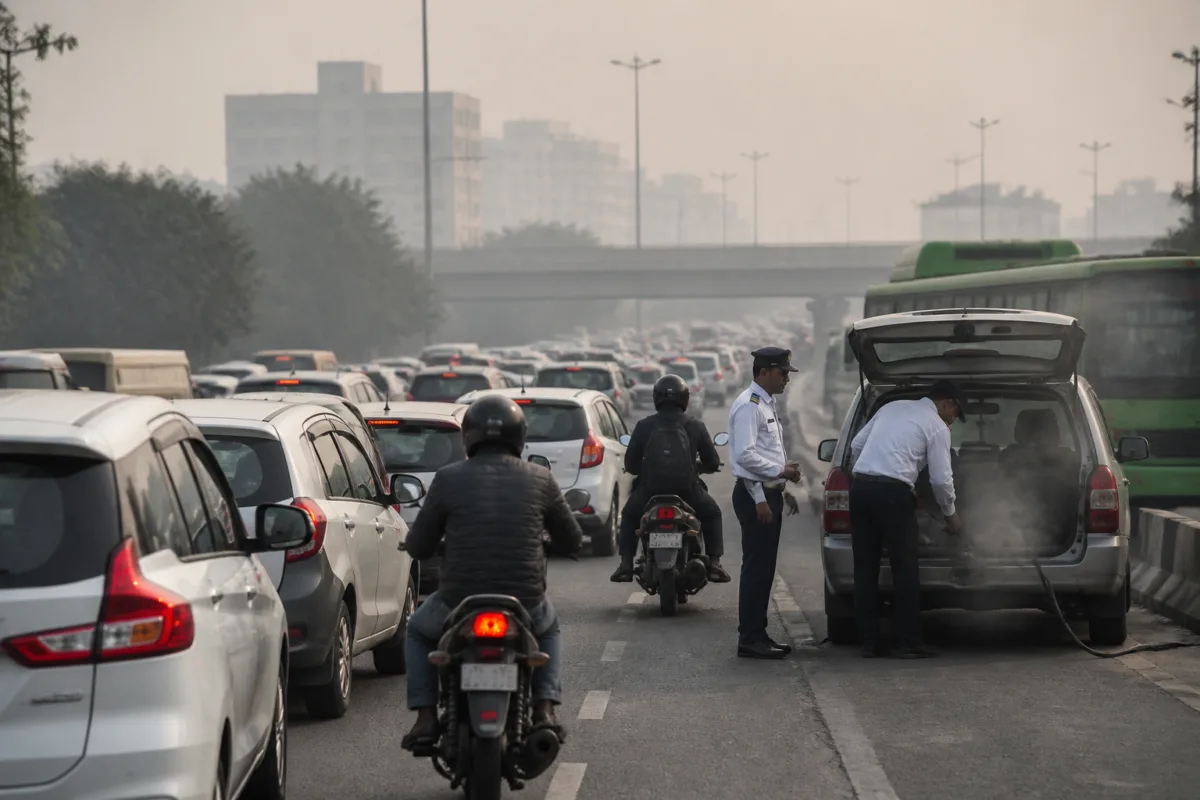
Delhi’s air quality reached the ‘very poor’ category at the start of November, with the Air Quality Index touching 307 at 7 am on Monday even as the minimum temperature fell to 18 degrees Celsius. The deterioration came alongside traffic restrictions and vehicle checks at several entry points into the capital, causing congestion on the Delhi-Gurugram and Delhi-Noida borders.
According to the Commission for Air Quality Management, Delhi recorded an AQI of 307 on Monday morning. The temperature was 21 degrees Celsius at the time, with humidity also recorded in the air. The maximum temperature was expected to remain around 29 degrees Celsius, while the minimum was forecast at 17 degrees Celsius.
The minimum temperature recorded on Sunday was 18 degrees Celsius, which was 1.9 degrees below normal for the date. It was the lowest minimum temperature recorded on November 1 since 2023, when the figure stood at 16.4 degrees Celsius. The maximum temperature on Sunday was 29 degrees Celsius, the lowest for November 1 since 2021, when it was recorded at 27.2 degrees Celsius.
Delhi’s AQI on Sunday reached 261 according to Central Pollution Control Board data, making it the worst level recorded in the season so far and the highest in 198 days. The SAMEER app recorded a higher figure of 277 for the same day. The difference reflects readings from separate monitoring systems.
CPCB data showed that 22 of its 57 monitoring stations in the capital recorded air in the ‘very poor’ category, while 21 stations reported ‘poor’ air and 14 reported ‘moderate’ air. Jahangirpuri recorded the highest AQI at 378. According to the SAMEER app, 25 of its 54 monitoring stations recorded ‘very poor’ air and 18 recorded ‘poor’ air.
PM2.5 remained Delhi’s main pollutant, according to the report. The combination of falling temperatures, high humidity and stagnant urban emissions has coincided with a worsening pollution situation, although the supplied report does not provide a quantified source-wise breakdown of emissions.
New pollution-control restrictions led to vehicle checks at Delhi’s borders on their first day of implementation. Teams were deployed to examine vehicle emission compliance, while traffic was affected at routes connecting Delhi with Gurugram and Noida. Long queues were reported near entry points, including municipal toll booths, as vehicles were checked.
The India Meteorological Department forecast mainly clear skies for Monday, with a maximum temperature of 29 degrees Celsius and a minimum of 17 degrees Celsius. Air-quality monitoring and vehicle-emission checks are expected to continue as the city enters the early winter pollution period.

