


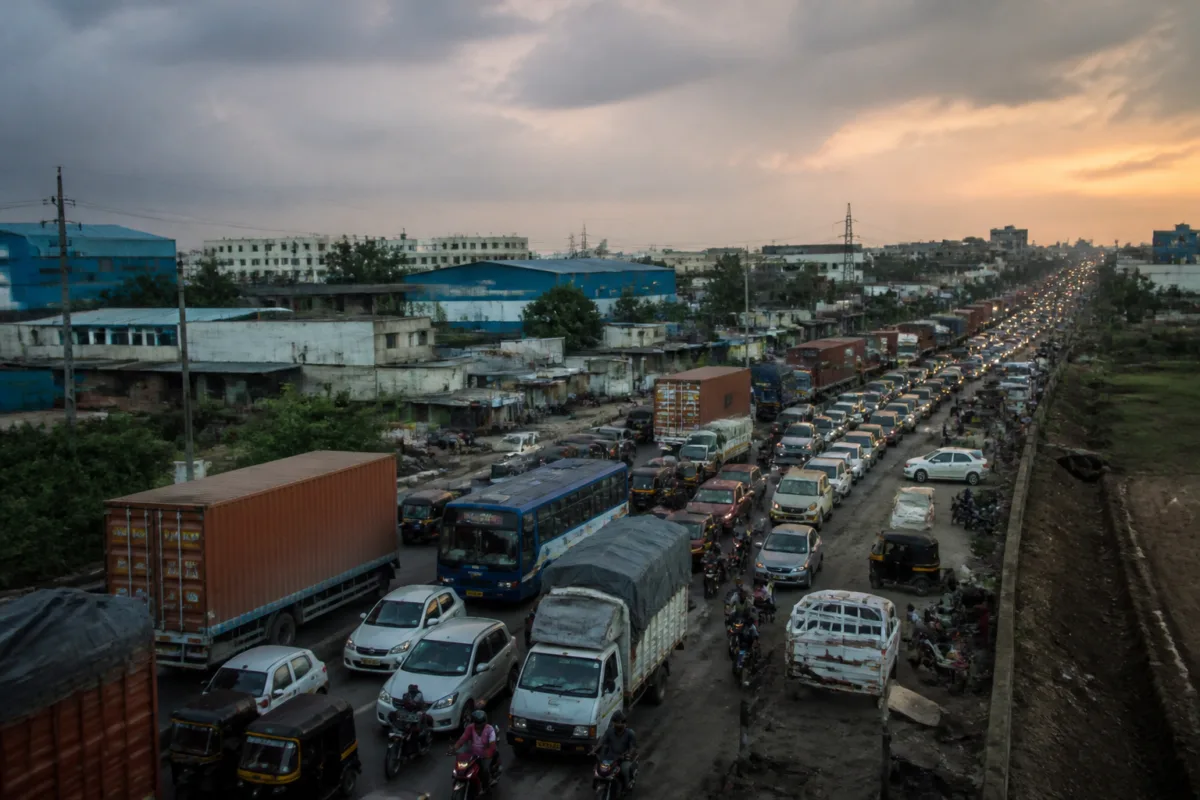
Chakan traffic congestion has become more than a recurring inconvenience for commuters. It is now exposing a structural mismatch between the rapid expansion of Pune’s industrial belt and the road network expected to carry workers, freight, school traffic, private vehicles and emergency services through it. A report by Lokmat – Pune says vehicle queues stretched for seven to eight kilometres on the Pune–Nashik route after Friday night, with ambulances also caught in the delay.
The immediate problem is visible on the road: long queues, slow-moving heavy vehicles and commuters spending hours to cover relatively short distances. The deeper issue is institutional. Chakan, Talegaon and the corridor towards Shikrapur have grown as connected industrial and urban systems, while several roads and junctions continue to operate with capacity shaped by an earlier phase of development.
That distinction matters. Traffic congestion is often treated as a local traffic-management problem, to be addressed through pothole repairs, encroachment removal or temporary diversions. The evidence cited in the report suggests that Chakan’s pressures are broader. Industrial land use, residential growth, freight movement and daily commuting have expanded together, but the supporting road hierarchy, junction design and public transport management have not kept pace.
The corridor’s importance is linked to the concentration of economic activity around it. The Chakan industrial estate has expanded, industries in Talegaon MIDC have grown, and urbanisation has increased the number of people travelling through or settling near the corridor. Heavy vehicles serving factories move alongside buses, two-wheelers, private cars and autorickshaws. This creates a road environment in which traffic is not only high in volume but also mixed in speed, size and purpose.
According to figures cited by Lokmat – Pune, the Talegaon–Chakan–Shikrapur section of National Highway 548D carried approximately 12,000 to 15,000 passenger car units, or PCUs, a day around 2016. The report says the available 2026 figures place daily traffic between 39,197 and 40,839 PCUs. On that account, the traffic load has more than doubled over the decade, and at some points is close to three times the earlier level.
The Pune–Nashik route shows a similar pattern. The report cites 2016 traffic of roughly 25,000 to 30,000 PCUs a day between Bhosari, Moshi and Rajgurunagar. In 2026, traffic on some sections between Nashik Phata and Chakan is reported to have reached 75,000 to 85,000 PCUs a day. These figures are presented as corridor-level indicators rather than a uniform measurement for every road segment, but they point to a clear capacity challenge: demand has increased sharply while road expansion has not matched the pace of use.
PCU is useful because it converts different vehicle types into a common measure of road pressure. A truck, bus, car and two-wheeler occupy different amounts of road space and affect traffic flow differently. Converting them into PCUs helps planners compare mixed traffic with the effective carrying capacity of a road. However, a high PCU count alone does not explain every bottleneck. Junction geometry, roadside activity, turning movements, lane discipline, loading activity, public transport stops and pedestrian crossings can all reduce the practical capacity of a corridor.
The Chakan experience described in the report reflects this interaction between network-wide growth and local obstruction. The roads carry large numbers of trucks and containers, but they also pass through junctions and built-up areas where informal activity competes for road space. Unauthorised autorickshaw stands at Talegaon Chowk and Ambethan Chowk are identified as contributing to delays. The growing number of autorickshaws and the absence of clearly managed stands add friction at precisely the points where vehicles need to merge, turn or pass through.
This is why removing encroachments, while necessary, cannot by itself resolve the problem. Such action may restore some usable road space, but it does not create additional capacity for a corridor whose traffic volumes have risen substantially. Nor does it settle the question of how freight vehicles should be timed, where public transport should stop, how junctions should be redesigned or which alternative routes can absorb traffic during incidents and peak periods.
The report says some encroachments have already been removed in the Chakan area. Yet the required widening of roads has not taken place in proportion to the rise in vehicles. The result is a familiar pattern in fast-growing industrial regions: short-term road maintenance is completed, but the transport system remains vulnerable because the underlying network has not been redesigned for its present economic role.
The human cost is distributed across different groups. Industrial workers face difficulties reaching factories on time and returning home after shifts. Students and schoolchildren are affected by slow or unpredictable journeys. Private vehicle users lose time and fuel, while freight delays can disrupt factory-linked movement. The reported obstruction of ambulances is particularly important because it converts congestion from an efficiency problem into a public safety concern. When an ambulance cannot move through a corridor, the consequences are not limited to inconvenience or commercial delay.
The administrative response described in the report also reveals the difference between a deadline for repairs and a plan for transport capacity. In August 2026, Deputy Chief Minister Eknath Shinde and Industries Minister Uday Samant visited the area after concerns were raised about traffic and infrastructure. The report says that the district administration set August 31 as the deadline for filling potholes, carrying out temporary repairs and removing obstacles on highways and adjoining roads.
Those measures address the immediate condition of the road. They do not, by themselves, answer the larger planning questions. Which agency is responsible for widening each section? How will land acquisition and funding be handled? Which junctions require grade separation, redesign or signal coordination? How will heavy vehicles be managed without shifting congestion into residential streets? Where will authorised autorickshaw stands be located? The report records these needs, but does not establish that a fully funded and time-bound programme covering them is in place.
This institutional uncertainty is central to the Chakan problem. Industrial corridors commonly involve multiple authorities responsible for national highways, state roads, municipal streets, industrial estates, traffic enforcement and public transport. When a corridor functions as one economic system but is administered through separate agencies, interventions can become fragmented. A pothole may be repaired by one authority while a junction remains poorly designed, a freight movement pattern goes unmanaged and roadside activity continues to reduce capacity.
The same fragmentation affects accountability. Residents experience one continuous traffic jam, but departments may measure separate road sections, issue separate work orders and operate on different timelines. For commuters and ambulance operators, the distinction between a highway, an industrial road and a municipal approach road is irrelevant when a bottleneck in one section blocks the entire journey. The urban system therefore needs corridor-level planning even when responsibilities remain divided.
The data reported for Chakan also raises a question about how industrial development is evaluated. Expansion is generally measured through factories, investment, employment and land use. But industrial growth creates secondary infrastructure demand: worker travel, freight access, housing, school movement, emergency response and service delivery. If these requirements are not planned alongside industrial capacity, the road becomes the point where economic growth is physically constrained.
The concern that industries could relocate because of poor infrastructure, mentioned in the report, is presented as a concern rather than an established outcome. What is established is that businesses, workers and residents are already paying the daily cost of unreliable movement. The corridor’s competitiveness is therefore tied not only to factory space or connectivity on paper, but also to the time and predictability required to reach that space.
The immediate traffic queues provide the most visible evidence, but the longer-term pattern is more significant. Between the reported 2016 and 2026 figures, traffic on the relevant sections increased sharply. During the same period, Chakan and nearby industrial areas continued to attract economic activity and urban settlement. If road capacity, junction management and freight planning remain unchanged, recurring congestion will continue to be treated as an incident even though it is a predictable outcome of the corridor’s current structure.
What remains unclear from the available report is the precise status of proposed widening works, alternative routes, junction upgrades and funding commitments. The report establishes the scale of the reported congestion, the traffic growth figures cited by the publication, the effect on commuters and ambulances, and the expiry of a short-term administrative deadline. It does not establish whether a comprehensive, coordinated implementation schedule has been approved.
That gap is the larger urban question. Chakan’s roads are carrying the consequences of industrial policy, regional urbanisation and freight dependence without a clearly visible equivalent expansion of public infrastructure. Permanent relief will require more than repairing damaged surfaces. It will depend on whether the authorities can align road capacity, land-use growth, freight operations, junction design, public transport and emergency access across the entire industrial corridor. Until then, the seven- to eight-kilometre queue will remain a symptom of a wider planning failure rather than an isolated traffic event.

