


A woman in Rajasthan who was declared murdered seven years ago was recently found alive. A man in Jhunjhunu was taken to a cremation ground after doctors declared him dead, only for signs of life to be noticed before the funeral began. In Agra, police arrived at a family’s home to report a death and found the supposedly dead man having tea with his wife. These cases appear extraordinary, but together they expose a more routine and consequential question: how reliably do hospitals and public authorities establish identity, confirm death and communicate that decision to families?
The incidents reported across Rajasthan, Uttar Pradesh, West Bengal and Maharashtra are not identical. Some involve apparent clerical mistakes, some involve a person showing signs of life after resuscitation efforts, and one concerns a woman whose identity was wrongly attached to an unidentified body. Treating them as one medical phenomenon would obscure the institutional differences between them. Yet they share a common point of failure: the systems expected to create an unbroken record of a person’s condition and identity did not operate consistently.
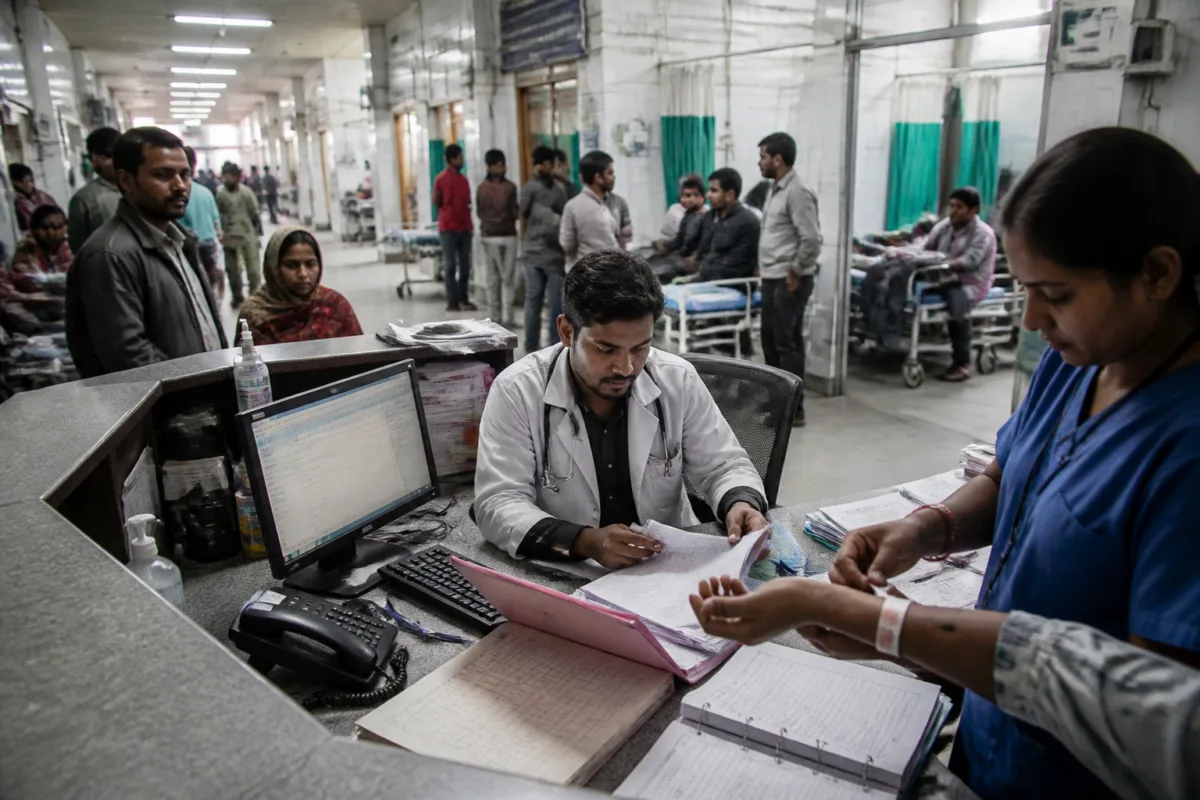
That record begins when a patient enters a hospital or emergency department. It includes registration details, clinical observations, treatment notes, identification marks, communication with relatives, the declaration of death, documentation, movement to a mortuary and, where necessary, release of the body to the family or authorities. Each step is meant to reduce uncertainty. When one step is skipped or incorrectly recorded, an error can move through the entire chain with the appearance of official certainty.
The Rajasthan case involving Aarti demonstrates the most damaging version of an identification failure. According to the report, Aarti disappeared after marrying Sonu in 2015. Police in Uttar Pradesh later found the body of an unidentified woman in a canal in Mathura. No post-mortem examination was conducted, and the body was cremated. After Aarti’s father identified photographs and clothing as belonging to his daughter, two men were arrested and served imprisonment in connection with the alleged murder. The recent discovery of Aarti alive has therefore raised questions not only about the original identification but also about the investigation and prosecution that followed.
This case is different from a hospital error, but it reveals why identity verification cannot be treated as a minor administrative task. A photograph, clothing, a family member’s recognition and police records may each appear persuasive in isolation. They do not necessarily establish identity with certainty, particularly when the body is unidentified and a post-mortem examination has not taken place. The reported consequences extended beyond a family’s grief: two people were imprisoned in a case whose foundation has now been undermined.
The Jhunjhunu incident shows another point of vulnerability. Rohitash Kumar, a 25-year-old deaf and mute man living in a shelter home, was taken to BDK Hospital after his health deteriorated. Doctors reportedly declared him dead at about 2pm after he failed to respond to treatment. His body was moved to the mortuary, the necessary documentation was completed and police transported it to a cremation ground. Signs of breathing were noticed only after the body was placed on the funeral pyre. Kumar was taken back to hospital and admitted to intensive care, where officials later said his condition was stable.
The reported administrative response was immediate. The district collector suspended three doctors, an investigative committee was constituted and the medical department secretary was informed. Officials from the revenue and Social Justice departments also visited the hospital. Those steps establish that the episode was treated as a serious institutional failure, but the supplied report does not provide the committee’s findings or explain which specific clinical and documentation procedures were followed before the death declaration.
The Agra case appears, on the available account, to be a clerical failure rather than a delayed recognition of vital signs. Kush Chaurasia was admitted to SN Medical College after a snake bite and was discharged a few hours later. The hospital nevertheless reportedly informed police that he had died. When an officer went to his home, Chaurasia was alive. His wife said the family was having tea when the officer delivered the news. The medical college principal ordered an inquiry, while the police station officer said the incident appeared to involve hospital staff recording the wrong patient’s name.
A wrong name in a hospital record may sound less serious than an incorrect clinical declaration, but its effects can be immediate. It can trigger police notification, create an erroneous death record, cause distress to relatives and complicate the status of another patient whose identity may have been displaced. The inquiry chaired by a medicine department professor was expected to submit a report within two days, but the supplied material does not state whether that report was completed or what corrective measures followed.
The Kolkata case similarly involved a death certificate and an alleged failure to match the record with the person. Sabir Molla had been admitted to Chittaranjan National Medical College Hospital after chest pain. His family was told that he had died and went to the morgue the next morning. Molla was later found alive inside the hospital after calling out to a relative from a bathroom in another building. The family alleged that the hospital had earlier refused to hand over the body because of a positive Covid test. Hospital authorities initiated an inquiry, and Molla was discharged later that morning.
The report does not establish whether the death certificate was issued for Molla or for another patient, nor does it provide the outcome of the inquiry. That uncertainty is itself significant. A death certificate is not merely a hospital form. It can activate legal, financial, police and family processes, including the release of a body, insurance claims, inheritance procedures and changes to government records. The more consequential the document, the stronger the need for traceable verification before it is issued.
The Siddharthnagar incident demonstrates a different breakdown: the family believed that Akram had died after suffering a severe heart attack in Mumbai, although the report says he had been referred for further treatment rather than declared dead by the hospital. Preparations for burial began in his village. When the ambulance arrived, residents noticed possible signs of life, and a doctor later confirmed that he was alive. Akram was taken to hospitals in the area and died during treatment, according to a villager quoted in the report.
This case shows why communication between hospitals, families, ambulance operators and distant relatives can become critical during medical emergencies. The available account does not clarify who communicated the death or how the misunderstanding began. It does, however, show how an incomplete or inaccurate message can travel across cities and become a funeral arrangement before a doctor in the receiving village has examined the patient.
The Beed case introduces a medical explanation that should not be conflated with identity errors. A newborn delivered after 27 weeks of pregnancy was declared dead at a government hospital in Ambajogai but was found alive 24 hours later and placed on ventilator support. Doctors described the event as involving Lazarus syndrome, in which signs of life may appear after unsuccessful resuscitation, and suspended animation, in which vital functions may temporarily cease. The baby later died from cardiopulmonary arrest. A five-member committee was formed, but its report was still awaited when the source article was published.
The distinction matters because a patient who shows signs of life after resuscitation and a patient whose identity is recorded incorrectly require different investigations. The first raises questions about clinical observation, resuscitation protocols and the timing of a death declaration. The second concerns registration, identification and information systems. A single broad explanation such as “medical negligence” cannot answer both.
What the cases do establish is the need to examine the institutional chain around death, rather than focusing only on the moment when a person was declared dead. The supplied reports mention suspensions, inquiries, police involvement and administrative visits, but they do not show whether hospitals routinely reconcile patient identifiers across departments, document the examination preceding death certification, verify bodies before release or audit errors after they occur. Nor do they establish whether these incidents represent a measurable national trend. The evidence supports scrutiny of procedures, not a statistical conclusion about how frequently such failures occur.
For citizens, the practical risk lies in the authority attached to hospital and police records. Families generally cannot independently assess a clinical declaration, challenge a mortuary identification or reconstruct the movement of a record through several departments. This imbalance makes institutional safeguards essential, particularly for patients without family support, people who are unable to communicate and unidentified bodies. Kumar’s case, involving a deaf and mute man living in a shelter home, illustrates how vulnerability can increase when no close relative is present to question a declaration immediately.
The next stage in each case is therefore not simply punishment or public reassurance. It is the production of documented findings: what happened, which record was created, who verified it, when the error was detected and whether the system has been changed. The Jhunjhunu, Agra, Kolkata and Beed inquiries were reported as underway or pending, while the Rajasthan case requires clarification of the original identification and criminal proceedings. Until those findings are available, the incidents confirm serious failures or alleged failures in different parts of the death-certification and identification chain, but they do not justify treating every case as proof of the same cause.

