


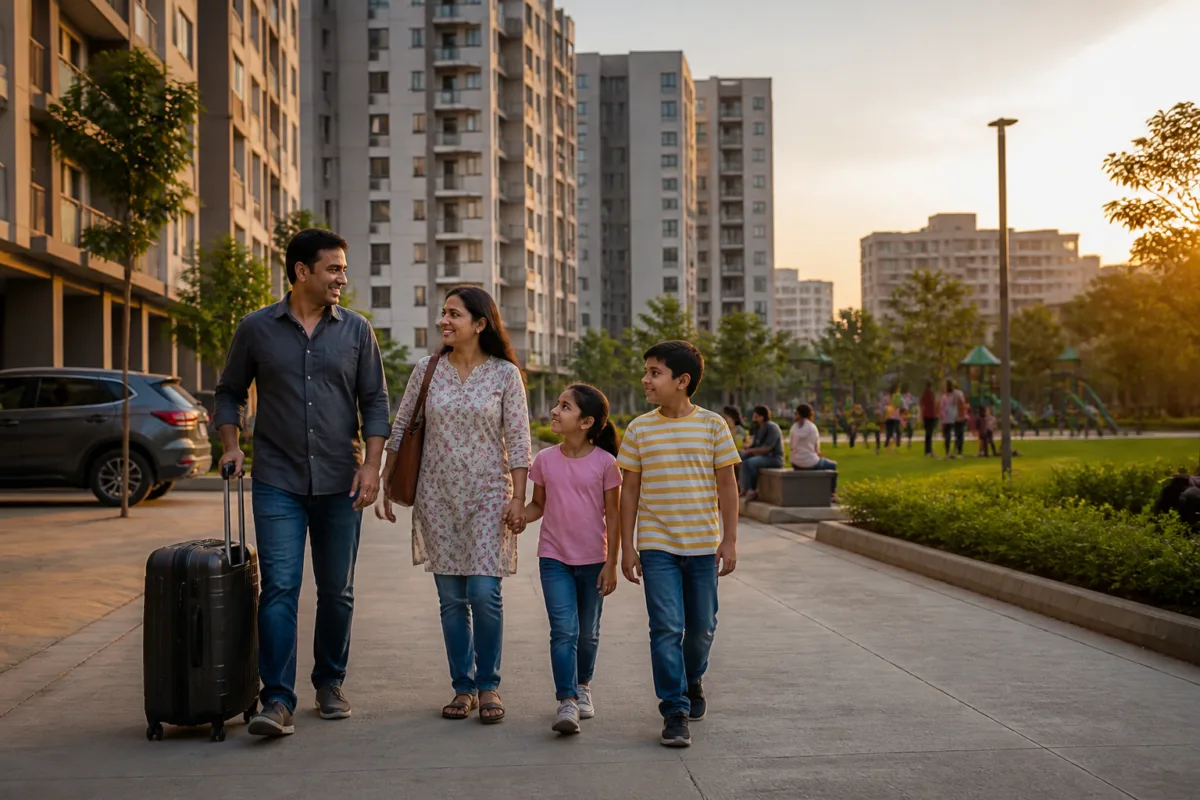
Ahmedabad is becoming a destination for professionals who once expected to build permanent lives in the United States. Their return is not being driven by a single policy announcement or one economic incentive. It is emerging from the interaction of long green-card queues, uncertain visa rules, ageing parents, children’s schooling, family networks and the belief that India now offers enough professional opportunity to make the move viable.
The experiences of several returnees reported by The Times of India show that this is not simply a story about immigration. It is also a story about how people choose cities. Decisions that were once framed around salaries and access to global careers are increasingly being weighed against housing, childcare, family support, social life, schooling, taxation and the ability to take professional risks without immigration status determining every major choice.
That does not establish a citywide reverse migration trend. The evidence supplied consists primarily of interviews with returnees and a tax adviser’s account of increased inquiries. But it does reveal the range of urban conditions that can influence highly skilled migrants when the promise of permanent settlement abroad becomes uncertain.
The American career path has long involved two separate milestones: entering the country for work and securing the right to remain there permanently. For Indian professionals, the second step can take substantially longer. The report cites the US H-1B programme’s annual worldwide ceiling of 85,000 visas and the country-specific limits affecting employment-based green cards. It also cites the US State Department’s November 2026 Visa Bulletin, which listed final action dates of November 1, 2013, for Indian applicants in the EB-2 category and January 22, 2014, for EB-3.
Those dates help explain why a professional can spend years building a career in the United States without having a clear settlement timeline. The uncertainty is not limited to the final application. It can affect decisions about changing jobs, starting businesses, buying homes, planning children’s education and bringing parents into a long-term family arrangement.
The report also places these individual decisions against a more restrictive US policy environment. It says the Trump administration introduced wage-weighted H-1B selection and announced a suspension of green-card labour-certification processing involving eight major technology companies in October 2026. A $100,000 fee imposed on certain new H-1B petitions in September 2025 remains blocked by federal courts, despite an extension until September 2027. These developments are reported as part of the uncertainty surrounding the immigration pathway, rather than as the sole reason for every return.
For Ketul Surati, the decisive issue was the absence of clarity. After nearly a decade in the United States, where he rose to vice-president at a global financial services multinational, he returned to Ahmedabad with his wife and three-year-old daughter in December 2025. He now works for an IT multinational in India and lives in Shantigram.
Surati said frequent changes in policies and rules made it difficult to judge whether remaining in the United States would be worthwhile. The decision was therefore not a rejection of the professional value of his American experience. He described that experience as important for exposure to global practices and career growth. But the green-card uncertainty changed the calculation of what came next.
His account also shows how housing and family geography enter the decision. Annual visits to Ahmedabad could not substitute for living near relatives. He wanted his daughter to grow up around the culture and family relationships he associated with India’s joint-family system. Saloni, who worked in talent sourcing and recruitment in the United States, has paused her career after the move. The family’s settlement in Shantigram illustrates how returning professionals are not only re-entering an employment market; they are re-establishing themselves within Ahmedabad’s residential and social infrastructure.
Tejas Patel made a more definitive immigration choice. After moving to the United States in 2010 and building an IT career, he returned to Ahmedabad in June 2026 after withdrawing his green-card application. He said quality of life, proximity to parents, social connections and the availability of household help shaped the decision. His children moved while they were still young and adjusted to a new school and environment.
Patel’s experience also demonstrates that returning can create a different kind of administrative vulnerability. He said an older PAN card and a later PAN issued in his name created difficulties with KYC procedures, opening accounts and accessing investments. The problem is a reminder that cross-border mobility does not end when a person boards a flight home. Returning professionals may have to reconcile financial identities, tax records, investments and documentation accumulated across two jurisdictions.
Samar Oza returned after his father suffered a heart attack. He had moved to the United States in 2014, spent around 11 years in the technology sector and eventually became chief product officer at an IT company in Ahmedabad. His decision was also influenced by the age of his children, as he wanted them to settle before starting school.
Oza’s account places immigration status directly against professional risk. He said an H-1B worker who loses a job and cannot find another within 60 days must leave the United States. In his view, that pressure can make people less willing to take career risks because their family’s future is tied to a visa. Returning to India, by contrast, has given him greater freedom to consider professional opportunities without the same immediate immigration consequence.
His family’s experience also brings gender and labour-market questions into the picture. His wife, Arya Desai, had worked at a refinery in Gujarat before marriage but could not work in the United States because she did not have a work permit. After returning, she began considering work again and taught Bharatanatyam at a school before taking a break. The move therefore changed not only the principal earner’s location but also the range of work available to another adult in the household.
The professional decision is being supported by changes in Ahmedabad’s economic base. Pranav Shah, who became a US citizen after moving there in 2000, returned to Ahmedabad three years ago to be closer to his parents while continuing to work remotely as an SAP consultant for the same US company. He said India now offers significant opportunity, while the city’s expanding global capability centres are creating new possibilities.
Parth Desai’s return presents a different route. After studying chip design and working in Silicon Valley, he came back to Ahmedabad because of family business opportunities and his fiancée’s decision to remain in India. He said American exposure to global professional standards helped him contribute more effectively to local organisations. In this case, return was not simply a response to difficulty abroad; it was a decision to apply international experience within an Ahmedabad-based business environment.
These accounts suggest that Ahmedabad’s attraction depends on a combination of inherited and emerging advantages. Family proximity and social networks are longstanding strengths. The newer element is the possibility of using international experience in India’s technology, manufacturing, business-services and professional sectors. The city can appeal to returnees when its economic opportunities are sufficiently credible to offset a reduction in foreign pay.
The salary comparison remains important. Surati said his pay package changed significantly after returning but that he had achieved what he considered reasonable pay parity. That statement should not be treated as evidence that all returnees can reproduce US incomes in India. It does show that the decision is being made through a broader household calculation, in which income is weighed against childcare, social support, family access, career stability and the cost of living.
Taxation is one of the clearest institutional complications. CA Rinkesh Shah, chairman of the ICAI Ahmedabad branch and an adviser on NRI taxation, said inquiries from Indians seeking to return from the United States had risen by about 20%. He said most were IT professionals on H-1B visas uncertain about green-card timelines. Their questions covered the effect of changing residential status on US salaries, business earnings, rental income and retirement benefits.
The same returnees may hold American stocks, mutual funds, exchange-traded funds, bonds, property and retirement accounts. Their transition therefore requires more than finding a job and a home. It involves understanding the India-US Double Taxation Avoidance Agreement, foreign tax credits and cross-border reporting obligations. The tax adviser’s comments indicate that the city’s professional ecosystem is also responding through specialised advisory demand.
Housing is part of that ecosystem, even when it is not the headline issue. Surati lives in Shantigram, Oza is also identified with the development, and Patel lives in Ambli. Their accounts connect migration decisions to specific residential locations, school access, family proximity and the everyday services available in Ahmedabad’s expanding urban areas. Oza said he now helps others considering the move with practical questions about where to live and which schools to choose.
That is a significant shift in the way global mobility is organised. Earlier migration decisions often moved households towards a foreign city through employers and visa systems. Return migration requires households to rebuild the same network in reverse: employment, housing, schooling, financial documentation, healthcare, family support and social relationships. The city that can make those connections easier becomes more attractive, even without offering the highest salary.
The evidence also contains important qualifications. Returnees continue to value aspects of American life, including respect for law and order, work culture and professional standards. Several do not describe their years abroad as a mistake. Nor does the report establish that immigration restrictions alone are causing a broad-based return to Ahmedabad. Some individuals returned because of parents, marriage, business opportunities or a desire to raise children near extended family. In other cases, the United States remains part of the family’s future, with children interested in higher studies there or professionals continuing to work for American companies.
The larger urban question is whether Ahmedabad can convert these personal returns into durable economic and social value. The reported experiences point to the importance of high-quality employment, internationally connected companies, reliable housing options, schools, financial services and administrative systems capable of handling cross-border lives. They also show that a city’s competitiveness is not measured only by office space or salary packages. It is measured by whether households can build a stable daily life around work.
For now, the evidence confirms a visible set of return decisions and rising professional inquiries, not a quantified migration reversal. What deserves monitoring is whether more returnees find sustained employment, whether Ahmedabad’s global capability and technology sectors absorb their skills, and whether the city’s housing, schooling, taxation and documentation systems can support families whose careers remain divided between India and the United States.

