


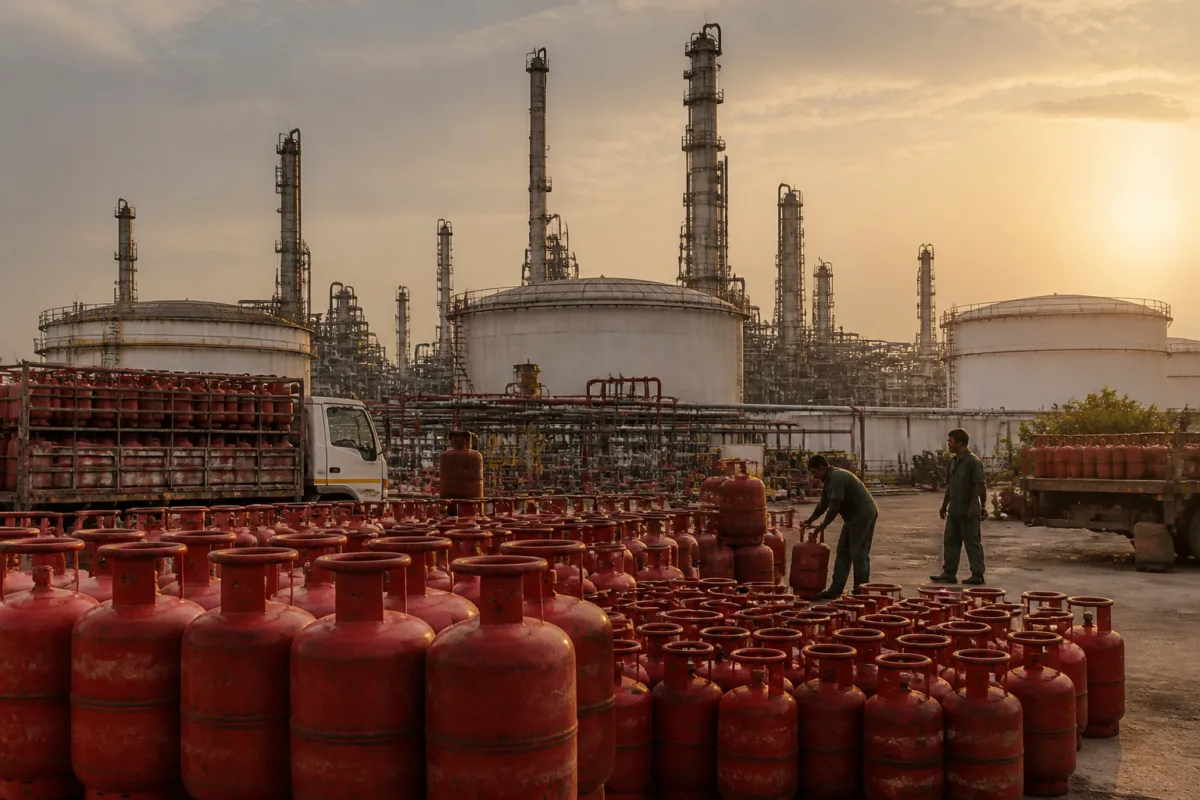
India’s three largest state-run fuel retailers posted a sharp rebound in quarterly profits, but the numbers reveal a more difficult reality beneath the headline recovery: refining gains are being used to absorb losses created by frozen retail fuel prices and delayed compensation for subsidised cooking gas. The resulting financial imbalance places Indian Oil Corporation, Bharat Petroleum Corporation and Hindustan Petroleum Corporation at the centre of a wider policy question about who ultimately pays for keeping essential energy affordable.
The three companies reported a combined standalone net profit of Rs 30,106 crore for the July-September quarter, according to company filings cited by Business Standard. The figure was 68.3 per cent higher than their combined earnings in the same quarter a year earlier and represented nearly 39 per cent of their combined FY26 profit of Rs 77,281 crore. It also marked a substantial reversal from their combined loss of about Rs 18,150 crore in the April-June quarter.
That reversal was driven mainly by improved refining margins and inventory gains rather than by a healthier fuel-retailing business. Petrol and diesel prices had remained unchanged since May, while domestic LPG prices had not changed since March, even as benchmark prices and crude oil input costs moved higher. The companies therefore earned strongly in some parts of their operations while accumulating losses in others.
The distinction matters because these companies are not only commercial enterprises. They are also key delivery mechanisms for fuel and cooking gas used by households, transport operators, businesses and public services. Their financial statements consequently provide a view of how price controls, subsidy obligations and international commodity movements are being managed through public-sector balance sheets.
The LPG subsidy burden is the clearest pressure point. IOC Director (Finance) Anuj Jain said during an investor call that losses on LPG stood at Rs 184 per cylinder in September. The figure rose to Rs 229 in October and was expected to reach Rs 309 in November and Rs 370 in December, according to the comments reported by Business Standard.
LPG remains a regulated commodity in the account presented by the companies, with the government expected to compensate retailers for the gap between the retail price and the actual cost. However, the payments had not arrived on time, leaving the three companies with combined fuel under-recoveries of Rs 67,900 crore at the end of September. IOC accounted for Rs 32,505.69 crore, BPCL for Rs 17,334.40 crore and HPCL for Rs 18,048.82 crore.
This is more than an accounting detail. Under-recovery is the financial expression of a policy choice: the consumer price is kept below the cost implied by international markets, while the resulting difference is carried by the fuel companies until compensation is received. If that compensation is delayed, the companies must finance the gap through their own balance sheets. The immediate retail price may remain stable, but the cost has not disappeared. It has shifted across the energy system.
The same tension is visible in petrol and diesel, although the mechanism is different. The companies were losing Rs 4-5 a litre on petrol and Rs 18-20 on diesel until last month, according to industry sources cited in the report. Unlike LPG, petrol and diesel are described as deregulated, meaning the losses are borne by the companies rather than automatically reimbursed by the government.
The result is a business model in which the companies’ overall profitability depends heavily on whether gains from refining, petrochemicals, gas and inventory movements can offset losses in retail fuel operations. This makes quarterly earnings highly sensitive to the timing of crude purchases, changes in international product prices and domestic price decisions.
The September-quarter results illustrate that unevenness. IOC reported a standalone net profit of Rs 21,630 crore, its highest-ever quarterly profit and almost three times the Rs 7,610 crore recorded a year earlier. The result represented nearly 59 per cent of IOC’s full-year FY26 profit of Rs 36,802 crore. BPCL’s standalone net profit, however, fell 22.5 per cent year-on-year to Rs 4,993 crore, while HPCL’s profit declined 9 per cent to Rs 3,483 crore.
The different outcomes show that the three companies were not equally positioned to benefit from the same market conditions. IOC attributed its performance to improved refining margins and stronger contributions from its petrochemical and gas businesses. A temporary decline in crude oil prices between mid-June and mid-August also lowered feedstock costs and generated an inventory gain of about Rs 7,000 crore for IOC.
Refining margins improved sharply for the other two companies as well. HPCL earned a gross refining margin of USD 32.15 per barrel in the September quarter, compared with USD 8.80 a barrel a year earlier. BPCL’s gross refining margin rose to USD 32.53 per barrel from USD 10.78. These figures show why refining performance was able to lift quarterly earnings even as fuel retailing remained under pressure.
Yet refining gains are not the same as a permanent solution to regulated-price losses. They depend on market conditions and can reverse when crude prices or product margins change. IOC itself cautioned that profitability in upcoming quarters could be adversely affected by inventory losses if crude oil prices fall as the situation in the Middle East normalises. That warning underlines the temporary nature of one part of the current recovery.
The companies’ first-quarter losses provide the other side of the cycle. During that period, crude prices rose above USD 100 a barrel amid the West Asia conflict, while retail fuel prices were slow to adjust. The subsequent easing of oil prices and improvement in refining economics during the second quarter helped restore profitability, but the report describes the recovery as uneven. Oil prices firmed again in October, creating another source of uncertainty for the companies.
For urban India, the financial structure has practical consequences even when consumers do not see an immediate change at the pump or on an LPG invoice. Petrol and diesel prices influence the operating costs of buses, taxis, delivery fleets, construction equipment and goods transport. LPG prices affect household cooking budgets as well as restaurants, small food businesses and other enterprises that rely on commercial or domestic cylinders. The supplied report does not quantify the direct effect on any of these users, but it establishes the policy mechanism through which price stability is being maintained.
The central institutional question is whether state-run fuel retailers are being asked to serve two objectives at once: operate as commercial companies and implement a price policy that shields consumers from international volatility. The September results show that these objectives can coexist during periods of strong refining margins. They also show that the arrangement becomes vulnerable when crude prices rise, retail prices remain frozen or compensation payments are delayed.
The subsidy system therefore depends not only on the announced retail price but also on the timing and certainty of government reimbursement. A delayed payment increases the companies’ accumulated under-recoveries. A favourable refining cycle can conceal that pressure in the profit and loss account, while a weaker cycle can expose it quickly. This makes reported profitability an incomplete measure of the financial health of the public fuel-delivery system.
The available figures also point to a concentration of risk. IOC’s record quarter contributed the bulk of the combined earnings, while BPCL and HPCL recorded lower profits despite significant improvements in refining margins. The three companies’ exposure to retail fuel pricing, LPG compensation and international markets is therefore not identical, even though they operate within the same broad policy environment.
What the evidence confirms is a strong second-quarter earnings rebound supported by refining margins, lower crude costs during part of the period and inventory gains. It also confirms that the companies carried substantial fuel under-recoveries and faced sharply rising LPG losses per cylinder. What remains unclear from the supplied material is when the accumulated LPG compensation will be paid, how the government will address the Rs 67,900 crore in reported under-recoveries, and how the companies’ earnings will perform if refining margins weaken.
Those developments will determine whether the September quarter represents a durable improvement or a temporary financial release. The next signals will come from movements in crude prices, refining margins, domestic fuel prices and the settlement of the companies’ unpaid subsidy claims.

