


Pune’s noise pollution data from the Ganesh festival was supposed to help authorities identify violations while they were happening. Instead, more than a month after the festival ended, the Maharashtra Pollution Control Board had still not released detailed readings from the 200 locations where monitoring was undertaken, according to a report by Lokmat – Pune. The delay turns a potentially useful enforcement system into a retrospective paperwork exercise.
The issue is not simply that a dataset has arrived late. It is that the value of noise monitoring depends heavily on when the information becomes available. During a major public festival, sound levels change by location and time. Residents, enforcement agencies and pollution-control authorities need information while the activity is taking place if excessive noise is to be reduced, responsibility assigned and violations acted upon. Once the festival is over, the same data may document what happened, but it cannot provide the same immediate protection to residents.
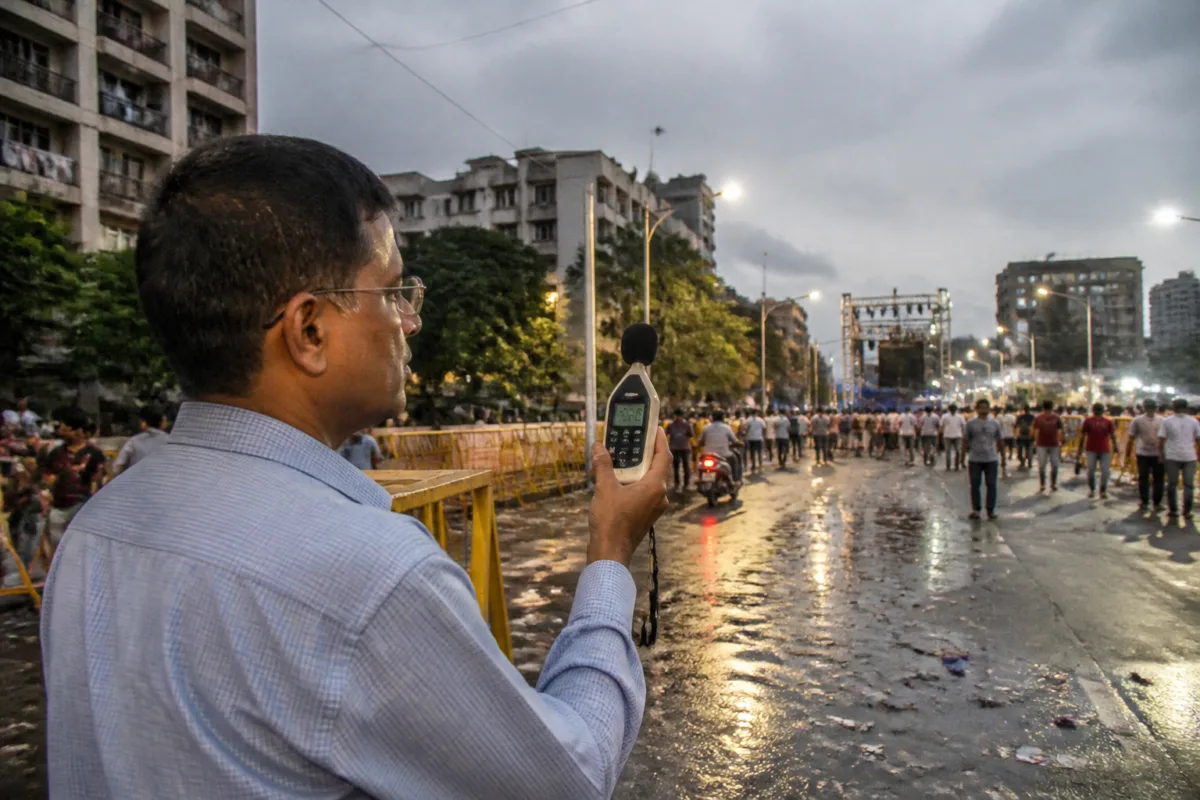
Lokmat – Pune reported that the MPCB was responsible for measuring noise levels during the Ganesh festival. Monitoring was carried out at 200 locations using decibel meters. The plan, as described in the report, was to measure sound levels each day between 6 pm and midnight, identify instances in which prescribed limits were exceeded, first instruct organisers or other responsible parties to reduce the volume, and involve the police if violations continued.
However, when asked for the detailed figures, the MPCB reportedly said that the information had not yet been received. The report said that the board had published only a consolidated summary report. That summary acknowledged that noise limits had been exceeded at different locations, but did not, according to the report, make clear which organisers or venues faced criminal complaints or what enforcement action followed.
This creates a basic accountability problem. A monitoring programme has three distinct stages: measurement, disclosure and enforcement. Public agencies may complete the first stage without completing the other two. If measurements are taken but detailed results are not released, citizens cannot independently understand where violations occurred. If violations are acknowledged but action is not identified, the monitoring exercise does not establish whether the rules had practical consequences.
The gap is especially important because the report places the Pune episode against directions from the Bombay High Court. During the festival period, the court had reportedly taken note of shortcomings in the enforcement of noise-pollution rules and initiated a suo motu proceeding. The court’s directions, as described by Lokmat – Pune, called for real-time measurement of noise levels and immediate criminal action when rules were breached.
The significance of those directions lies in the connection between evidence and intervention. Real-time monitoring is not only a technical requirement. It is an administrative design choice. It determines whether an authority can respond to a violation while it is occurring, whether the police receive actionable information, and whether residents can see that complaints are being treated as evidence rather than as isolated grievances.
The report also indicates that the MPCB publicly presented the monitoring exercise as a special campaign. Measurements were to be taken at 200 locations, and the initiative received public attention before and during the festival. A campaign of this scale creates an expectation that the resulting information will be available in a form that citizens can understand. At a minimum, that would mean identifying the monitoring locations, dates and time periods, recorded sound levels, applicable limits and action taken where limits were exceeded.
The absence of such detail leaves several questions unanswered. The supplied report does not establish how many of the 200 locations recorded violations, how frequently limits were crossed, which areas recorded the highest readings, whether breaches were concentrated around particular types of events, or how many cases were referred to the police. It also does not state whether the detailed records exist but have not been published, or whether the compilation of the data itself remains incomplete. These are not minor technical omissions. They determine whether the exercise can be evaluated.
The distinction between a summary and an operational record matters. A summary can indicate that violations occurred across different locations, but it cannot show the distribution, timing or severity of those violations. Without that detail, it is difficult for citizens to assess whether enforcement was selective, consistent or absent. It is also difficult for the regulator to demonstrate that its own process worked as intended.
The timing of disclosure has a direct effect on public trust. The report quotes Milind Kelkar, a Pune resident, as saying that senior citizens, patients and young children faced considerable difficulty because of festival noise. His criticism was that publishing data a month after the festival would not help determine which groups were responsible or what action was taken at the time. The concern reflects a broader feature of environmental regulation: the harm is experienced locally and immediately, while the official response can become distant and delayed.
The report also refers to a representation submitted before the festival by the Loudspeaker-Free Punekar Manch to B. M. Kukde, the MPCB’s Pune regional officer. The group reportedly sought daily publication of noise readings on the board’s website or through newspapers. According to the report, the officer acknowledged the seriousness of the issue and assured the group that action would be taken. The report says that no such publication had occurred by the time of its publication.
This sequence points to a recurring weakness in public monitoring systems: the public is often asked to trust the process without being given timely access to the process’s outputs. In the absence of daily disclosure, citizens cannot know whether a complaint corresponds with a recorded breach, whether a particular location was monitored, or whether enforcement officials were alerted. The result is a system in which the authority retains the information while the affected public receives only a delayed summary.
There is also an institutional coordination question. The MPCB is described as the agency responsible for measuring noise levels, while police action was expected when violations continued after warnings. That arrangement requires clear handover procedures. Measurements must reach the enforcement agency quickly, the responsible parties must be identified, and the outcome must be recorded. The supplied report does not explain whether this chain functioned, where it failed, or whether responsibility for delayed action lay with data collection, reporting or police response.
That uncertainty is precisely why detailed publication matters. Transparency can expose whether the problem is insufficient monitoring, delayed data processing, weak coordination or a reluctance to pursue cases. A consolidated statement cannot answer those questions on its own. Nor can a public announcement that a special campaign was conducted.
The Pune episode also demonstrates why noise should be treated as an urban governance issue rather than only as a festival-management issue. The affected spaces are shared urban environments. Streets, residential areas, hospitals and public gathering places are used simultaneously by different groups with different needs. Regulation therefore depends on predictable standards, accessible measurements and rapid enforcement, not merely on appeals for voluntary restraint.
The report does not provide the detailed readings, the exact legal limits applied at each location, the number of complaints received, or the number of cases registered. It would be inappropriate to infer from the delay alone that no enforcement occurred. The available evidence supports a narrower conclusion: the MPCB had not made the detailed monitoring data available by the time of the report, and the publicly available summary did not, according to the report, establish the full enforcement record.
That distinction is important for accountability. A delayed dataset may eventually reveal that action was taken. But if the data is not published in a timely and location-specific form, residents cannot assess the response when it matters, and the authority cannot demonstrate compliance with the real-time approach described in the court directions.
The next test is therefore not another announcement of monitoring. It is whether the MPCB publishes the detailed records from the 200 locations, identifies the violations recorded, explains the action taken and clarifies how the monitoring and police-enforcement chain operated. Until those elements are available, Pune’s festival noise programme remains more visible as a promise of measurement than as a demonstrable system of enforcement.

