


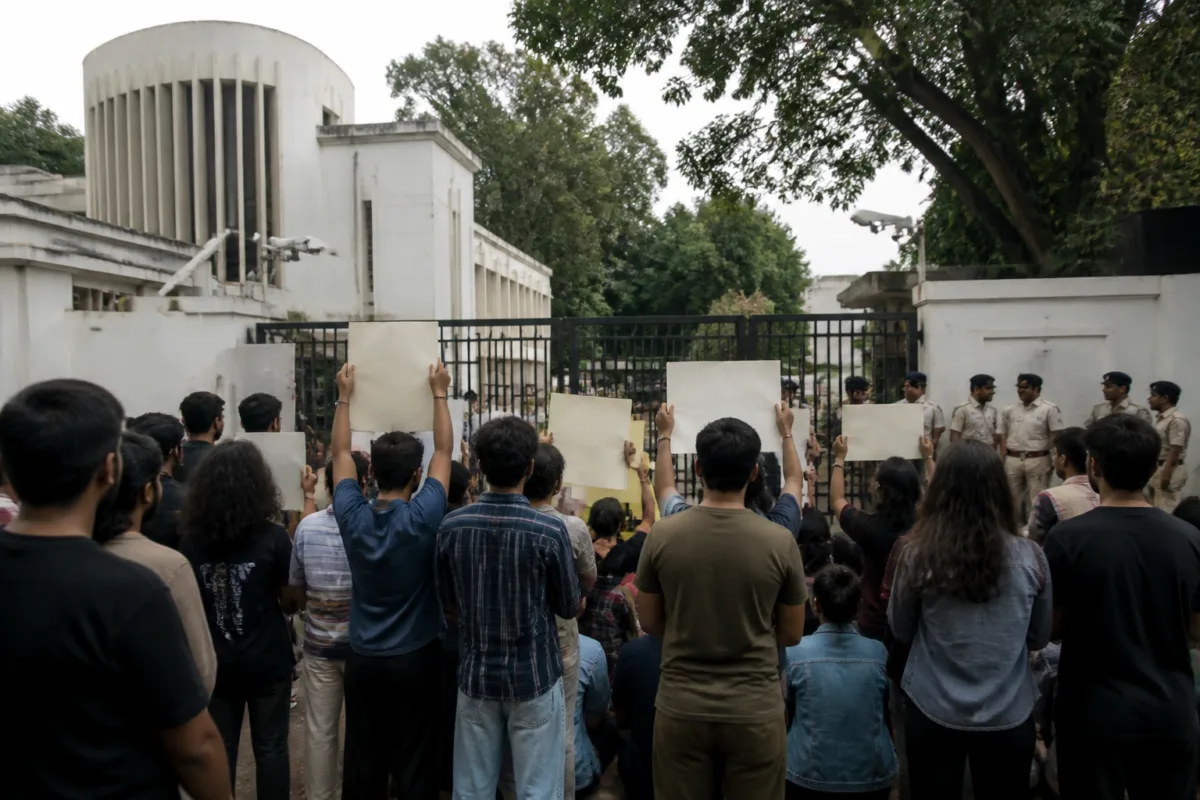
The SRFTI protest has entered its 34th day, but the dispute at Kolkata’s Satyajit Ray Film and Television Institute is no longer confined to a list of student demands. It has become a contest over who controls a public campus, how security is defined after violence, and whether disciplinary systems can retain legitimacy when communication between students and administrators breaks down.
The students’ union is seeking intervention from the Union Ministry of Information and Broadcasting after the September 27 campus violence. Its demands include the withdrawal of police personnel from the campus, the resignation of Vice-Chancellor Santosh Kumar Ajmera, the revocation of disciplinary action, and an independent inquiry into the violence and subsequent institutional decisions. The administration rejects the students’ account and says security measures and disciplinary proceedings were initiated in response to specific incidents.
That divergence is central to understanding the length of the protest. The dispute is not only about what happened during the violence. It is also about how the institute interpreted the events, whose version was recorded, and whether the measures taken afterwards have made the campus safer or more coercive in the eyes of students.
The students’ union has alleged that outsiders assaulted students, faculty members and staff during the September 27 violence. At a press briefing at Kolkata Press Club, union president Blossom Hazarika said the administration had failed to act against those responsible and had not implemented assurances given during initial meetings. The union also criticised the Vice-Chancellor’s first official communication, issued on October 1, saying it portrayed the campus as normal even though students remained traumatised and unable to resume classes.
The administration disputes that account. Registrar Deepak Kumar said the allegation that the institute had failed to address students’ security concerns was “absolutely false and fake”. He said permission for the September 27 event had been granted before Ajmera took charge, and that the Vice-Chancellor later accompanied student representatives and the Dean of Films to meet senior Kolkata Police officials twice.
The competing accounts show how institutional trust has become a practical governance issue. A campus cannot return to normal academic activity simply because physical security arrangements are strengthened. Students and administrators must also agree on what constitutes a threat, which actions require disciplinary response, and how decisions are communicated. In the SRFTI dispute, those questions remain contested.
Security infrastructure has added another layer to the conflict. The students’ union has questioned the installation of CCTV cameras across the campus, arguing that the cameras raise surveillance concerns. It has also referred to an understanding reached during a 17-day strike in 2024, under which the administration was expected to inform students before installing new cameras.
The disagreement reflects a wider problem in institutional campuses: security systems are often introduced as technical responses to incidents, while those affected experience them as changes to the balance of power. Cameras, police deployment and restrictions on gatherings may address immediate risks, but their acceptance depends on consultation, defined rules and clarity about how surveillance material will be used. The source material does not establish the terms of the CCTV installation or whether the 2024 understanding remains formally binding. Those unresolved details are therefore part of the dispute rather than settled facts.
The students’ demands also include the unconditional withdrawal of rustication orders, disciplinary proceedings and show-cause notices, along with an assurance that no further punitive action will be taken. They have alleged that several students facing disciplinary proceedings belong to Dalit and Muslim communities. That allegation requires careful examination through institutional records and an independent process; the supplied report does not establish whether disciplinary action was applied disproportionately.
The institute says six students were rusticated on the recommendations of the Dean’s Council for specific acts of misconduct, including threats, abusive behaviour and intimidation of officials. Kumar also alleged that one student physically assaulted Ajmera. The institute said it had filed First Information Reports over the campus violence, strengthened security arrangements, and provided medical assistance and psychological support to affected students.
These claims point to two different understandings of accountability. For the union, accountability begins with action against those it says were responsible for the September 27 violence and with an inquiry into the administration’s role in permitting an external event. For the institute, accountability includes disciplinary action against students accused of misconduct and protection of officials and residential areas from intimidation, vandalism and unauthorised activity.
The conflict has also expanded beyond the original incident. The union has sought an independent inquiry by the Alumni Association into the violence on September 27 and October 4, permission granted to an RSS-affiliated organisation to hold an event at the institute’s Main Theatre, and the administration’s role in the developments. It has called for a General Council meeting to examine proposed amendments to the institute’s by-laws that would restrict the use of its premises by external organisations unrelated to filmmaking.
This question about external access is significant because institutional premises are not merely neutral venues. Permission to use a theatre or campus space can affect perceptions of institutional autonomy, especially when the event is followed by violence or prolonged disagreement. The institute’s decision-making framework for external organisations, the transparency of permissions and the proposed by-law changes have consequently become part of the governance dispute.
The chronology supplied in the report also reveals how unresolved incidents can compound one another. The September 27 violence was followed by further developments on October 4, a 17-day strike in 2024 was invoked in the debate over CCTV installation, and an unauthorised torch march on October 27 was cited by the institute as a reason for seeking police assistance. Each event has been interpreted through the earlier conflict, making it harder for either side to treat subsequent actions as isolated.
The result is a cycle in which security measures become evidence of administrative hostility for protesters, while protests and unauthorised gatherings become evidence of institutional vulnerability for administrators. Without a trusted process for separating these issues, the campus remains locked in a dispute where every new action reinforces the other side’s case.
The Ministry of Information and Broadcasting’s role is therefore important, not simply because the students have requested intervention, but because the institute’s existing mechanisms have not resolved the conflict after 34 days. The report does not state whether the ministry has accepted the request, ordered an inquiry or issued any direction. That absence is material: the immediate political demand has been made, but the response from the relevant ministry is not established in the supplied evidence.
The institute, meanwhile, says it remains committed to addressing genuine student grievances through dialogue, while insisting that dialogue must be accompanied by institutional discipline and mutual responsibility. Ajmera said faculty members were engaging with students to understand their concerns and expressed hope that dialogue would help restore normal academic activities.
The SRFTI dispute ultimately raises a straightforward institutional question: can a campus recover from violence when security, discipline and communication are handled as separate administrative actions rather than as parts of one accountable process? The available evidence confirms that both sides have taken formal positions, that police assistance and disciplinary measures are in place, and that academic normalcy has not been restored after more than a month of protest. What remains unresolved is how the competing accounts will be independently examined, whether the ministry will intervene, and whether the proposed changes to campus rules will be debated through a process accepted by students, faculty and the administration.

