


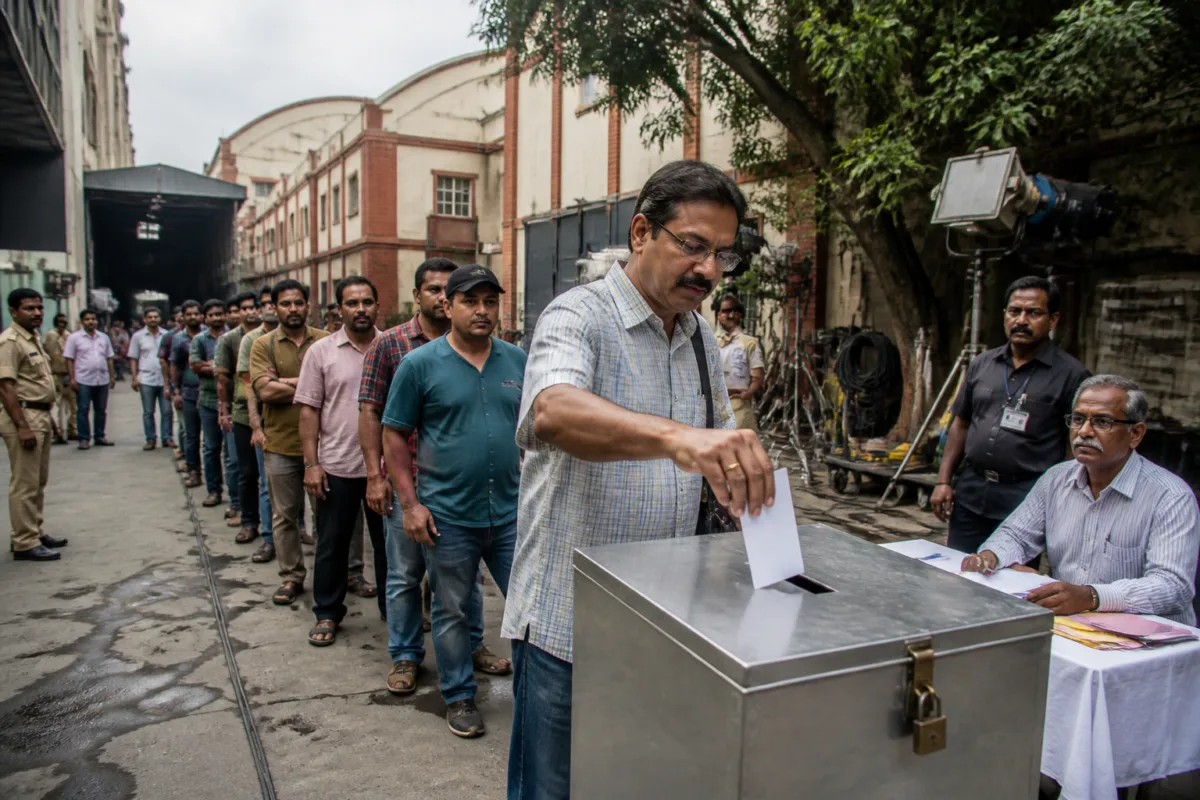
Polling across 23 guilds in Kolkata’s Tollygunge entertainment industry is more than an internal election exercise. It is a test of whether a fragmented production workforce can rebuild a representative system after years of allegations involving political control, restricted access to work and disruption to filmmaking.
The guilds cover the practical workforce that keeps film and television production functioning, including sound, lighting, filmmaking, assistant direction, make-up, hairdressing, dancing and other specialised roles. Their elected representatives will ultimately choose the office-bearers of the federation, the institution that makes key decisions affecting the industry’s functioning.
Twenty-three of the 26 guilds are holding elections over the weekend. Polling is taking place at Technicians Studio, Indrapuri Studio, NT1 Studio and Bharat Laxmi Studio, with police deployed outside two venues. Ballot boxes are being used, while the most closely contested contests include the assistant directors’ guild and the make-up artists’ guild. Around 50 candidates are contesting 13 positions in the assistant directors’ guild, while about 36 candidates are competing for nine positions in the make-up artists’ guild.
The scale and structure of the election matter because guilds are not simply professional associations in the Tollygunge system. They have also functioned as gateways to employment. The report says that guild cards served as accreditation for people seeking to work in the industry, and that several skilled professionals allegedly lost work because they did not possess one. Filmmakers bringing assistant directors from Mumbai also reportedly faced difficulties when those professionals lacked local guild cards.
That makes the election a question of access as much as representation. When a guild controls or influences entry into production work, its rules can shape who gets hired, how many people are engaged and whether producers can bring in specialised workers from outside the local network. The consequences are felt not only by actors and directors but also by technicians, assistants, make-up artists, hairdressers, dancers and other workers whose employment depends on the continuity of shoots.
Satabdi Samanta, a member of the Cine and Video Assistant Directors’ Guild who voted at NT1 Studio, said elected representatives should work according to the needs of the people who voted for them. Her comment captures the institutional issue at the centre of the process: whether guild committees are accountable to members or operate primarily as gatekeeping bodies.
The federation’s future authority will also be shaped by the outcome of the elections. Earlier, guilds held elections at different times of the year, and the number of elected representatives varied between guilds. The current process is intended to produce representatives who will collectively choose federation office-bearers, creating a common leadership structure across the different segments of the workforce.
This is significant because Tollygunge’s problems have not been limited to internal disagreements. The number of films produced each year has been dwindling, while long-standing concerns about the functioning of Studio Para have affected the wider production environment. According to the report, stakeholders have linked several of these problems to the alleged transformation of the industry into a fiefdom of the erstwhile ruling party, the Trinamool Congress. The change of regime ended what was described as that stranglehold but also triggered allegations that the BJP was attempting to control the industry’s functioning.
The allegations point to a recurring governance problem in cultural production: institutions created to represent workers can become centres of political influence when access to employment depends on membership, accreditation or approval. The supplied report does not establish the extent of political control over each guild, but it records allegations from different periods and the damage that stakeholders say followed.
BJP MLA Rudranil Ghosh said the current election process involved several cameras, police deployment and a transparent method of voting. He also said that earlier turmoil affected the Bengali film industry, with losses suffered by technicians and artists. Ghosh described a period in which rules were strict, outside producers did not come forward and local producers stayed away because of a sense of fear within the guilds.
Veteran actor Mithun Chakraborty, who serves as cultural adviser to the state government’s information and cultural affairs department, similarly said that the environment of Tollywood had been damaged and that people had been reluctant to work there. He referred to a previous “ban culture” and said that shooting should not be halted, adding that people should now choose their representatives democratically.
These statements place the guild elections within the operational economy of film production. A shutdown or prolonged dispute does not affect only headline talent. It interrupts daily-wage and project-based work for technicians, assistants and support staff, while also raising uncertainty for producers who must schedule crews, secure locations and complete shoots within planned budgets. The report does not provide figures for the losses or quantify the decline in annual film production, but it indicates that the impact has extended across the workforce.
The governance question is also connected to the freedom of producers to assemble crews. The report says several producers alleged that the Federation of Cine Technicians and Workers of Eastern India, headed by Swarup Biswas, dictated the number of people to be hired for a project, with some hires allegedly exceeding production requirements. These are allegations reported by Telegraph India and are not independently established in the supplied material. Their importance lies in the issue they raise: how a labour-protection system can balance employment opportunities with a producer’s need to hire an efficient and technically appropriate crew.
That balance is now addressed in a state government advisory issued on Friday. The advisory outlines standard working conditions, wages, safety, welfare and professional conduct for the film, television, OTT and digital-content industries. It also emphasises producers’ freedom to engage crew members. The advisory therefore places two institutional principles alongside each other: minimum protections for workers and greater flexibility for producers.
The success of that framework will depend on how it interacts with the guild structure. A written advisory can set standards, but the day-to-day experience of workers will still depend on how guilds issue accreditation, interpret rules, resolve disputes and represent members before producers and the federation. The supplied material does not specify the advisory’s enforcement mechanism, penalties or administrative responsibilities, leaving those questions open.
The election process could provide an opportunity to clarify those relationships, but the polling itself cannot establish whether the industry’s institutional problems have been resolved. Representatives must still be selected, federation office-bearers must be chosen and the government’s advisory must be translated into workplace practice. The report also does not establish whether the number of films produced has begun to recover or whether outside producers have returned in greater numbers.
For Kolkata’s built and production environment, the implications extend beyond the screen sector. Tollygunge’s studios are workplaces, employment hubs and specialised production facilities. Their use supports a chain of technicians, service providers and creative workers whose incomes depend on regular shoots. When production becomes uncertain, the effects are distributed across that ecosystem rather than confined to a single company or guild.
The central question is therefore not simply who wins the guild elections. It is whether the federation that emerges can make representation compatible with open access to work, transparent rules, safe conditions and predictable production. The evidence currently confirms a major attempt to reset the industry’s internal governance, supported by a new state advisory and a visible election process. It does not yet confirm whether the reset will end disputes over political influence, guild cards, crew size or production access. Those outcomes will become clearer when the elected representatives choose the federation’s office-bearers and begin implementing their mandate.

