


Telangana’s Innovation Start-up Challenge is presenting public procurement as a route for young companies to work directly on government problems, beginning with solar-powered irrigation. The initiative is significant not only because it invites start-ups to submit ideas, but because it proposes that successful innovators could eventually secure government contracts. That places the challenge at the intersection of technology, infrastructure delivery and administrative capacity.
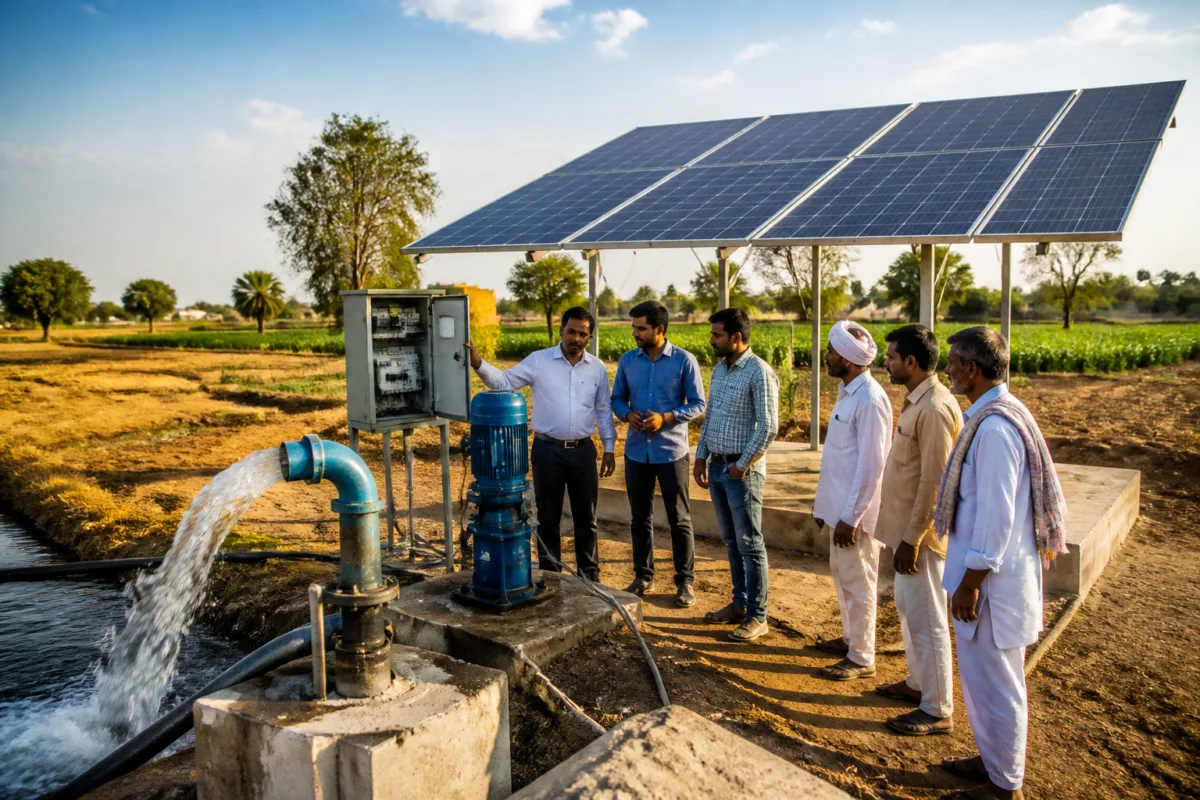
The first identified problem is practical and highly specific: developing affordable solar pumps or retrofit kits for deep borewells. According to the report, the proposed solutions are expected to be 30 per cent cheaper than existing alternatives, use theft-resistant solar panels and include tamper-proof grid metering. These requirements show that the state is not seeking technology in the abstract. It is defining a procurement problem around cost, security and the management of electricity supplied to agricultural users.
The wider objective is to provide solar-powered irrigation facilities to every farm in Telangana while reducing the burden on the power sector. The supplied report does not provide a target date, estimated project cost, number of farms or details of the state’s existing irrigation-energy demand. Those missing figures matter because the eventual scale of the programme will determine whether a promising prototype can become a reliable public infrastructure system.
This is the central challenge for the Telangana Innovation Start-up Challenge. A start-up may be able to demonstrate a pump, retrofit kit or metering system in controlled conditions. Government departments, however, must assess whether the solution can work across different borewell depths, farm conditions and maintenance environments. They must also determine who will own, operate, repair and monitor the equipment after installation. The announcement identifies technology readiness, team capability and potential public and industrial impact as evaluation criteria, but the report does not specify the post-selection implementation framework.
The initiative was launched at a curtain-raiser event for the Invest Telangana Global Summit in Delhi last week. Chief Minister A. Revanth Reddy had directed officials to invite innovative solutions for solar irrigation, which has been designated the lead challenge. The state has invited start-ups, innovators, researchers, technology companies, industry and academic institutions to participate. Applicants from across India and global innovation hubs are eligible.
That broad eligibility is important because the state is attempting to widen the pool of potential contractors beyond established infrastructure and technology companies. Conventional public procurement often favours organisations with a long record of executing large contracts. Start-ups, research institutions and smaller technology firms may have relevant ideas but lack the experience, scale or administrative familiarity needed to enter government supply chains. TISC is designed to create an entry point for these organisations.
But opening the door to new suppliers is only the first step. The more difficult institutional question is whether government departments can evaluate, purchase and manage unfamiliar technologies without weakening standards of accountability. Public procurement requires clearly defined specifications, transparent evaluation, financial scrutiny and mechanisms for performance monitoring. A challenge-based model can help officials identify new solutions, but it does not remove the need for these safeguards.
The evaluation criteria announced for TISC—relevance to the identified problem, uniqueness of innovation, technology readiness, team capability and potential impact—suggest an attempt to combine technical and administrative considerations. Relevance is particularly important in the solar irrigation challenge. An innovative product that does not address the practical conditions of deep borewells, theft risks or grid metering would not solve the problem identified by the state. Similarly, a technically viable system may not be suitable for public deployment if its maintenance requirements are too high.
The proposed theft-resistant panels and tamper-proof metering also reveal the operational dimension of the challenge. Solar irrigation is not simply a matter of replacing one energy source with another. Equipment is installed in open, dispersed locations and must function over time outside controlled urban or industrial environments. Protection against theft and manipulation therefore becomes part of the infrastructure design. The report does not state how these features will be tested or which department will verify performance, but their inclusion indicates that the state is considering risks beyond the initial installation.
The programme also connects rural infrastructure with the state’s broader urban and industrial innovation agenda. TISC will address seven priority challenges confronting rural and urban Telangana, although the supplied report does not identify the other six. This makes the initiative broader than a single agricultural technology competition. It is being positioned as a mechanism through which public institutions can draw on innovation capabilities to address service-delivery problems across the state.
For urban governance, the relevant lesson is the proposed shift from treating start-ups primarily as vendors of digital services to treating them as potential partners in solving physical infrastructure problems. Solar pumps, metering systems and irrigation equipment are built-environment interventions. They affect energy use, public spending, agricultural productivity and the reliability of essential services. The same procurement approach, if expanded, could eventually be tested in other areas of infrastructure, although the report does not confirm which sectors will be selected.
The application process is currently the clearest measurable milestone. Proposals must be submitted through tisc.telangana.gov.in by November 30. The dates for shortlisting, departmental reviews and the final round will be announced separately. This sequence indicates that the government intends to move from an open call to a staged evaluation process, but the supplied material does not establish how many proposals will be shortlisted, whether pilot projects will follow or how contracts will be awarded.
Those details will determine whether TISC becomes a procurement pipeline or remains an innovation showcase. A challenge can generate attention and ideas without producing a deployable public solution. The transition from submission to departmental review is therefore crucial. Officials will need to assess not only whether proposals are novel, but also whether they can be standardised, financed, installed and maintained at scale. The report confirms that government contracts are a possible outcome, but it does not say whether every selected solution will receive a contract or what form that contract will take.
The state’s stated ambition—to provide solar-powered irrigation to every farm—also raises questions about the relationship between innovation and programme delivery. A lower-cost pump or retrofit kit could improve affordability, but the final cost to farmers and the public administration would depend on installation, financing, maintenance, replacement and monitoring. The report provides no details on subsidies, ownership arrangements, procurement volumes or farmer eligibility. Until those elements are established, the 30 per cent cost objective remains a design requirement rather than evidence of an achieved saving.
TISC’s value will ultimately be measured by what happens after the competition. The immediate output will be a set of proposals. The public-interest outcome would be a tested and accountable system that reduces energy pressure, works reliably in the field and can be maintained over its operating life. Those are separate stages, and the announcement has so far described the first stage in detail while leaving the later stages to be developed.
The challenge marks a potentially important change in how Telangana approaches public problem-solving: government departments are defining problems and inviting a wider innovation ecosystem to respond. The evidence currently confirms the launch of the initiative, the solar irrigation focus, the evaluation criteria and the November 30 application deadline. The next developments to watch are the shortlisted proposals, the departmental review process, the publication of the final-round schedule and any announcement on pilots or government contracts.

