


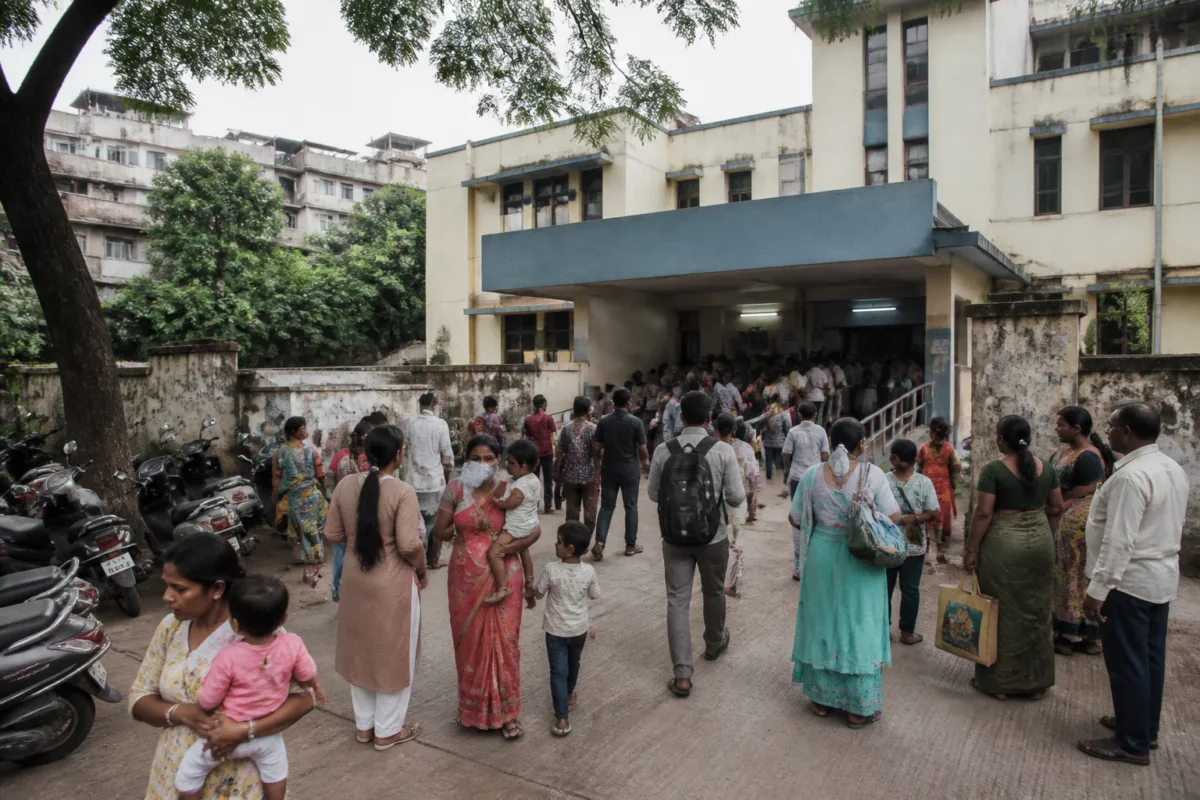
Laigude Hospital in Vadgaon Khurd has become an important low-cost healthcare facility for residents of Khadakwasla, Kirkatwadi, Nandgaon, Dhayari, Raikar Mala, Vadgaon Budruk, Manikbaug and Narhe. Yet the Pune civic hospital is also revealing a deeper weakness in the city’s public health system: a facility that treated thousands during the Covid-19 pandemic is reportedly operating without several basic systems needed to function as a full-service hospital.
The hospital treated 33,805 patients between April 1, 2025 and March 31, 2026, according to the report. Its outpatient department sees between 100 and 120 patients every day. It provides low-cost case papers, free or subsidised treatment for senior citizens and pregnant women, and free medicines to eligible patients under the urban poor scheme. The hospital also offers 24-hour normal delivery services, conducts 10 to 12 deliveries a month, examines 60 to 70 pregnant women monthly and vaccinates more than 250 children.
Those numbers show that Laigude Hospital is not a peripheral facility with marginal demand. It is part of the everyday healthcare network for a large and densely populated section of Pune. Its importance is especially clear for households that depend on municipal services because private consultations, diagnostics and hospitalisation can impose costs that they cannot easily absorb.
The hospital’s current limitations are linked partly to the way emergency capacity created during the pandemic has been maintained after the crisis. More than 18,000 patients were treated at the hospital during the Covid period, while over 100,000 RT-PCR tests were conducted there, the report states. Fifty oxygen beds were established through corporate social responsibility funding and municipal support. The hospital also received two oxygen-generation plants, including the Pune civic administration’s first plant that produced oxygen from air.
However, both oxygen-generation plants are reportedly non-functional. Nine ventilators received through the PMO fund are also lying unused, while equipment intended for male sterilisation procedures remains without use. The issue is not merely that old equipment occupies space. It indicates a gap between emergency procurement and sustained public-health planning: equipment was installed when the need was urgent, but the hospital has not acquired the operational capacity required to integrate it into routine services.
The same problem is visible in maternity care. Laigude Hospital provides normal deliveries, but it does not have inpatient or operating-theatre facilities. Patients requiring caesarean deliveries or more serious intervention must be referred to Kamala Nehru Hospital, Sonawane Hospital or Sassoon Hospital. For residents of a fast-growing urban area, this means that access to a local outpatient service does not necessarily translate into access to complete care.
A referral is not automatically a failure. Hospitals need different levels of specialisation, and municipal systems commonly divide services between primary, secondary and tertiary facilities. But referrals become a public concern when a hospital serves a large catchment area, lacks permanent specialist doctors and does not have the operating facilities needed for predictable emergencies. The distance, transport time, availability of beds and ability of families to navigate another hospital all influence whether a referral is practically accessible.
The diagnostic laboratory offers another view of the capacity problem. Blood and urine tests are available at low rates, but the report says the laboratory operates from a single room. Staff face difficulty handling tests, including those involving children, when the facility has only one working table. A woman quoted in the report said she and her sister were asked to bring a prescription from a doctor at Laigude Hospital before their tests could be conducted. The account also describes a staff member advising them to use a private laboratory because of the limited space and workload.
The reported shortage of modern medicines for diabetes and blood pressure, along with a lack of specialist doctors, further reduces the value of the services already available. An outpatient department can register large numbers of patients, but its effectiveness depends on the continuity of medicines, access to diagnostics and the availability of doctors who can manage conditions beyond basic consultation.
Vaccination access is similarly affected by supply. The report describes shortages of doses such as rotavirus and Japanese encephalitis vaccines. A local resident, Rahul Shinde, said he returned after seeing a notice that the rotavirus dose was unavailable. In a municipal health system, a missed vaccination visit can impose additional travel and time costs on families, particularly women bringing young children to a facility on the expectation that a scheduled service will be available.
These gaps expose the difference between a hospital’s formal presence and its functional capacity. A building, an outpatient department and a list of services do not by themselves create a dependable public-health institution. Capacity is produced by the combination of infrastructure, equipment maintenance, staff, medicines, diagnostics, referral arrangements and day-to-day administration. If one part fails, residents experience the entire facility as unreliable even when other services continue to operate.
The debate over Laigude Hospital’s future has also acquired an institutional dimension. The report says the Pune municipal administration has been considering giving part of the facility to a private operator for a multispeciality hospital. A similar attempt in October 2020 reportedly faced strong opposition from local residents and was stopped by elected representatives at the time. The current discussion concerns the possibility of operating the upper floors through a private arrangement while retaining the ground floor for municipal services.
The disagreement is therefore not simply between public and private healthcare. It concerns what the municipality intends the hospital to be. Residents are asking the civic body to upgrade and operate the facility itself as a full-capacity multispeciality hospital rather than use privatisation to fill gaps in staffing, equipment and operations. Their position, as reported, is based on the hospital’s existing public role and the continuing demand from surrounding neighbourhoods.
A private operating model could potentially bring staff, management or specialised services, but the supplied report does not establish the terms of any proposal, its financial structure, the services that would remain free or subsidised, or how accountability would be enforced. Those details are central to evaluating whether such an arrangement would expand access or change the character of a facility used by low-income residents. Without them, the privatisation debate remains largely a question of administrative direction rather than a demonstrated solution.
The medical officer quoted in the report, Dr Bhagwan Patil, said the outpatient department receives 100 to 120 patients daily and that antenatal examinations, delivery services and child vaccination are functioning smoothly. He also said staff were making an earnest effort to provide the best possible service with limited resources. That statement is important because it distinguishes frontline performance from institutional capacity. Staff can keep essential services running, but they cannot independently resolve shortages of specialists, unavailable equipment, inadequate laboratory space or the absence of an operating theatre.
The reported accumulation of old furniture and waste in the hospital premises adds a basic maintenance concern to the larger capacity problem. Cleanliness is not a cosmetic issue in a healthcare facility. It affects patient confidence, staff working conditions and the safety of people already seeking treatment. The presence of waste and unused material also suggests that asset management and routine upkeep have not kept pace with the hospital’s public role.
Laigude Hospital’s experience raises a wider question for Pune’s municipal health network: how should emergency investments be converted into durable neighbourhood healthcare? During the pandemic, oxygen beds, testing infrastructure and ventilators were mobilised quickly. The subsequent challenge is to decide which assets remain clinically useful, who will maintain them, which staff are required, and how they connect with the city’s referral hospitals. The report suggests that this transition has not been completed at Laigude.
The hospital’s patient volumes, maternity workload, vaccination activity and subsidised services establish a strong case for examining its capacity through evidence rather than through a simple public-versus-private argument. The immediate facts are clear: Laigude continues to serve a substantial population, but several reported facilities are unavailable or incomplete. What remains unclear is the municipal administration’s formal plan for the oxygen plants, ventilators, operating theatre, specialist appointments, laboratory expansion, vaccine supply and any private-sector proposal.
Those decisions will determine whether Laigude Hospital remains primarily an outpatient centre with limited support services or becomes a more complete public hospital for Pune’s eastern and south-eastern neighbourhoods. Until the civic administration makes its service, staffing, funding and operating plans public, the hospital’s central problem will remain unresolved: demand is already present, but institutional capacity is not matching it.

