


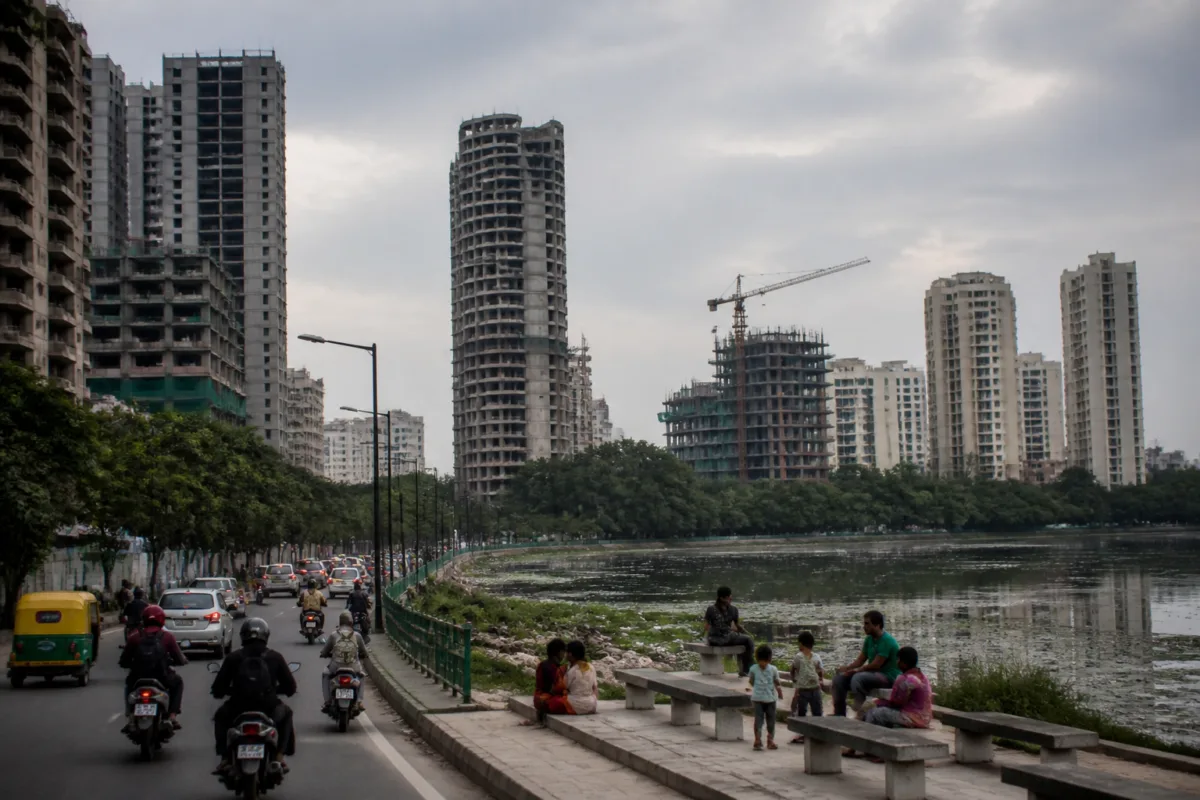
Bengaluru’s development debate is increasingly about more than traffic, housing or infrastructure capacity. At the 17th Bengaluru City District Kannada Literary Conference, speakers argued that the city’s rapid expansion has weakened its cultural identity, damaged its environment and taken it further away from ordinary residents. Their remarks point to a larger urban question: who is the city’s development intended to serve?
The concerns were raised during a seminar on “Bengaluru in the 21st Century”, held as part of the conference that began on Friday. Speakers described the city’s growth over the past two and a half decades as extraordinary and unnatural, arguing that its consequences are visible not only in pollution but also in the weakening of social relationships and public access to cultural life.
These are not conventional infrastructure complaints. They concern the social systems that make a city liveable: access to cultural institutions, the condition of lakes and surrounding landscapes, the handling of waste and sewage, and the ability of people from different backgrounds to share public life. The discussion therefore places Bengaluru’s physical expansion alongside a less measured but equally important change—the shrinking of the city’s common civic and cultural space.
The speakers’ arguments also reveal how development is being experienced differently by different groups. The claim made at the seminar was that Bengaluru has moved closer to affluent residents, real-estate interests and influential groups while becoming more distant from the general public. This was presented not as a single policy failure, but as the cumulative result of changes in culture, land use, environmental management and the political economy of urban growth.
The cultural economy of development
Raghunath C. H., editor of Prajavani’s ‘Abhimata’ section, argued that cultural and arts institutions had also become dependent on corporate patronage. According to him, this has taken these institutions away from ordinary residents and restricted them largely to wealthy groups. He described the outcome as the construction of a “cultural graveyard” in the name of development.
The argument raises an institutional issue that is often missing from urban planning discussions. Cultural infrastructure is usually treated as an additional amenity, to be considered after roads, buildings and commercial districts. Yet theatres, libraries, local arts spaces, festivals and community institutions help determine who can participate in a city’s public life. When such spaces become inaccessible or dependent on private sponsorship, the city may continue to look prosperous while becoming less socially shared.
The report does not establish the number of cultural institutions affected, nor does it provide a comparison of public and private spending on arts and culture. It does, however, record a direct concern from a newspaper editor speaking at a city-focused conference: that the benefits associated with Bengaluru are not reaching the general public equally. That distinction matters because the debate is not simply about preserving tradition. It is about who gets access to the city’s institutions and opportunities.
Pollution beyond the municipal boundary
Environmental geologist and writer M. Venkataswamy framed Bengaluru’s growth through the city’s pollution burden. He said excessive population had pushed land, water and air pollution beyond acceptable levels. He further alleged that waste and sewage generated in the city were being sent to rural areas because they could not be adequately processed within Bengaluru.
If accurate, this reflects a familiar but consequential urban arrangement: the city receives the economic and social benefits of concentration while shifting part of its environmental burden beyond its administrative limits. Rural communities then experience health problems despite not being responsible for generating the waste, according to the speaker’s account.
The supplied report does not include measurements of air pollution, the volume of waste or sewage, treatment capacity, disposal locations, or health records. Those details would be necessary to assess the scale of the problem independently. What the conference discussion establishes is that the relationship between Bengaluru and its surrounding rural areas is being questioned in terms of environmental fairness.
This is also a governance problem. Waste and sewage management are not only technical functions. They involve land allocation, treatment infrastructure, transport, monitoring, enforcement and coordination between urban and rural authorities. When disposal is described as occurring outside the city, the key question is whether the receiving communities have consent, protection and institutional capacity to manage the consequences. The report does not answer those questions, but it brings them into the city’s development conversation.
The disappearance of urban memory
Cultural thinker Professor K. Y. Narayanaswamy said Bengaluru was losing its cultural memory while progress, globalisation and inevitability were being used as explanations for the change. He described the result as a loss of cultural identity. In his account, the city’s changing appearance and tastes had been accompanied by the disappearance of lakes, fairs and places that once accommodated people who arrived in the city without clear direction or established networks.
That observation connects cultural memory to urban accessibility. Lakes and fairs are not only heritage markers; they can also function as shared spaces where residents meet outside formal institutions. Places that absorb newcomers help cities build social relationships across class, language and occupational backgrounds. When such spaces disappear, the city may retain its economic dynamism while losing some of the informal networks that help people belong.
The report does not identify specific lakes, fairs or public places that have disappeared, and it does not provide a timeline for these changes. It therefore cannot support a comprehensive conclusion about the extent of cultural loss across Bengaluru. But the speakers’ concerns point to a gap in the way urban change is commonly recorded. Construction, investment and road expansion are easier to measure than the loss of gathering places, neighbourhood customs and shared memories.
The politics of cultural space
The conference discussion also raised concerns about the increasing role of politics in cultural activities. Speakers said cultural spaces were becoming sites for political ideology and religious provocation, while cultural programmes were receiving political priorities. These statements were presented as concerns by the participants, rather than as independently verified findings in the report.
Even so, the issue is relevant to urban governance because public and cultural spaces are shaped by rules about access, programming, sponsorship and institutional control. When these spaces become politically contested, their role as common civic platforms can narrow. The city’s cultural identity then risks being defined by powerful organisations rather than by the diverse communities that use its streets, lakes, halls and neighbourhood institutions.
The comments also suggest that Bengaluru’s identity is being treated as something that can be consumed or marketed rather than maintained through everyday public participation. The report refers to changes in food and social customs, including the growing influence of practices from other states. Such changes are not inherently evidence of decline in a city that has long attracted migrants. The deeper concern expressed by the speakers was that rapid change was occurring without an equally strong effort to preserve shared civic relationships and local memory.
What the evidence confirms—and what it does not
The evidence in the report is a record of a public discussion, not a citywide diagnostic study. It confirms that writers, cultural thinkers and an environmental geologist associated Bengaluru’s recent growth with cultural exclusion, environmental stress and weakening human relationships. It also documents a clear demand from the speakers for urgent corrective action.
It does not establish the precise scale of pollution, the quantity of waste transferred to rural areas, the number of cultural institutions affected, or the extent to which development benefits are distributed unequally. Nor does it identify specific government decisions, projects or agencies responsible for the changes described. Those questions would require municipal data, environmental records, land-use documents, public spending figures and testimonies from affected rural and urban communities.
That limitation does not make the discussion irrelevant. Cities are often assessed through indicators such as investment, construction and connectivity, while the costs of expansion remain distributed across less visible places and groups. The Bengaluru conference placed those costs at the centre of the conversation. Its most important message was that a city’s development cannot be judged only by the speed of its physical growth.
The larger urban question is whether Bengaluru can expand without reducing access to its cultural institutions, transferring environmental risks to neighbouring communities and weakening the public relationships that allow a diverse population to share the city. The conference did not provide a policy framework or implementation plan. It did, however, identify the areas that require closer examination: cultural access, pollution treatment, rural disposal practices, public spaces and the institutional control of the city’s identity.
For now, the report leaves the scale of these problems unmeasured. What it makes clear is that Bengaluru’s development debate has moved beyond the language of growth. It now includes a contest over who belongs in the city, who benefits from its infrastructure and who bears the environmental and cultural costs of its transformation.

