


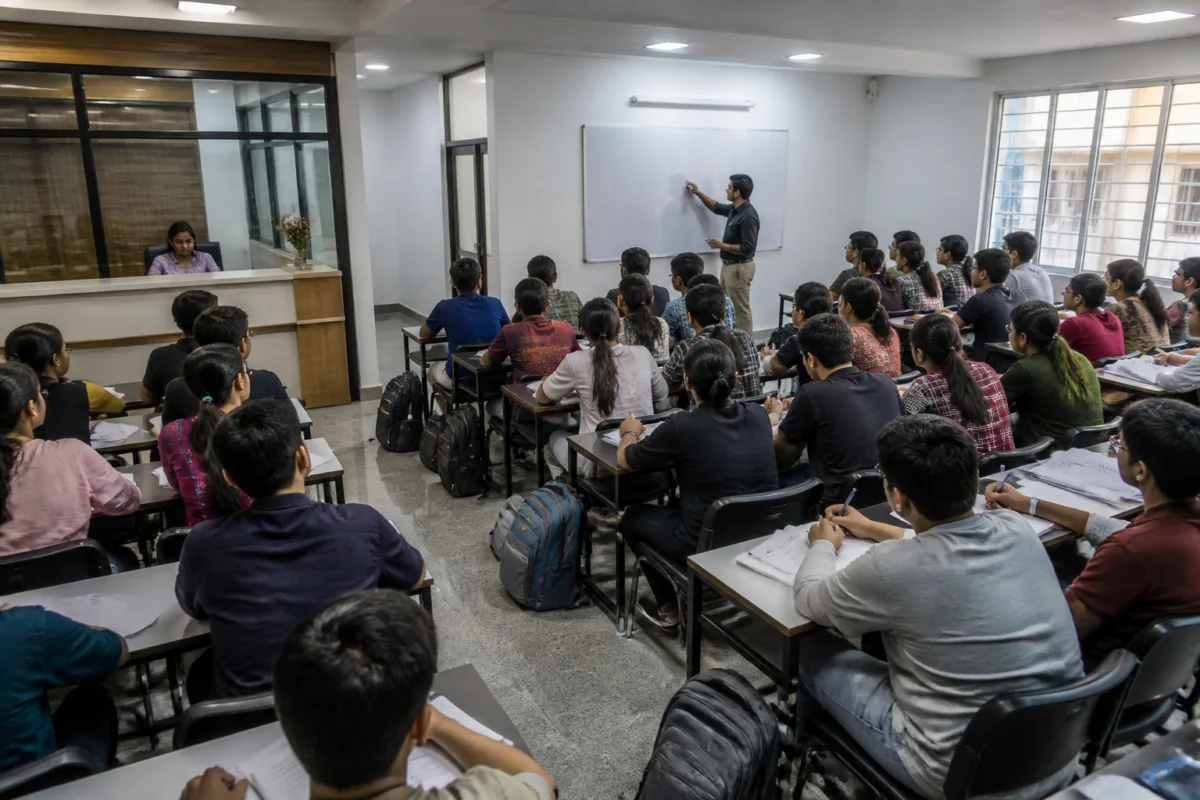
Karnataka’s draft rules for tutorial and coaching centres attempt to bring a largely dispersed education market under a single regulatory framework. The proposal covers private tutorial institutions, coaching centres and online teaching providers, while placing limits on who can be enrolled, how long classes can run, what can be advertised and how student distress must be addressed.
The draft, titled the Karnataka Tutorial Institutions or Coaching Centres Registration and Regulation Rules, 2026, has been issued by the state government’s Higher Education Department, according to a report by Prajavani. It proposes mandatory registration for all such centres in the state, including institutions already operating and those that teach online.
That approach is significant because the rules do not treat coaching merely as a private service between an institution and a family. They frame it as an activity with consequences for school and college schedules, student welfare, public accountability and the relationship between formal education and the parallel preparation market around it.
Under the draft, students below 15 years of age or those who have not completed Class 10 cannot be admitted to tutorial or coaching centres. The provision draws a regulatory boundary around early-age participation in coaching, although the supplied report does not state how the government plans to monitor compliance across physical and online classes.
Registration would be completed online through the Seva Sindhu portal. The proposed registration fee is Rs 15,000, with an additional Rs 5,000 payable for each course. The report states that a validity period would be prescribed for registration certificates, but it does not specify that period. The draft also proposes district-level monitoring committees to inspect compliance and hear complaints, creating a local administrative layer between the centres and the state government.
This institutional design matters because registration is not only a record-keeping exercise. It would give the government a formal list of providers, establish a route for complaints and create a basis for enforcement. At the same time, the effectiveness of such a system would depend on whether district committees have the staff, procedures and authority needed to monitor both classroom-based and online operations. The supplied report does not provide details about the proposed committees’ staffing, inspection frequency or operating budgets.
The draft also seeks to regulate the time students spend in coaching. Centres would be permitted to provide a maximum of five hours of instruction a day, including examination, revision and doubt-clearing classes. Coaching classes would not be allowed during the official hours of schools or colleges.
The restrictions directly address the overlap between formal education and coaching. The draft proposes to curb integrated training arrangements in which students are enrolled in a school or college but spend more time at a coaching centre. It would also prohibit permanent teachers and lecturers working in government schools and colleges from teaching at coaching centres.
These provisions place the coaching market within a wider question of institutional responsibility. If school or college enrolment is used alongside extensive coaching hours, the distinction between formal education and private preparation becomes difficult to enforce. The draft’s proposed restrictions attempt to restore that distinction by regulating schedules, teacher participation and the amount of daily instruction outside the formal institution.
Advertising is another area covered by the proposal. Coaching centres would not be permitted to promise high marks or ranks, or publish advertisements that mislead parents and students. The provision targets the way educational services are marketed, particularly where outcomes are presented as guaranteed rather than as dependent on student performance and other factors.
The report does not include the draft’s detailed definition of misleading advertising, nor does it state what evidence would be required before action is taken. Those details will be important because enforcement will depend on how claims in printed, digital and online promotional material are assessed. The proposed district-level complaint mechanism could become the administrative route for such disputes, but the source does not specify the procedure.
Mental health is a central part of the proposed framework. The draft says centres preparing students for professional-course admissions should provide access to counsellors, organise mental-health workshops and display emergency contact numbers and suicide-prevention helpline numbers. Student examination results would not be allowed to be published publicly.
These provisions recognise that coaching is not only an academic activity. The draft links examination and result pressure with mental distress and suicide-related tragedies, and places obligations on centres to provide support and protect student privacy. It does not, however, specify the required qualifications of counsellors, the frequency of workshops, the helplines that must be displayed or the reporting process when a serious welfare concern arises.
The proposed privacy rule on examination results also changes how performance can be used for promotion. The source does not state whether centres would be allowed to share results privately with students and parents, or how the restriction would apply to anonymised performance data. Those operational details would determine the difference between protecting students from public comparison and limiting legitimate academic communication.
The enforcement framework proposed in the draft combines financial penalties with regulatory action. Institutions violating the rules could face a fine of up to Rs 5 lakh or cancellation of their registration. An appellate authority would also be empowered to take action in the matter.
A maximum penalty of Rs 5 lakh gives the rules a stronger enforcement mechanism than a purely advisory code. But the source does not specify whether penalties would vary by the nature or frequency of the violation, how repeat offences would be treated or whether cancellation would immediately stop an institution’s operations. The answers would be important for ensuring consistent action across centres of different sizes and business models.
The proposed framework also raises a question about regulatory coverage. Physical coaching centres can be linked to a premises, a local authority and a district administration. Online providers may operate across districts or from outside the state while serving students in Karnataka. Since the draft explicitly includes online teaching centres, its implementation will require the government to define how registration, inspection, complaints and penalties apply when teaching is delivered digitally.
The source report provides no estimate of the number of tutorial or coaching centres in Karnataka, the number of students affected, the scale of online coaching or the revenue generated by the sector. It also does not state whether the government has published an impact assessment or a timetable for finalising the rules. As a result, the immediate evidence establishes the proposed regulatory architecture but not its likely administrative workload or financial impact on families and providers.
The draft is therefore best understood as an attempt to shift coaching-centre regulation from an informal market relationship towards a registration-and-compliance model. Its reach extends beyond fees and licences: it covers age eligibility, daily teaching hours, school schedules, government teachers, advertising, counselling, public disclosure of results and complaint resolution.
What remains uncertain is how the rules will be finalised and implemented. The supplied report does not mention a consultation deadline, final notification date or commencement date. The next significant developments will be the government’s handling of the draft, the final wording of the registration and enforcement provisions, and the creation of the district-level committees that would be expected to monitor compliance.

