


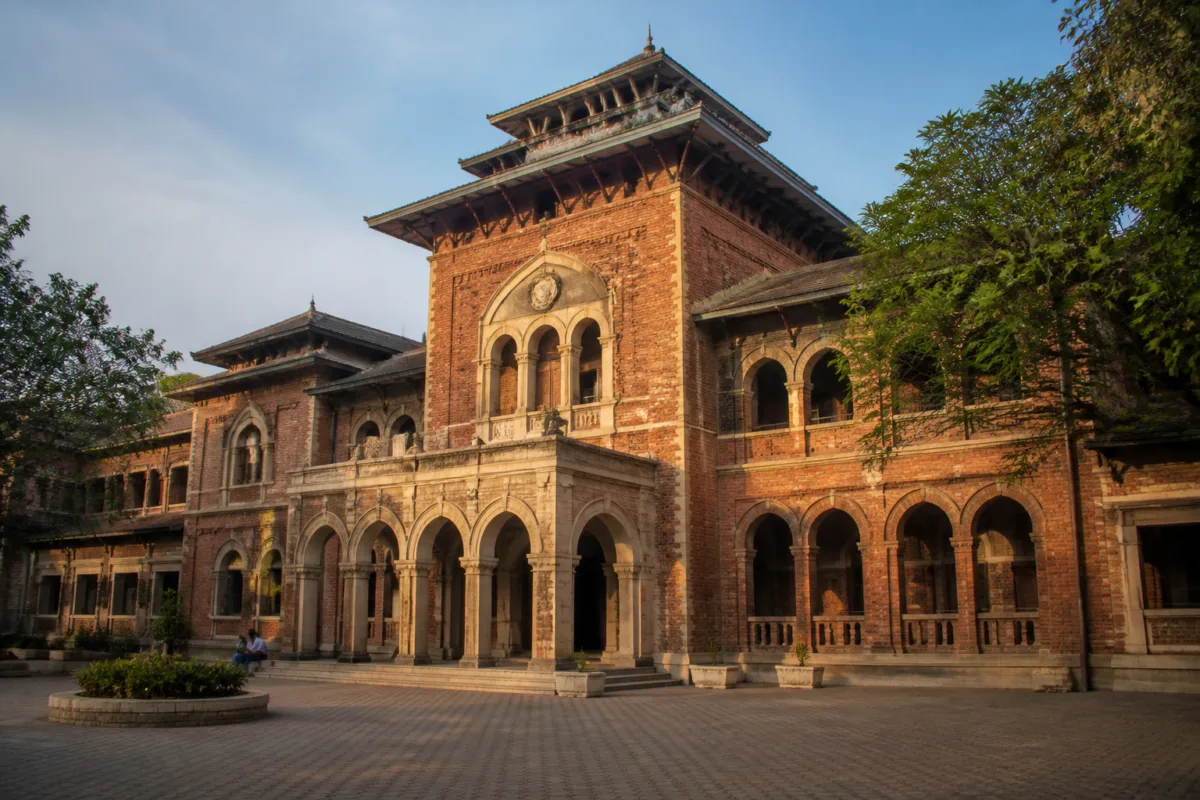
The assessment of Sardar Patel Bhavan in Ahmedabad offers a reassuring finding with an important qualification: the historic municipal building is considered compatible with the city’s seismic zone, but it is also showing minor subsidence and several visible signs of deterioration. For a structure associated with the formative years of Ahmedabad’s civic administration, the distinction matters. Safety is not a one-time verdict; it depends on continued monitoring, maintenance and carefully designed strengthening.
The building was evaluated as part of a CEPT University student project examining settlement in the soil and seismic compatibility. The study identified biological growth, fading, spalling, cracks and moisture in the structure. Researchers also found that the building was settling slightly into the soil. At the same time, their assessment determined that it remains fit for Ahmedabad’s seismic zone. The project therefore shifts attention away from a simple question of whether the building is safe or unsafe. Its more useful message is that structural fitness and conservation need to be managed together.
Sardar Patel Bhavan is not an ordinary old building. It was constructed in 1885 as an administrative structure and has a brick masonry system, a jack arch roof and timber trusses. Its colonial-era design includes arched corridors and a grand facade. Ahmedabad Municipal Corporation has assigned it Grade I status for its historical and heritage value, placing it among the city’s most significant surviving civic structures.
The building’s importance is also tied to the institutional history of Ahmedabad. Sardar Vallabhbhai Patel served there between 1917 and 1928, first as a councillor and later as president of the then Ahmedabad Municipality. He became municipal president in 1924 and remained involved in civic administration until April 1928, when he resigned to focus on the national freedom movement. The building is therefore connected not only to a prominent political figure, but also to the period in which the city’s municipal priorities were being shaped.
Today, Sardar Patel Bhavan houses the office of the Ahmedabad World Heritage City Trust. Its municipal assembly hall has been preserved, including the chair used by Patel. That combination of continued institutional use and historical preservation makes the building’s condition a practical governance issue. It must remain sufficiently stable for occupation and public functions while retaining the materials, spaces and features that give it heritage value.
The CEPT project was undertaken by Dhruvam Patel, a student of the faculty of technology, under the guidance of Pratik Gajjar. Its assessment examined both the building’s relationship with the ground and its response to seismic conditions. Those two factors are closely connected in older masonry buildings because settlement can contribute to cracks, uneven load distribution and deterioration over time. The supplied study does not establish that the observed cracks were caused by subsidence, nor does it quantify the rate of settlement. It does, however, identify settlement as an issue requiring attention.
The distinction between observed damage and structural conclusion is significant. Biological growth, moisture, spalling and fading indicate exposure and ageing. Cracks can have different causes, ranging from surface deterioration to movement in building elements, but the supplied report does not classify each crack or identify a single cause. What the study does establish is that these conditions coexist with minor settlement and that the building merits monitoring and strengthening measures.
Researchers simulated strengthening techniques, including masonry stitching, on a model of the building. Masonry stitching is intended to help connect cracked or separated portions of masonry, but the source material does not provide a final conservation design, cost estimate or implementation schedule for the technique at Sardar Patel Bhavan. The simulation should therefore be understood as part of the technical investigation rather than as an announced repair programme.
Gajjar said a detailed report on possible conservation techniques would be submitted to the Ahmedabad Municipal Corporation after the completion of another project under way at the site. That next report is likely to be important because the present assessment establishes the broad condition of the building but does not disclose the full scope of intervention required. The extent of repairs, the method of monitoring settlement, the treatment of moisture and biological growth, and the protection of the timber and masonry systems remain to be detailed.
This is where the case becomes relevant to municipal administration beyond one heritage property. Historic civic buildings often sit at the intersection of several responsibilities: heritage designation, structural safety, everyday occupation and public access. A municipal corporation may be responsible for maintaining the building, while heritage institutions and conservation specialists may guide decisions about materials and interventions. The CEPT study’s proposed submission to the AMC shows that the next stage will depend on an institutional response rather than on research alone.
The building’s Grade I status also makes the choice of intervention consequential. A structure with arched corridors, a historic facade, a jack arch roof and timber trusses cannot be treated exactly like a contemporary reinforced-concrete building. The supplied material does not state which conservation standards or approval processes will apply, so those details cannot be assumed. It does show, however, that strengthening must be designed around the building’s existing construction system and heritage value.
Ahmedabad’s seismic context adds another layer to the assessment. The CEPT researchers determined that the building is fit for the city’s seismic zone, which is the central reassuring finding in the study. But seismic compatibility does not eliminate the need for routine condition assessment. The same structure can be judged adequate in relation to seismic forces while still requiring action on water ingress, biological growth, material loss, cracking or settlement. Treating the seismic finding as a permanent certification would therefore misread what the study says.
The evidence available from the project is also a reminder of the limits of heritage protection when it is not paired with maintenance systems. A historical designation records value, but it does not by itself stop moisture, biological growth or ground movement. Nor does continued use automatically guarantee that a structure is being monitored in a systematic way. In this case, the assessment has brought the building’s physical condition into the same conversation as its history.
The numbers attached to the building’s history underline its long institutional life. It was built in 1885, and Patel worked there from 1917 to 1928, including his period as municipal president from 1924. The building has therefore passed through more than a century of changing administrative, urban and conservation conditions. The source does not provide a maintenance history, previous structural assessments or data on the rate of deterioration, leaving those aspects unresolved.
That missing baseline is important for the next stage. Monitoring is most useful when it can show whether cracks are stable or changing, whether settlement is continuing and whether moisture-related damage is expanding. The present account confirms that researchers recommended monitoring and strengthening, but it does not specify the instruments, inspection frequency or thresholds that would trigger intervention. Those details would determine how the recommendation becomes an operational municipal programme.
The wider urban question is how Ahmedabad manages buildings that are simultaneously working institutions, public memory sites and ageing physical assets. Sardar Patel Bhavan embodies the city’s civic history, but its preservation cannot depend only on symbolic value. It requires technical evidence, administrative ownership and a clear process for translating assessment into repairs.
The CEPT study confirms that Sardar Patel Bhavan has not been found unfit for Ahmedabad’s seismic zone. It also confirms that minor subsidence and visible deterioration require continued attention. The next material development will be the detailed conservation report to be submitted to the AMC after the ongoing project at the site is completed. Until that report is available, the building’s exact strengthening plan, monitoring system and implementation timeline remain unstated.

