


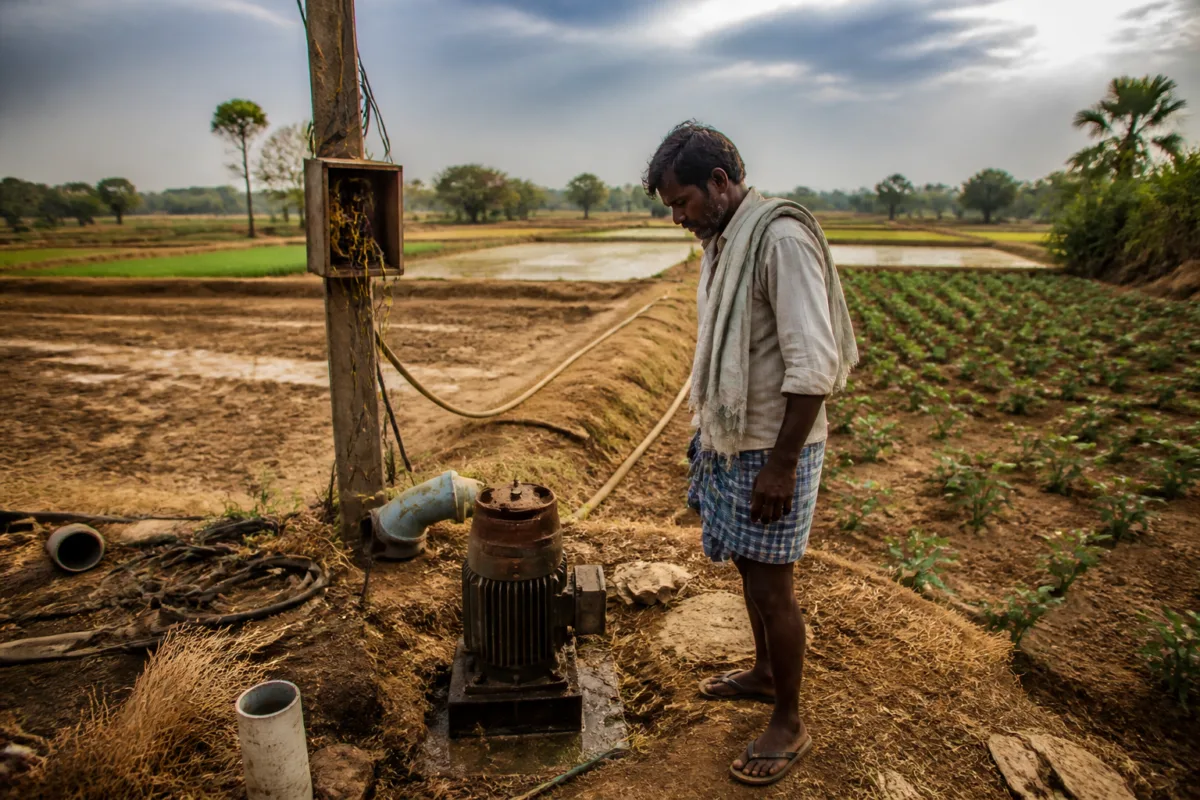
Telangana’s borewell crisis is no longer only a question of whether farmers can find groundwater. It is increasingly a question of whether they can afford to keep the machinery running long enough to use it. Across several districts, farmers are reporting longer motor operating hours, repeated breakdowns, voltage-related failures and repair bills that can reach Rs 40,000, even as groundwater availability becomes less certain.
The immediate pressure is being felt during a crucial cultivation season. Farmers dependent on borewells must pay for electricity, motors, repairs and the labour involved in removing and reinstalling equipment. Yet these expenses do not guarantee irrigation. A repaired motor can restore the mechanical ability to draw water, but it cannot ensure that the borewell will yield enough water for the crop.
That distinction is central to understanding the problem. Irrigation reliability depends on at least two linked systems: the electrical and mechanical system that powers the pump, and the aquifer that supplies the water. The experience reported by farmers in Telangana shows stress in both systems at the same time.
## When irrigation infrastructure becomes a recurring cost
P Narender Reddy, director of Pomal Rythu Producer Company in Nawabpet mandal of Mahbubnagar district, told the Times of India that excessive use of borewell motors had contributed to low voltage this season. He said most farmers had incurred at least Rs 10,000 per acre, while also pointing to a change in the availability of motors designed to operate under low-voltage conditions.
According to Reddy, such motors had been used in Telangana earlier but were no longer being manufactured after the formation of the state. He linked that change to improved irrigation facilities and rainfall having reduced demand for the equipment. The result, as described in the report, is a mismatch between the operating conditions farmers face and the equipment available to them.
A motor failure is not simply a maintenance incident. It interrupts the timing of irrigation and can delay other farm operations. Chintapally Suresh Kumar Reddy of Yacharam mandal in Ranga Reddy district said he spent Rs 40,000 repairing motors serving his three acres under vegetable and paddy cultivation. He said the expense would raise his production costs and reduce productivity.
The cost is therefore distributed across the cultivation cycle. Farmers pay for the repair itself, lose time while the motor is removed and serviced, and face the possibility that delayed irrigation will affect output. The report does not establish a uniform financial loss for all affected farmers, but the accounts indicate that repair expenditure is becoming a material part of cultivation economics.
Kondal Reddy of Rythu Swarajya Vedika said motor problems during both drought and rainy seasons were causing inconvenience. Farmers often had to wait for motors to be removed, repaired and reinstalled, losing time during important agricultural operations. His reference to farmers losing “auspicious time” reflects the practical urgency attached to cultivation schedules, where the timing of an operation can matter as much as its completion.
## The groundwater constraint behind the motor problem
Motor repairs would be a manageable technical issue if water availability were stable. The report suggests that this assumption is weakening. Telangana’s average groundwater depth stood at 9.46 metres below ground level in June and was projected to decline to 11.01 metres by August under a scenario of 30% rainfall deficiency.
These figures describe a deeper water table, but they do not by themselves establish the condition of every borewell. Groundwater conditions vary by location, geology, rainfall and extraction patterns. They do, however, show why farmers can spend heavily on pumping equipment without receiving a corresponding assurance of water.
The system has a compounding structure. As water levels fall, motors may need to run longer to draw water. Longer operating periods can increase wear and the frequency of breakdowns. At the same time, higher dependence on borewells can contribute to greater electricity demand in local networks. Where supply is accompanied by low voltage, motors may be exposed to operating conditions that farmers say increase repair requirements.
This creates a cycle in which the cost of accessing water rises while the certainty of accessing it declines. The farmer is paying to maintain access to a resource whose availability is becoming harder to guarantee. That is different from a conventional equipment-replacement problem and points to a broader groundwater-management challenge.
A University of Hyderabad study conducted in Mandra village of Narketpalli mandal in Nalgonda district found that motor failures and repairs occurred, on average, twice a month. Farmers spent around Rs 5,000 on each repair, according to the report. More than 89% of the farmers surveyed sought subsidies or institutional support for motor maintenance.
The study’s findings are specific to the surveyed village and should not be treated as a statewide average. They nevertheless provide a useful indicator of how repeated equipment failure can become a regular operating expense rather than an occasional disruption. The demand for maintenance support also suggests that farmers see the problem as too large to manage individually.
## Why solar pumps do not remove the water risk
Farmer groups cited in the report believe that solar-powered irrigation systems could reduce problems associated with recurring motor failures and conventional electricity supply. Solar pumps can change the power source and may reduce exposure to some electricity-supply constraints. But they do not, on their own, create groundwater.
Thota Yadagiri, a farmer, said the effectiveness of solar-powered pumps would ultimately depend on groundwater availability. That qualification is important for policy. If the primary constraint is low voltage, a different energy source may address part of the problem. If the constraint is a declining aquifer, more dependable pumping can still leave farmers without sufficient water and could intensify extraction pressure.
The distinction also matters because a pump subsidy and a water-security policy serve different purposes. The first helps with equipment access or operating costs. The second must address the availability and management of the resource being pumped. The material supplied in the report does not specify the design, coverage or implementation status of the government’s solar irrigation push, so its likely statewide effect cannot be assessed from this evidence alone.
What the reported experiences do establish is that energy reliability, equipment maintenance and groundwater availability cannot be treated as separate administrative issues. Farmers encounter them as one irrigation system. A motor that fails, a voltage supply that fluctuates and a borewell that produces less water all affect the same cultivation decision: whether and when a field can be irrigated.
## The institutional gap is maintenance, not only installation
Public discussion around irrigation infrastructure often focuses on creating new capacity—more pumps, more connections or more efficient energy systems. The Telangana accounts bring attention to a less visible part of infrastructure governance: keeping existing systems functional and affordable.
The reported request from more than 89% of surveyed farmers for subsidies or institutional support for motor maintenance indicates that repair access is a collective concern. Individual farmers may not have the cash, spare parts, technical support or time needed to manage repeated failures. Delays also have a direct agricultural consequence because the equipment is needed at specific points in the crop cycle.
The source material does not identify a single agency responsible for addressing all these issues. Electricity supply, groundwater monitoring, agricultural support, equipment markets and irrigation schemes involve different institutional functions. That fragmentation can make it difficult for farmers to obtain a response that matches the actual problem. A repair subsidy may not address low voltage; an electricity intervention may not address falling groundwater; a solar pump may not resolve an aquifer deficit.
The evidence therefore points towards the need to evaluate irrigation support as a service chain rather than as a collection of disconnected schemes. The relevant measure is not merely whether a pump has been installed or repaired, but whether farmers can obtain timely and dependable irrigation at a cost compatible with cultivation.
## What the Telangana borewell crisis reveals
The reported crisis reveals a form of infrastructure stress that is easy to miss in project-based assessments. A borewell may exist, a motor may be connected and an irrigation scheme may be available on paper, yet the system can still fail in practice because maintenance is unaffordable, voltage is unstable or water levels have fallen.
It also shows why groundwater depth is not only an environmental indicator. It has direct implications for farm expenditure, productivity and the viability of crops that depend on pumping. When farmers spend Rs 40,000 on repairs for three acres, or at least Rs 10,000 per acre according to a farmer-producer organisation representative, the water crisis is being translated into a cost-of-production crisis.
The available evidence does not establish how many farmers across Telangana face these conditions, nor does it quantify the total economic loss. It does show a consistent relationship between borewell dependence, repeated motor problems, rising repair expenditure and uncertainty over water availability. The University of Hyderabad study adds a measured village-level example of frequent failures and strong demand for institutional support.
The next policy question is consequently broader than whether Telangana should promote solar-powered irrigation. It is whether the state’s irrigation support systems can address energy quality, motor durability, repair access and groundwater limits together. Until those elements are considered as one system, farmers may continue to spend more to operate borewells while receiving less assurance that the water will be there when it is needed.

