


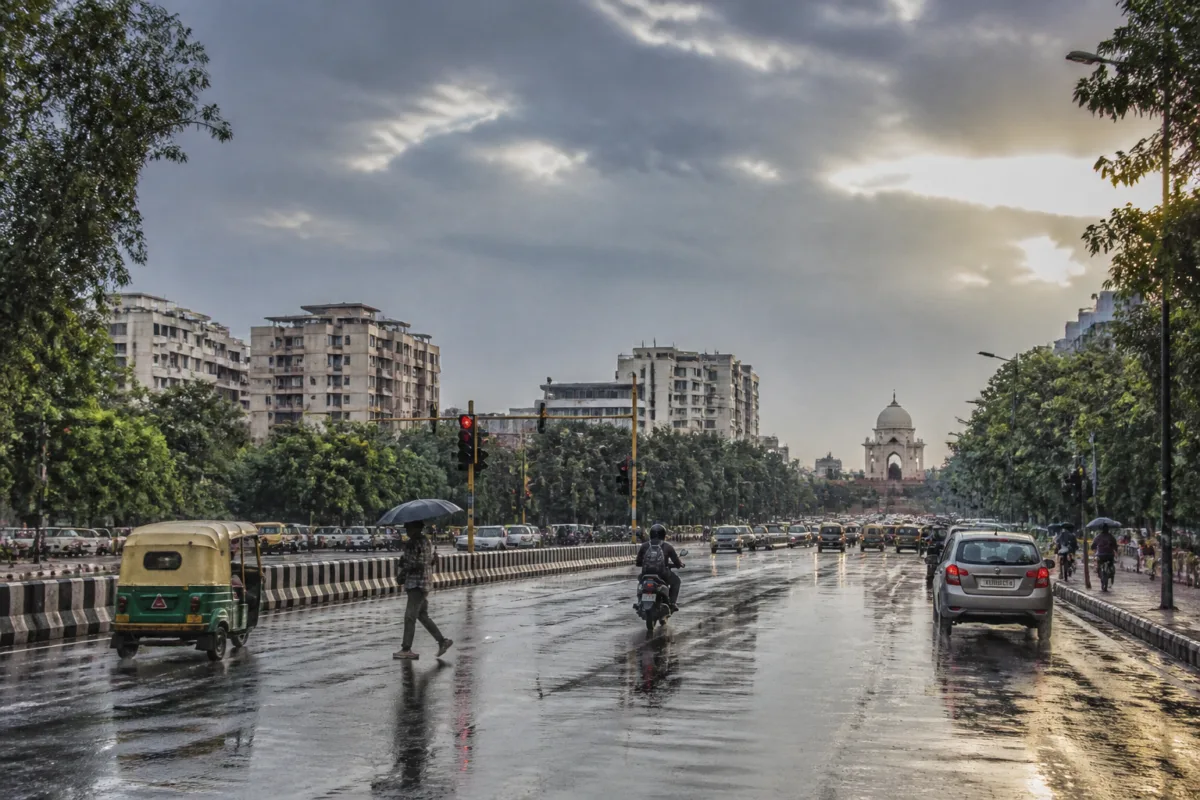
Delhi’s air quality improved sharply in October 2026, but the evidence points more strongly to unusual weather conditions than to a decisive change in the city’s pollution system. The month recorded the cleanest October air in the past decade by one measure, while rainfall reached levels not seen in four years and temperatures fell to an October record at the Safdarjung weather station.
The Centre for Research on Energy and Clean Air recorded Delhi’s average Air Quality Index at 167 in October 2026. That was the lowest October average since 2015, when the average AQI was recorded at 264. The improvement was substantial compared with recent years: the October average was 223 in 2025, 234 in 2024, 219 in 2023 and 210 in 2022.
Yet the month was not uniformly clean. Delhi recorded five days in the ‘poor’ air-quality category, three days in the ‘satisfactory’ category and 22 days in the ‘moderate’ category during October, according to the figures reported by Live Hindustan. The highest AQI of the month was 245 on 21 October, placing the city in the poor category.
That pattern matters because it complicates any simple conclusion that Delhi’s pollution burden has structurally eased. Air quality remained sensitive to changing conditions, and the cleanest readings came after substantial rainfall and a sharp temperature decline. The data therefore offers a useful distinction between a temporary improvement in ambient conditions and a sustained reduction in emissions.
Rainfall was the most visible factor. Delhi received 123.3 mm of rain up to 8.30 am on 30 October, making it the wettest October in four years and the fourth-wettest October since 1954. October’s normal rainfall is 15.1 mm. The previous October with higher rainfall was 2022, when the city recorded 128 mm.
The concentration of rain was also unusual. In the 24 hours ending at 8.30 am on Friday, Delhi received 61.4 mm. That made it the wettest October day in four years and the sixth-wettest October day recorded since 1951. The Safdarjung weather station recorded the same 61.4 mm rainfall figure cited in the assessment of the month’s air-quality improvement.
The immediate effect was visible in the AQI. Delhi’s AQI was 60 on Friday, the cleanest October reading since 10 October 2022, when it stood at 44. Rain can temporarily reduce airborne particulate concentrations by removing pollutants from the atmosphere, while cooler and wetter conditions can also alter the conditions under which pollution accumulates near the ground. The supplied assessment, however, does not establish that rainfall eliminated the sources of emissions themselves.
The temperature record reinforces the importance of the weather pattern. Delhi’s average minimum temperature in October was 20.7 degrees Celsius and the average maximum was 32.6 degrees Celsius. On 30 October, the maximum temperature was 20.7 degrees Celsius, the lowest October maximum recorded at Safdarjung since 1951. A day that would normally be associated with daytime warmth instead brought an unusually low maximum temperature alongside heavy rain.
The combination of rain and lower temperatures altered the conditions in which Delhi’s pollution was being measured. The Centre for Research on Energy and Clean Air’s Manoj Kumar said October 2026’s average AQI was lower than in previous Octobers, but remained 1.5 times higher than the average AQI recorded in September 2026. His assessment, as reported by Live Hindustan, was that the reduction before the implementation of the Graded Response Action Plan should be read alongside the 61.4 mm rainfall recorded at Safdarjung.
This is the central institutional lesson in the October data: pollution-control measures and weather conditions cannot be treated as interchangeable explanations. The reported improvement occurred before GRAP was implemented, and the sharpest fall in AQI followed heavy rain. That does not by itself measure the effectiveness or otherwise of GRAP. It does show why changes in AQI need to be read against meteorological conditions and not only against the timing of administrative restrictions.
Delhi’s broader 2026 numbers show a similar need for caution. Between January and October, the city’s average AQI was 168, the lowest for that period since 2020, when it was 156. That is an improvement against the recent period identified in the report, but it does not establish that Delhi has crossed into a permanently cleaner phase. The October average was still higher than the January-to-October figure, indicating that the annual pattern cannot be explained through one month alone.
The timing of the poor-air days also changed. The report noted that 21 October was the first time since 2015 that air quality in the poor category was recorded in the second half of October. In recent years, poor AQI readings had generally appeared in the first half of the month. This shift does not remove the pollution problem; it indicates that the onset and movement of pollution episodes can vary from year to year.
That variability is important for a city whose air-quality response relies on graded administrative action. GRAP is designed as a response framework for deteriorating air quality, but the October experience shows that the point at which restrictions are introduced can coincide with rapidly changing natural conditions. If rain arrives at the same time as a response plan, the resulting AQI improvement becomes difficult to attribute to any single intervention without more detailed evidence.
The available figures also reveal the limits of a citywide average. An October AQI average of 167 conceals the difference between 22 moderate days, five poor days and a cleanest reading of 60 after heavy rainfall. A monthly average is useful for comparison, but residents experience pollution through daily fluctuations and local exposure. The supplied report does not provide neighbourhood-level readings, source-apportionment data or pollutant-specific concentrations, so it cannot establish how conditions varied across Delhi or which emission sources contributed most during the month.
That missing evidence is significant for urban governance. Weather can provide short-term relief, but it does not replace action on the activities that generate pollution. The October data identifies a cleaner period; it does not demonstrate that transport, construction, road dust, industry or other sources have reduced their emissions. Nor does it show whether the city’s improved readings will persist under drier conditions.
For citizens, the immediate outcome was better air during parts of the month, alongside unusually wet and cool weather. For administrators, the episode is a reminder that AQI trends must be interpreted with rainfall, temperature and the timing of regulatory measures. For researchers and policymakers, it underlines the need to separate weather-driven dispersion and removal from durable improvements in emissions control.
The evidence confirms that Delhi had an unusually clean October by recent historical standards, while also recording exceptional rainfall and a record-low October maximum temperature at Safdarjung. What remains unresolved is how much of the improvement came from weather and how much reflected changes in emissions or enforcement. The next useful comparison will be whether air quality remains improved when the exceptional rainfall effect is no longer present.

