


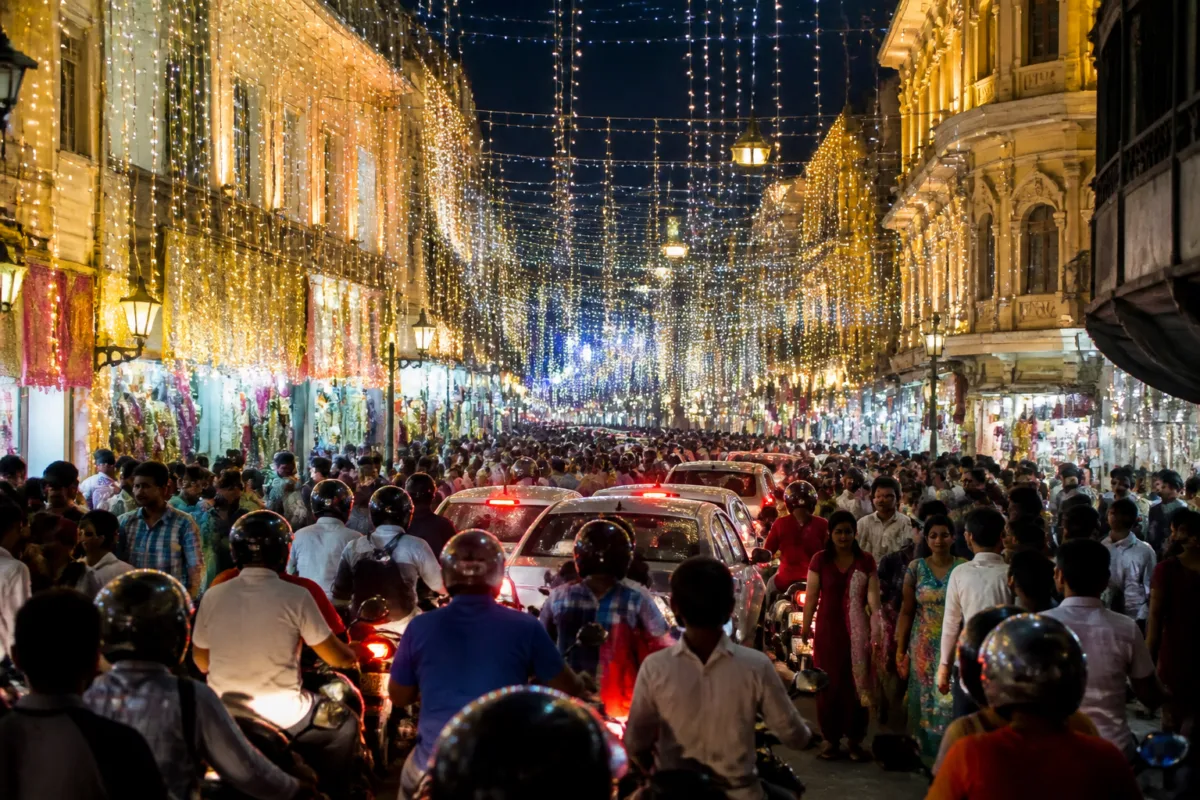
Pune light pollution has become a visible public-space problem on Laxmi Road and Kumthekar Road, where festive decorations, illuminated shop displays and advertising fixtures are combining to create intense glare. The issue is not simply whether Central Pune’s commercial streets look attractive during Diwali. It is whether public roads can be brightly illuminated for commercial and festive purposes without clear limits on intensity, duration, electrical connections, road safety or impacts on people and wildlife.
A report by Pune Mirror – Pune describes continuous strings of small lights installed along roughly 700 to 1,000 metres of Laxmi Road, between Belbaug Chowk and Vijay Talkies. A similar display is reported on Kumthekar Road, from Chitale Sweet Mart to Khalkar Talim. Residents and shoppers told the publication that the illumination is strong enough to cause discomfort and make two-wheeler riding more difficult after sunset.
The timing is significant. The lighting has appeared during the peak Diwali shopping period, when Laxmi Road and nearby commercial areas draw large crowds. The report says shoppers began arriving in the morning and that activity continued until about 10 pm, with traffic congestion and haphazard parking adding to the pressure on already crowded streets. In such conditions, glare becomes part of a wider street-management problem rather than an isolated visual nuisance.
The evidence available in the report points to three overlapping systems: a busy retail economy, a public road used as a promotional surface, and a civic environment with limited publicly stated controls on temporary illumination. The reported lighting on Laxmi Road appears to have been installed by a cloth and tailoring business as part of its advertising. The display therefore raises a basic governance question: when commercial branding extends beyond a shopfront and occupies the visual space above a public road, who authorises it and under what conditions?
That question matters because the street is not only a marketplace. It is also a movement corridor used by pedestrians, two-wheeler riders, motorists, residents, delivery workers and emergency services. During the festive season, the same road must absorb a sharp increase in footfall and traffic. Additional light may improve visibility in some locations, but unshielded or poorly directed light can also produce glare. The report does not provide measured brightness levels, a technical assessment or an official account of the permissions issued. Those gaps prevent a precise judgment about whether the installations breached any rule. They do, however, expose the absence of information that citizens need when public infrastructure is being altered for temporary commercial activity.
The distinction between illumination and glare is central. Decorative lighting is intended to make a street more welcoming or festive. Glare, by contrast, reduces visual comfort and can interfere with the ability to see. Praneeta Rajeshirke, a shopper from Mohammadwadi quoted in the report, said the bright lights made it difficult to ride a two-wheeler because the glare affected her vision. Bharati Choudhary, a Pune Camp resident and teacher, said the excessive lighting strained the eyes and questioned how the installations were connected to the power supply.
These accounts are not a substitute for measurements, but they identify the street-level consequence of a design decision. On Laxmi Road, the reported lights do not operate in isolation. Bright shop advertisements on both sides of the road are said to combine with the overhead strings, producing a harsher visual environment. Heavy traffic and the seasonal heat add to the discomfort. The report specifically notes that the contribution of the lighting to local temperature cannot be established without actual temperature measurements. That distinction is important: the sensation of heat and the documented experience of glare are separate issues and should not be treated as evidence of the same environmental effect.
The health concern is also presented with some specificity. Dr Vinod Shaha, a senior medical practitioner quoted by Pune Mirror – Pune, said elderly people and those who have undergone cataract surgery may be particularly sensitive to harsh light. He also said people who wear glasses and children can experience discomfort, including repeated blinking and difficulty keeping their eyes open. His advice, as reported, was to avoid intense light where possible and take precautions to prevent eye strain.
The available material does not establish the prevalence or severity of eye problems among visitors to Laxmi Road. It does show why brightness should be treated as a public-health and street-design issue rather than only as a matter of taste. A city’s festive environment is experienced at eye level. The quality of that experience depends on how light is directed, how long it remains on, whether it is concentrated at face level and whether it competes with vehicle and shop lighting.
The wildlife dimension widens the policy question. Aniket Kamble, a volunteer with Feather and Fangs, WAR Trust, told the publication that intense urban lighting can disorient birds that migrate at night, especially when they rely on the moon, stars and natural light for navigation. He also raised the risk of collisions with glass facades and disruption to the sleep and behaviour of birds roosting in trees. The reported impact, he noted, depends on the intensity and direction of the light and the species involved.
This is not an argument that every festive light installation causes measurable ecological damage. The report contains no bird-mortality data, light-intensity readings or site-specific ecological survey. It does establish that direction, intensity and duration are relevant variables. That creates a practical administrative responsibility: if temporary lighting is permitted in a dense commercial district, the approval process should be capable of addressing more than aesthetics and electrical safety.
The governance chain is currently unclear in the supplied material. The report asks who permitted the lighting, whether the civic body has limits on brightness, height or duration, and whether electricity may have been drawn from Maharashtra State Electricity Distribution Company Limited poles. Choudhary raised the question of possible unauthorised connections, but the report does not establish that electricity was illegally drawn. It records a concern that requires an official response, not a conclusion.
That distinction is crucial for urban reporting and public administration. A temporary installation on a public road may involve several responsibilities: the municipal authority for use of public space and obstruction, the electricity distribution utility for electrical connections and safety, traffic authorities for visibility and movement, and possibly local police or market-management agencies for crowd control. The source material does not identify which authority approved the displays or whether any joint inspection took place.
The absence of a clearly visible framework creates a recurring risk in Indian cities. Festive activity is often treated as temporary and therefore receives less scrutiny than permanent construction or advertising. Yet a temporary installation can still occupy public space, alter traffic conditions, affect pedestrians and change the visual environment for thousands of people. Its short duration does not remove the need for permission, accountability and enforcement.
Laxmi Road’s commercial importance makes this especially relevant. The report describes the stretch as drawing one of the season’s largest crowds, with demand for clothes, saris, jewellery, footwear, rangoli material and diyas. Families reportedly filled the road and adjoining lanes, while two-wheelers were parked haphazardly and routes from Sadashiv Peth and Narayan Peth became congested. In that setting, the public value of a lighting display cannot be assessed independently of pedestrian movement, road visibility and access.
The case also illustrates how commercial streets are changing. Online shopping has expanded, but the reported Diwali crowds show that physical markets continue to offer something digital platforms cannot fully replace: the ability to see, compare and purchase goods in person within a concentrated urban district. That concentration creates economic value for traders, but it also intensifies demands on public infrastructure. Lighting, parking, crowd management, waste collection, footpaths and traffic control become part of the same urban system.
The immediate debate is therefore not between festive cheer and darkness. It is about whether the commercial success of a public street should depend on making that street brighter without a publicly understood standard. A workable system would need to establish who can install temporary lighting, what technical conditions apply, how connections are verified, how advertisements are regulated, and when displays must be switched off. The report does not show whether such a system exists or was applied in this case.
The next step should be documentary and administrative clarity. Authorities would need to identify the permissions issued for the Laxmi Road and Kumthekar Road installations, verify their electrical arrangements, assess whether the lights obstruct or impair visibility, and state whether any limits apply to brightness, height and operating hours. Until those facts are available, the central conclusion remains limited but important: Central Pune’s festive lighting has exposed a gap between the private promotion of commercial streets and the public responsibility to keep them safe, comfortable and environmentally accountable.

