


A renewed threat to remove Aurangzeb’s tomb in Khuldabad has brought Maharashtra’s heritage governance into focus, not simply because of the monument’s contentious history, but because the site is protected by the Archaeological Survey of India (ASI). Maharashtra cabinet minister Nitesh Rane has said that a date for removing the tomb has been decided, although it will not be disclosed. The claim places a politically charged monument at the intersection of historical memory, state authority and the legal protection of built heritage.
Rane made the statement at an event in Chhatrapati Sambhajinagar while speaking about the removal of encroachments from historic forts. He attributed the initiative to Chief Minister Devendra Fadnavis and described the forts as being affected by what he called “jihad”. He then said the tomb also had a deadline, adding that the government did not want it in Maharashtra and that Fadnavis would announce the date.
The statement is not the first such threat. In March 2025, amid demands from BJP leaders and Hindutva organisations for the tomb to be demolished, Rane had said the government had already planned its removal and that journalists would learn about it only after the demolition. He had also referred to the demolition of the Babri Masjid while calling on Hindutva organisations to play their part.
The immediate institutional fact is that the tomb is not an unregulated private structure. It is a protected monument under the ASI, which places its management within a formal conservation framework. In a written reply to the Rajya Sabha in April 2025, Union Culture Minister Gajendra Singh Shekhawat confirmed the monument’s protected status. The central government also stated that the ASI had installed a 12-foot-high metal sheet around the tomb, added concertina wire to surrounding walls and deployed private security personnel in coordination with the district administration to prevent damage.
That security arrangement reveals how the state has already treated the site: as a monument requiring protection from potential harm. It also shows that the issue is not only about a political demand to remove a structure. Any attempt to alter or demolish a protected monument would have to confront the administrative and legal framework through which the ASI manages such sites. Fadnavis acknowledged this institutional constraint in March 2025, saying that while there was agreement with the demand for removal, any action would have to take place within the framework of the law.
The source material does not establish that a formal demolition order, administrative notification or court direction has been issued. Rane’s latest statement is an assertion by a state minister that a date has been decided. The identity of the authority that selected the date, the legal instrument supporting the proposed action and the mechanism through which the ASI would be involved have not been disclosed in the supplied material. This distinction matters because public statements and administrative decisions do not carry the same legal status.
The site’s history adds another layer to the controversy. Aurangzeb died in Ahmednagar on March 3, 1707, at the age of 88, after a reign of nearly 49 years. The final 25 years of his rule were spent largely in the Deccan, where his extended military campaign against the Marathas placed significant pressure on the Mughal empire’s resources. His association with the region is therefore inseparable from the political and military history that continues to shape public memory in Maharashtra.
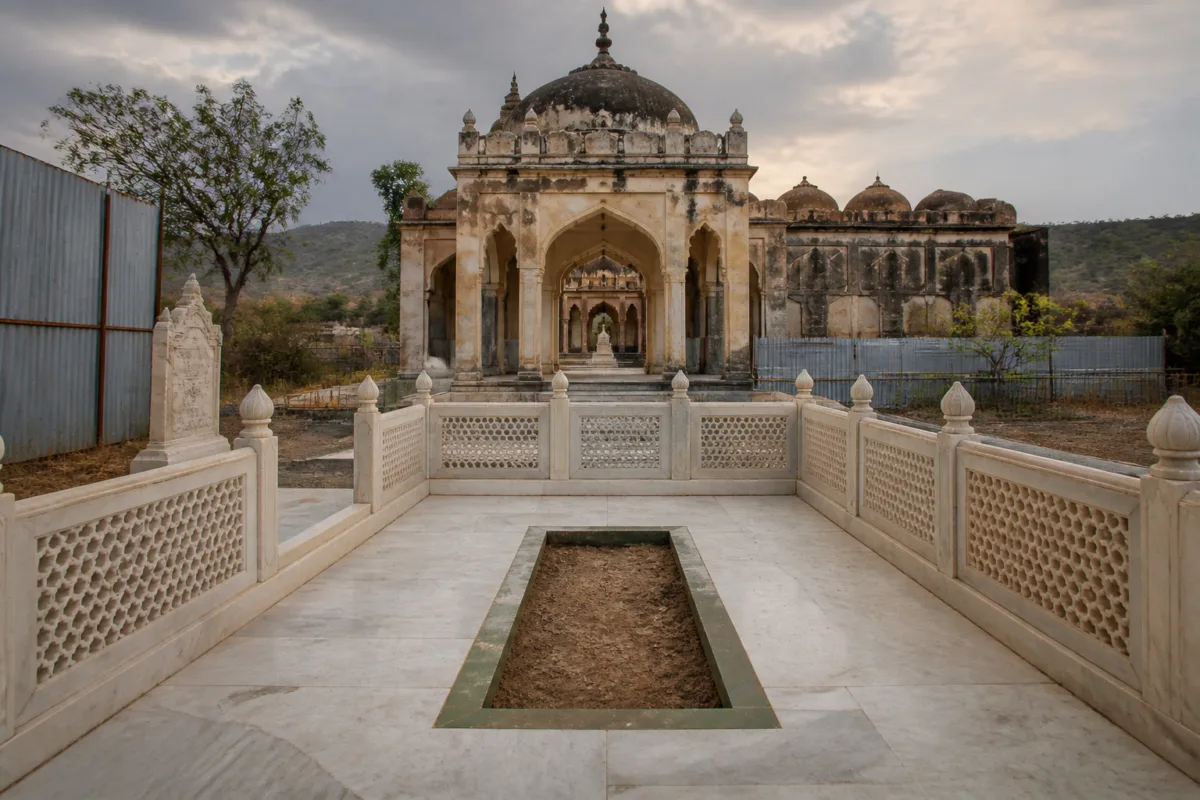
Yet the monument itself does not resemble the grand imperial mausoleums associated with other Mughal rulers. Aurangzeb’s wishes were for a modest burial near the shrine of the Sufi saint Shaikh Zainuddin Shirazi at Rauza, now Khuldabad, near Chhatrapati Sambhajinagar. His body was transported from Ahmednagar and buried in an open grave. The ASI’s description records the grave as an earthen mound with a small sabza plant growing on it, enclosed by a marble floor and perforated marble railing. The gateway and domed porch were added in 1760 by the Nizam of Hyderabad.
The character of the grave is important to understanding the dispute. The present controversy is not centred on an enormous palace, a functioning institution or a large urban development. It concerns a small protected site whose political meaning has grown far beyond its physical scale. The monument’s modest form has not insulated it from historical conflict; instead, its location and association with Aurangzeb have made it a recurring object of mobilisation.
The Maratha connection is central to that mobilisation. Aurangzeb’s prolonged conflict with the Marathas and his role in the execution of Chhatrapati Sambhaji Maharaj in 1689 give the tomb a particularly sensitive place in Maharashtra’s historical narrative. At the same time, the fact that the tomb survived after Aurangzeb’s death is itself part of the region’s history. Historical accounts record that Shahu I, the fifth Chhatrapati of the Maratha Empire, visited the tomb after his release from Mughal captivity in 1707.
That episode is cited in V G Khobrekar’s Maharashtra government publication, Maharashtracha Itihas Maratha Kalkhand, and discussed by historian Richard Eaton in A Social History of the Deccan. It does not settle the present political dispute, but it demonstrates that the monument’s history cannot be reduced to a single contemporary interpretation. The site has existed through shifts in imperial power, Maratha expansion and later administrative regimes. Its survival is part of the historical record that current demands seek to reinterpret.
The conflict therefore exposes two different approaches to heritage. One treats a monument primarily as a physical remnant that can be removed if its associated historical figure is considered unacceptable to present-day identity. The other treats it as evidence of a layered past, including periods of conflict, coexistence and political change. The ASI’s protected status reflects the second approach: preservation does not necessarily endorse every aspect of a figure’s conduct or legacy. It preserves a site because the site forms part of the historical record.
This distinction is particularly important for public institutions. Heritage protection is not designed only for monuments with universally admired associations. Sites connected to rulers, wars and political violence often remain historically significant precisely because they reveal how power operated and how societies changed. If protection is made dependent on contemporary approval of the individual associated with a monument, conservation policy becomes vulnerable to political shifts.
The Khuldabad dispute also illustrates the divided structure of heritage administration in India. The ASI is the central agency responsible for the protected monument identified in the parliamentary reply, while the state government and district administration have roles in local security, public order and the surrounding area. The source indicates that these institutions have already coordinated security measures. It does not, however, provide details of any formal state proposal to transfer, alter or remove the monument, nor does it identify an official ASI position supporting such action.
This division means that a ministerial announcement cannot by itself explain what would happen next. A decision affecting a protected monument would require clarity on the applicable law, the competent authority, the status of the monument’s protection and the relationship between state-level political direction and central conservation responsibility. Those details are not contained in the latest statement, leaving the practical status of the alleged deadline uncertain.
The government’s earlier position, as reported in the source, was that any action would have to remain within the framework of the law. That statement is the clearest available indication of the formal constraint on the proposal. The latest remarks have revived the demand but have not publicly supplied the legal or administrative steps that would convert it into an operative decision.
For residents and visitors, the issue also has a direct public-space and civic-management dimension. The ASI has already erected metal sheeting, installed concertina wire and deployed private security to protect the site from damage. Such measures alter access and the experience of the monument, while also signalling that authorities anticipate a risk to the physical structure. The supplied material does not state whether access has been restricted, whether tourism operations have been affected or whether any damage has occurred.
What the evidence confirms is narrower but significant. A state minister has renewed a demand to remove an ASI-protected tomb and claimed that a date has been decided. The monument’s protected status has been confirmed in Parliament, and security measures have been documented. The site carries a contested historical meaning connected to Aurangzeb’s Deccan campaigns and the Maratha past, but it also has a documented history of survival through later political periods.
What remains unestablished is whether a lawful administrative process to remove the monument exists, whether the ASI has been consulted or whether any formal order has been issued. The next consequential development will therefore not be another political declaration but the production of an official decision, notification, court proceeding or conservation authority record that clarifies the proposal’s legal status. Until then, the Aurangzeb tomb remains a protected monument at the centre of a widening dispute over who controls the interpretation—and physical fate—of Maharashtra’s contested heritage.

