


Foxconn is working on a new collaboration with OpenAI that could expand cooperation in data-centre racks, components and other artificial intelligence hardware, Chairman Young Liu said on Friday. The announcement comes as the electronics manufacturer increases its reliance on AI infrastructure and prepares to expand production capacity.
Liu told reporters at Foxconn’s annual technology event that he had met OpenAI Chief Executive Sam Altman earlier in the day. He said the two companies would make an announcement once the details of the proposed collaboration were confirmed, but did not provide further information about its scope, location or timeline.
Any new agreement would build on a deal announced last year under which Foxconn and OpenAI agreed to work together on designing and engineering data-centre racks, components and other AI hardware. The earlier arrangement placed Foxconn within the expanding supply chain for the physical infrastructure required to run increasingly demanding AI systems.
Foxconn, formally known as Hon Hai Precision Industry, is Nvidia’s biggest AI server maker. The company has six factory buildings in Houston, Texas, where it manufactures AI servers for Nvidia, and Liu said Foxconn sees a need for further expansion there.
The company’s cloud and networking products segment, which includes AI servers, accounted for 51 per cent of its second-quarter revenue, according to company information cited in the report. It was the first time that the segment had exceeded half of Foxconn’s quarterly revenue, underlining the growing importance of AI-related hardware to the manufacturer’s business.
The planned OpenAI collaboration is emerging at a time when AI-sector stocks have faced pressure from concerns that heavy investment in computing infrastructure may not be sustainable as borrowing costs rise. Liu rejected the suggestion that the industry was in a bubble and said Foxconn expects to maintain double-digit growth next year.
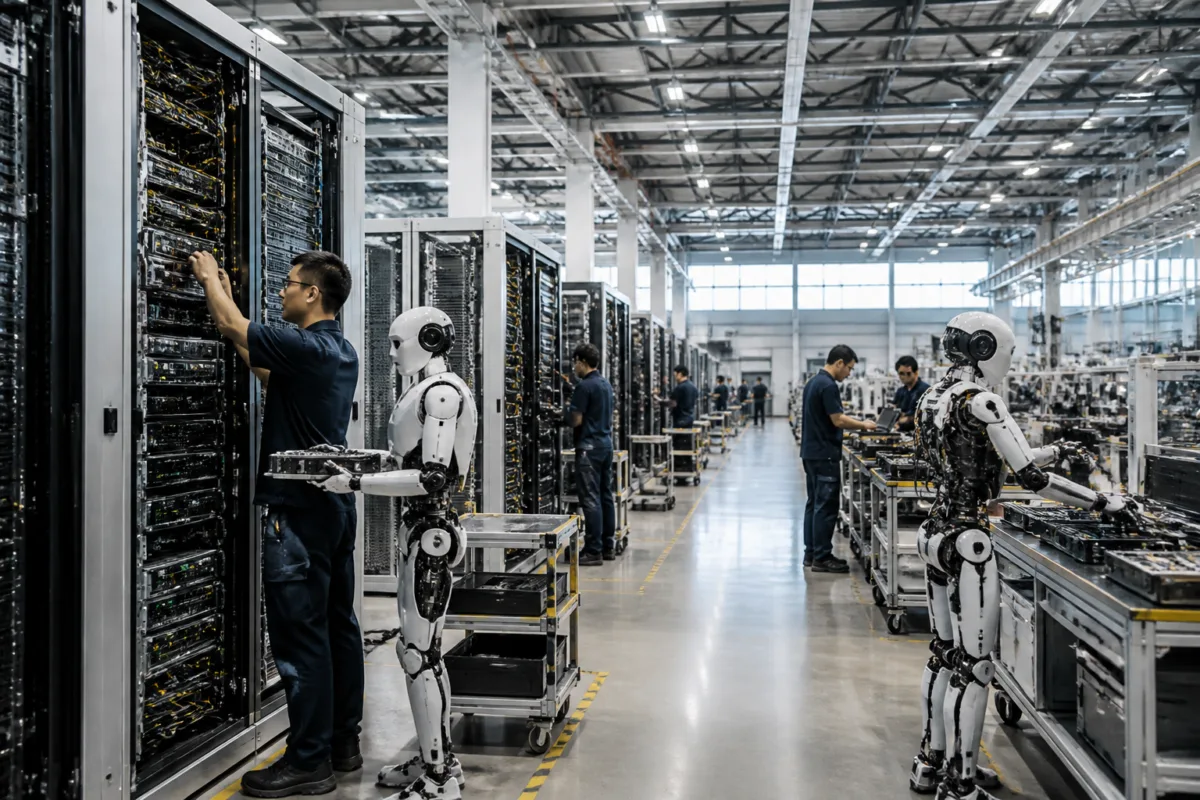
Foxconn is also increasing the use of humanoid robots in its manufacturing operations. Brand Cheng, chairman of Foxconn Industrial Internet, said more than 10 humanoid robots had been deployed for internal use at the company’s Texas facilities. Foxconn plans to extend the deployment beyond Texas, he added.
Presentation materials cited in the report showed that Foxconn Industrial Internet introduced two wheeled robot models in October. One model is designed to lift objects vertically, while the other can bend at the waist for assembly, loading and unloading tasks. The unit is also developing artificial intelligence models for humanoid robots based on Nvidia’s GR00T foundation model.
The companies have not yet disclosed the structure of the proposed new tie-up. Further details, including the hardware involved and the locations or facilities that could be affected, are expected when the collaboration is formally announced.

