


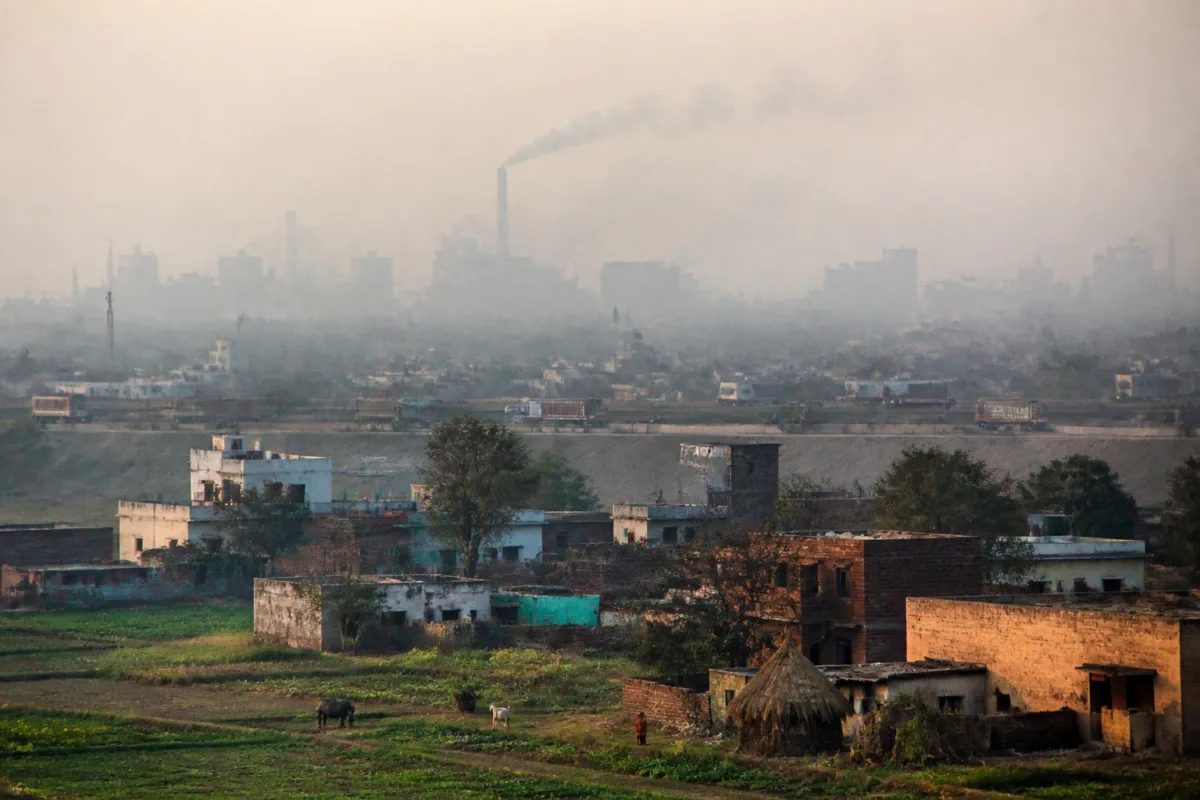
The assumption that villages are naturally protected from India’s air pollution crisis is becoming difficult to defend. An analysis of PM2.5 data from 2014 to 2023, covering urban and rural areas across 24 states, found that pollution in many rural regions was close to urban levels and above India’s annual national standard of 40 micrograms per cubic metre. The finding shifts the policy question from how cities should clean their air to how entire regions should manage pollution that moves across administrative boundaries.
The analysis, by Manoj Kumar, chief researcher at the Centre for Research on Clean Air, was published in India Air Quality and Energy Insights in August 2026, according to Jagran – New Delhi. It used village boundary data from the Survey of India and pollution estimates from the Atmospheric Composition Analysis Group at Washington University in the United States. The study compared rural and urban pollution across 24 states, examining annual PM2.5 levels over a decade.
Its central finding is not that rural areas are uniformly as polluted as cities. In 22 of the 24 states studied, urban PM2.5 levels were higher than rural levels. The more important finding is that the difference was often narrow. In Punjab, Rajasthan, Bihar and Goa, the gap between urban and rural pollution was less than 5 percent. In Delhi, Punjab, Rajasthan, Bihar, Odisha, Madhya Pradesh and West Bengal, rural annual PM2.5 levels were also above the national standard, while the urban-rural difference in these states was below 10 percent.
That pattern complicates the way air pollution is usually governed. When the difference between a city and its surrounding countryside is small, treating them as separate pollution problems can obscure the movement of emissions. The source analysis states that pollutants do not stop at administrative boundaries. This means that a city-level plan can be undermined by sources outside the municipal area, just as rural communities can be affected by emissions generated in nearby urban or industrial regions.
## What the rural air pollution data shows
The state-level figures illustrate the scale of the problem. In 2023, average rural PM2.5 was recorded at 63.9 micrograms per cubic metre in Haryana and 60.7 in Uttar Pradesh. Both levels were substantially above the national annual standard. Rural PM2.5 was also reported at 48.4 micrograms per cubic metre in Chhattisgarh, 47.4 in Tripura and 46.3 in Jharkhand.
The figures matter because PM2.5 is not simply a visible nuisance or a seasonal urban inconvenience. The analysis uses it as the indicator for comparing long-term air pollution across settlements. The reported annual averages suggest that exposure is distributed across a wider geography than the largest metropolitan areas, even though cities remain important concentrations of traffic, construction, industry and other emission sources.
The data also cautions against a simplistic rural-versus-urban comparison. Rural areas recorded lower PM2.5 than cities in most of the states examined, but lower does not mean clean. A rural average can remain above the national standard while still being below the corresponding urban average. This distinction is essential for public policy because a relative comparison may make rural pollution appear less urgent than the absolute exposure level indicates.
The source material does not provide a detailed breakdown of emissions by activity, district or season. It therefore does not establish how much of the pollution in each state comes from transport, industry, agriculture, household fuel use, construction, waste burning or other sources. It does, however, establish the wider spatial pattern identified by the analysis: rural air quality in several states is poor enough to require attention alongside urban pollution.
The use of village boundaries and atmospheric pollution estimates is significant for another reason. Conventional air-quality governance is often organised around cities, municipal limits and designated monitoring locations. A village-level spatial comparison makes it possible to see pollution beyond the places where monitoring and administrative attention are most concentrated. The supplied report does not state how many rural monitoring stations exist or how the estimates compare with ground observations, so the findings should be read as a regional assessment rather than a complete account of local exposure.
## Why city-based clean-air planning is insufficient
India’s National Clean Air Programme is cited in the analysis as the principal policy framework that needs a broader geographic approach. The report argues that pollution-control plans should not remain limited to individual cities but should be prepared at a regional level. Such planning would include air-quality monitoring in villages, identification of pollution sources and measures to control them.
This is an institutional challenge as much as a technical one. Municipal bodies, state pollution control boards, district administrations and rural local institutions operate through different jurisdictions and responsibilities. Air, however, is not governed by those boundaries. A city may regulate some local sources while having limited authority over emissions carried from adjoining districts. Rural administrations may experience poor air quality without possessing the monitoring capacity or regulatory tools required to identify its origin.
The analysis therefore points towards an airshed approach, even though the supplied material does not set out a detailed institutional model. An airshed treats a connected region as a shared atmospheric system. Under such a framework, urban centres and villages would be assessed together, with pollution sources mapped across the geography rather than assigned only to the location where elevated concentrations are recorded.
The practical first step identified in the report is better monitoring. Without reliable information from rural areas, policy can mistake the absence of measurement for the absence of pollution. The analysis calls for air-quality monitoring in villages and source identification, but the source does not specify the number, technology or operating agency for such a network. Those details will determine whether regional planning becomes an implementable programme or remains a broad administrative principle.
The findings also raise questions about how clean-air targets are evaluated. If a city’s annual average improves while surrounding rural areas continue to record high PM2.5, a city-only assessment may show progress without capturing the condition of the wider population. Conversely, a regional plan could reveal that the most effective intervention lies outside the city that receives the greatest public attention.
## The policy gap is geographical
The most consequential message in the analysis is geographical: the boundaries used to administer pollution are not the same as the boundaries through which pollution travels. This does not make city-level action irrelevant. Urban transport, construction, industry and waste management remain important areas for local intervention. It does mean that local action cannot be the entire strategy where cities and villages form a connected pollution zone.
The state comparisons reinforce that point. Haryana and Uttar Pradesh recorded the highest rural averages among the figures cited in the report, but elevated rural pollution was also reported in central, eastern and northeastern states. The presence of high rural levels across different regions suggests that the issue should not be treated only as an extension of Delhi’s air crisis or as a problem confined to the northern plains.
At the same time, the supplied evidence does not support a single national explanation. The study compares pollution levels, but the report does not identify uniform causes across all 24 states. Conditions in an agricultural region, an industrial belt, a forested district or a peri-urban corridor may differ substantially. Regional planning will therefore require source-specific evidence rather than a standardised intervention applied everywhere.
The decade-long period examined, from 2014 to 2023, gives the findings greater relevance than a single bad-air episode. Annual comparisons can reveal persistent exposure that is missed by attention focused only on winter peaks or major urban emergencies. The source material does not provide the year-by-year trend or explain whether rural pollution rose, fell or fluctuated during the period. That remains an important unanswered question for future reporting and policy assessment.
The evidence nevertheless establishes a clear policy concern. Rural India cannot be treated as a clean-air reserve simply because its average PM2.5 is lower than that of nearby cities. In several states, rural levels exceeded the national standard, and in some, the difference from urban pollution was minimal. The city-village divide is therefore a weak basis for designing pollution control.
The larger urban question is whether India’s clean-air institutions are organised around the places where pollution is measured or around the atmospheric systems that produce and carry it. The analysis reported by Jagran – New Delhi supports the latter approach. What remains to be clarified is how rural monitoring will be expanded, which agencies will coordinate across districts and states, and which pollution sources will be prioritised in each region. Those implementation questions will determine whether airshed-level planning can convert a wider understanding of pollution into measurable reductions.

