


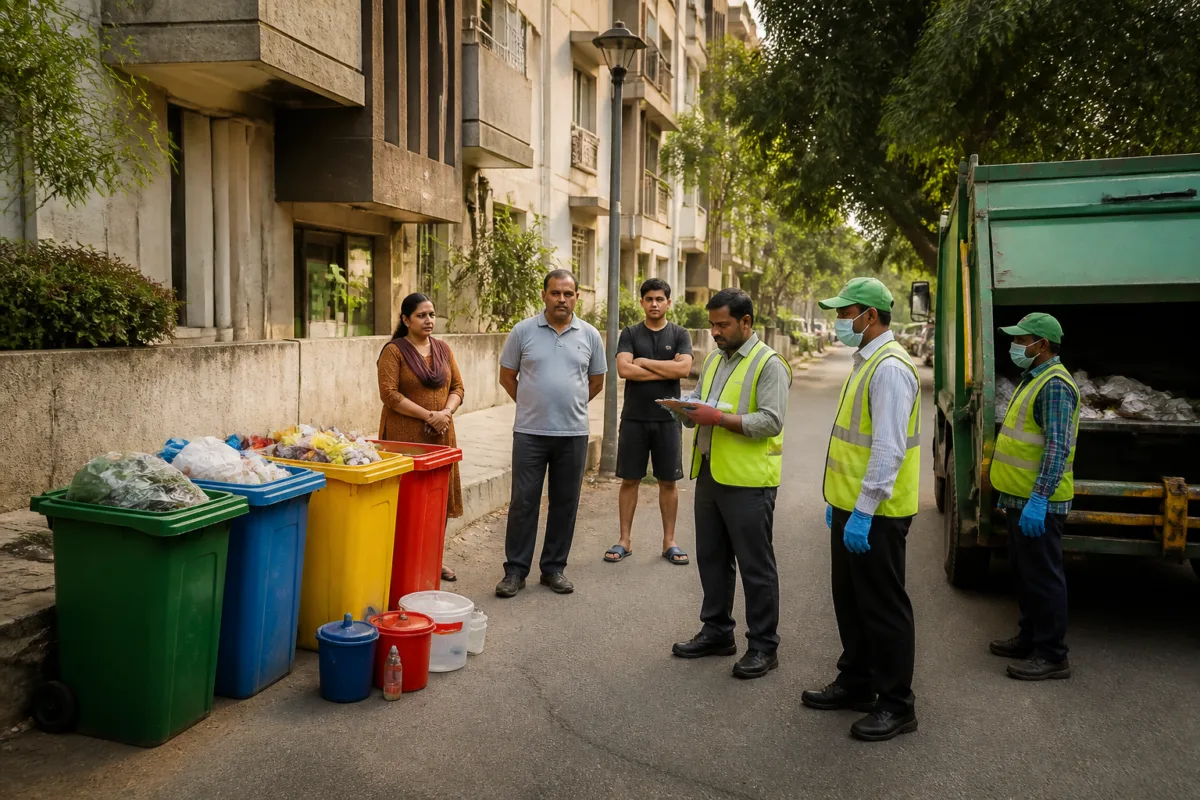
The New Delhi Municipal Council (NDMC) has issued final warning notices to 10 households in a central government employees’ residential complex on Baba Kharak Singh Marg for handing over unsegregated waste, with fines starting at Rs 500 to follow if residents do not comply.
The notices were issued after an inspection of the complex, where the civic body found households giving mixed waste to collectors. The action is part of an NDMC campaign to enforce segregation into four categories: wet waste, dry waste, sanitary waste and special-care waste.
The complex has 135 flats, of which 75 are currently occupied. Residents are being asked to separate waste before handing it over to private collectors deployed by resident welfare associations and to waste-collection vehicles. The NDMC said the households that received notices would face challan action if they failed to improve their waste-handling practices after the final warning.
The inspection was conducted as part of a campaign led by NDMC chairman Manoj Kumar Dwivedi. The campaign includes surprise checks of private waste collectors appointed by resident welfare associations and of vehicles involved in collecting waste from residential areas.
The civic body has identified four colonies for development as ‘Anupam Colonies’. These are the central government employees’ residential complex on Baba Kharak Singh Marg, West Kidwai Nagar, Sarojini Vihar and Chanakyapuri’s Chanakya Rail Enclave. The NDMC has set a target of declaring them Anupam Colonies before December 10, 2026, subject to their meeting prescribed standards.
Inspections of properties in the four colonies are being carried out as part of the initiative. The plan includes processing wet and horticultural waste within the colonies, reducing the need to transport this waste to plants located farther away. The source report did not specify the processing capacity, equipment or operating arrangements planned for each colony.
The NDMC also plans to establish three ‘reduce, reuse and recycle’ centres under the initiative. These centres are intended to channel old but usable items to people who need them. The civic body said the resident welfare associations of all four colonies had agreed to support the programme.
The segregation requirement places responsibility on multiple participants in the waste chain: households must separate waste, collectors must receive it according to category, vehicles must handle it appropriately and the relevant municipal departments must monitor compliance. The NDMC has emphasised the participation of residents, sanitation workers and departments involved in the campaign.
For residents of the inspected complex, the immediate change is the shift from warning-based enforcement to possible financial penalties. The NDMC has stated that challans will begin at Rs 500 and may be higher, although the report did not provide a detailed fine schedule or clarify the process for issuing and contesting penalties.
The next operational step is continued inspection of the four identified colonies against the standards for Anupam Colony status. The NDMC’s stated deadline is December 10, 2026, by which it aims to complete the process for qualifying colonies.

