


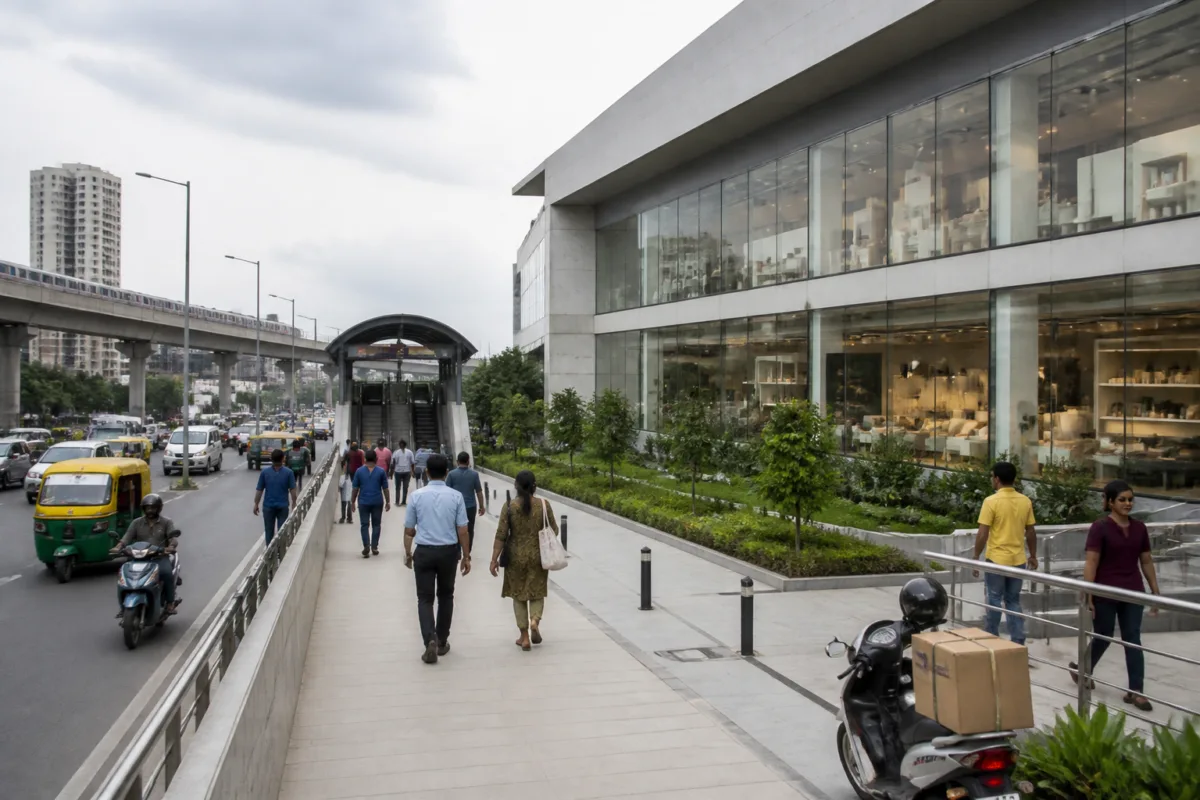
IKEA’s second Bengaluru store, opening at Konanakunte Cross on November 5, is more than another retail outlet for the Swedish furniture company. Its location near a metro station and its shift towards smaller city stores show how the retailer is trying to solve a basic urban problem: how to make a large product range physically accessible without relying only on peripheral destination stores or online delivery.
The 80,000-sq-ft store at Purva Zentech on Kanakapura Main Road will display more than 5,200 products, while customers will be able to order from IKEA’s full range of over 7,000 products. It is within walking distance of Konanakunte Cross Metro station, giving the store a direct connection to Bengaluru’s public transport network. That placement is significant because IKEA’s expansion model depends not only on adding stores but also on making them reachable within the routines of an increasingly dispersed city.
The company has set itself a clear accessibility ambition. “Our ambition is to have people reach us either one click online or 30 minutes away physically,” said Pooja Grover, Country Expansion Manager, IKEA India, according to The Hindu BusinessLine. The statement brings together the two channels around which IKEA’s Indian strategy is being reorganised: digital access for convenience and physical stores for the product experience.
That balance is important for furniture retail. Unlike many standard online purchases, furniture and home products often depend on customers seeing sizes, finishes and room settings before placing an order. IKEA’s Bengaluru expansion is therefore designed around a combination of display, ordering and fulfilment rather than a simple choice between an online shop and a conventional store.
The company’s new outlet format also reflects a reassessment of its earlier approach. IKEA is winding down its Whitefield plan-and-order point, which had been introduced as a smaller format. Grover said the limited space restricted the company’s ability to showcase its range. The decision indicates that smaller outlets may improve proximity but can weaken the physical experience that distinguishes IKEA from a purely digital furniture marketplace.
The replacement is not a return to a single, uniform megastore model. Instead, IKEA is seeking city stores that are smaller than its largest formats but still offer a broad product experience. The Bengaluru outlet will have 5,200 products on display, with the remaining range available to order. This creates a hybrid model: a sizeable physical presence within the city, supported by a wider digital and fulfilment network.
Bengaluru has already been an important market for the company. IKEA began online sales in the city in 2021, and the retailer says brand recall in South Bengaluru was around 90 per cent. Adosh Sharma, Chief Commercial and Operations Officer, IKEA India, attributed the company’s understanding of the market partly to the strong response from customers familiar with the brand. That recognition has helped IKEA identify popular product categories as it plans the next stage of its physical expansion.
The location at Konanakunte Cross also places the store within a specific urban pattern. Kanakapura Main Road is a major southern Bengaluru growth corridor, and the proximity of the metro station gives the outlet a connection beyond customers travelling by private vehicle. The available information does not establish how many customers will use the metro or how the store’s traffic will affect the surrounding road network. It does, however, show that transit access is part of the company’s stated accessibility strategy rather than an incidental detail.
For Bengaluru, the development illustrates the changing relationship between retail and transport infrastructure. Commercial destinations increasingly need to serve customers across a city where employment, housing and consumption are spread across multiple corridors. A store positioned near rapid transit can potentially draw from a wider catchment while reducing the need for every customer to make a long road journey. The source material does not provide projections for footfall, travel modes or delivery volumes, so the practical impact of the metro connection will become clearer only after operations begin.
IKEA’s decision also comes as it attempts to deepen its presence in existing markets and enter new Indian cities. The company is targeting 30 stores across India by 2030 and aims to quadruple sales by that year. It is evaluating Coimbatore, Visakhapatnam, Vijayawada, Jaipur and Chandigarh for the next phase of growth. These locations suggest a strategy that is no longer limited to the largest metropolitan markets, even though the company continues to strengthen its position in Bengaluru.
The expansion has a financial tension at its centre. IKEA India reported revenue of ₹1,749.5 crore in FY25 and a net loss of more than ₹1,300 crore. The company’s immediate priority remains market penetration rather than profitability, Sharma said. It is continuing to invest in stores, distribution centres and delivery infrastructure while building the scale it believes will be necessary for future growth.
That approach makes the store network an operating system, not merely a collection of showrooms. Each new outlet requires investment in real estate, inventory, staffing, customer service and delivery capacity. Distribution centres and last-mile infrastructure must support orders that may not be fulfilled from the store where they are placed. As the network expands, the company will need to absorb these costs across higher volumes. The supplied report does not provide store-level profitability or delivery-cost data, so it is not possible to assess whether the smaller city-store format will improve margins.
Online sales are expected to contribute around 25-30 per cent of IKEA India’s business, while physical stores will remain central to the strategy. This split is revealing. Digital commerce provides reach without requiring a store in every market, but physical outlets remain necessary for product discovery and customer confidence. IKEA’s model is therefore not a straightforward transition from stores to e-commerce. It is an attempt to make the two channels support each other.
The 30-minute accessibility goal also has an important qualification. The company’s wording refers to reaching IKEA either through one online click or physically within 30 minutes. The two forms of access are not equivalent. Online access depends on delivery coverage, fulfilment time and shipping costs, while physical access depends on location, public transport, road congestion and the time required to browse and complete a purchase. The company has stated the ambition, but the supplied material does not set out the performance measures that will determine whether it has been achieved.
This distinction matters in a city such as Bengaluru, where distance is experienced through travel time rather than kilometres alone. A store can be geographically close but difficult to reach during peak traffic. Conversely, a metro-linked location may improve access for some households while remaining inconvenient for customers buying bulky products that require delivery. The Konanakunte Cross store’s position provides a useful test of how a large-format retailer can combine transit access with home delivery, but the evidence is not yet available to judge the outcome.
The move away from the Whitefield plan-and-order point further shows that proximity alone cannot define a successful urban retail format. IKEA found that the limited space reduced its ability to present the range. The lesson, based on the company’s own account, is that a city outlet must be close enough to reach but large enough to communicate the brand’s product proposition. This places pressure on retailers to identify locations where urban accessibility and operational scale can coexist.
The broader policy landscape is indirect but relevant. Metro stations are intended to connect people to employment, services and commercial destinations, while retailers make location decisions based on customer access and business viability. The IKEA store does not represent a public transport project, and the source does not claim any formal partnership with the metro operator. Its proximity nevertheless demonstrates how private commercial investment can make use of public transport infrastructure and how transit stations can become anchors for activities beyond commuting.
IKEA’s planned expansion across India will test whether this model can be adapted to cities with different sizes, incomes, transport systems and retail cultures. The company has named five cities under evaluation, but it has not announced store openings, investment amounts or timelines for those markets in the supplied report. What is established is the direction: deeper penetration in existing markets, selected entry into new cities, a larger role for city stores and continued reliance on online sales for a significant share of business.
The Bengaluru store therefore marks a transition in IKEA India’s expansion story. The company is not abandoning large-scale physical retail, nor is it treating e-commerce as a substitute for stores. It is trying to build a network in which city-based outlets provide a fuller product experience, online channels extend the range, and distribution infrastructure connects both to customers.
The evidence confirms the scale of the ambition but also its unresolved business challenge. IKEA plans 30 Indian stores and fourfold sales growth by 2030 while reporting a substantial FY25 loss and prioritising market penetration. The next indicators to watch are whether the Konanakunte Cross format attracts customers through both road and metro access, whether the smaller city-store model can replace limited plan-and-order points, and whether investment in physical and delivery infrastructure eventually supports the profitability the company has deferred.

