


The Coffee Board of India is pursuing a two-part strategy to strengthen Indian coffee: create a unified international identity through the proposed INDICOF brand and reduce the sector’s dependence on manual plantation work through technology. Taken together, the initiatives reveal that the industry’s challenge is not limited to selling more coffee. It is also about how India presents a fragmented product internationally and how plantations remain viable as wages rise and labour becomes harder to secure.
The proposals were outlined by Coffee Board chairman MJ Dinesh at the Central Coffee Research Institute in Balehonnur, where the Board is also assessing a remote-operated weeding machine. The two efforts operate at different points in the value chain. INDICOF is intended to shape how Indian coffee is recognised in overseas markets, while the machine is being examined as a possible response to operational pressure inside plantations.
That combination is significant because coffee production depends both on market positioning and on the ability of growers to manage cultivation costs. A stronger international identity may help distinguish Indian coffee and its regional varieties. But branding cannot resolve the immediate constraints faced by plantations if basic activities such as weeding and harvesting continue to require labour that is increasingly expensive or unavailable during peak seasons.
India currently supplies coffee to 120 countries and is described by the Coffee Board as the world’s seventh-largest coffee producer and fifth-largest exporter. It cultivates Arabica and Robusta across about four lakh hectares. These figures show that India already has an established export presence and a substantial production base. The Board’s argument is that this presence has not yet translated into a single, recognisable global identity for Indian coffee.
The proposed INDICOF initiative seeks to bring different coffee-growing regions under one international brand while retaining their distinct identities. The intention, according to Dinesh, is to present the diversity and quality of Indian coffee through a common platform rather than market each regional identity in isolation. The branding proposal is therefore not simply a packaging exercise. It is an attempt to connect geography, quality and national origin in markets where buyers may recognise individual products without necessarily associating them with a broader Indian coffee identity.
The Board has written to the external affairs minister on the initiative, after which Indian embassies prepared reports on its advantages and disadvantages. Dinesh said the response received so far had been positive. The reports and the response indicate that the proposed brand involves more than the Coffee Board’s internal marketing machinery. It also requires coordination with overseas missions and a decision on how Indian coffee should be represented across different markets.
The central administrative question is how a single identity can accommodate a product that is geographically and commercially diverse. Coffee grown in Chikkamagaluru, Kodagu and other regions does not have one uniform production profile. The proposed brand will have to communicate common national origin without erasing the regional characteristics that give speciality coffee much of its value. The supplied account does not establish how the brand architecture, certification system, funding or market rollout would work, leaving those as important implementation details still to be defined.
The Board’s Vision 2047 targets underline the scale of the ambition. It aims to increase annual coffee production from the current 3.5 lakh tonnes to seven lakh tonnes and generate Rs 50,000 crore in foreign exchange earnings by the centenary of Independence. It also wants speciality coffee to account for 15% of total production. These targets combine volume growth with value upgrading: India is expected to produce more coffee while increasing the share of output positioned as speciality coffee.
That dual objective creates a structural tension. Expanding production can require more land, better yields or the development of non-traditional growing areas. At the same time, speciality coffee depends on quality, traceability and the distinctiveness of growing regions. The source report says the Board plans to expand cultivation in non-traditional areas and improve yields in Karnataka’s established coffee belt, but it does not provide a land-use plan, yield projections or details of how the speciality target will be measured.
Chikkamagaluru’s position in this strategy is both historical and operational. The district is regarded as the birthplace of coffee in India, and planters believe it can contribute through sustainable practices and premium speciality varieties. Its importance, however, is not only symbolic. Chikkamagaluru and neighbouring Kodagu are among the areas where growers are reporting difficulty in finding workers during peak weeding and harvesting periods.
The labour issue affects cultivation at specific points in the agricultural cycle. Weeds compete with coffee plants for soil moisture and nutrients, particularly when they are not controlled before the monsoon. Delays in weeding can therefore create a direct cultivation problem, while the shortage of workers raises the cost of addressing it. The issue described by growers is not a general technology gap alone; it is a mismatch between seasonal work requirements and the availability and cost of labour.
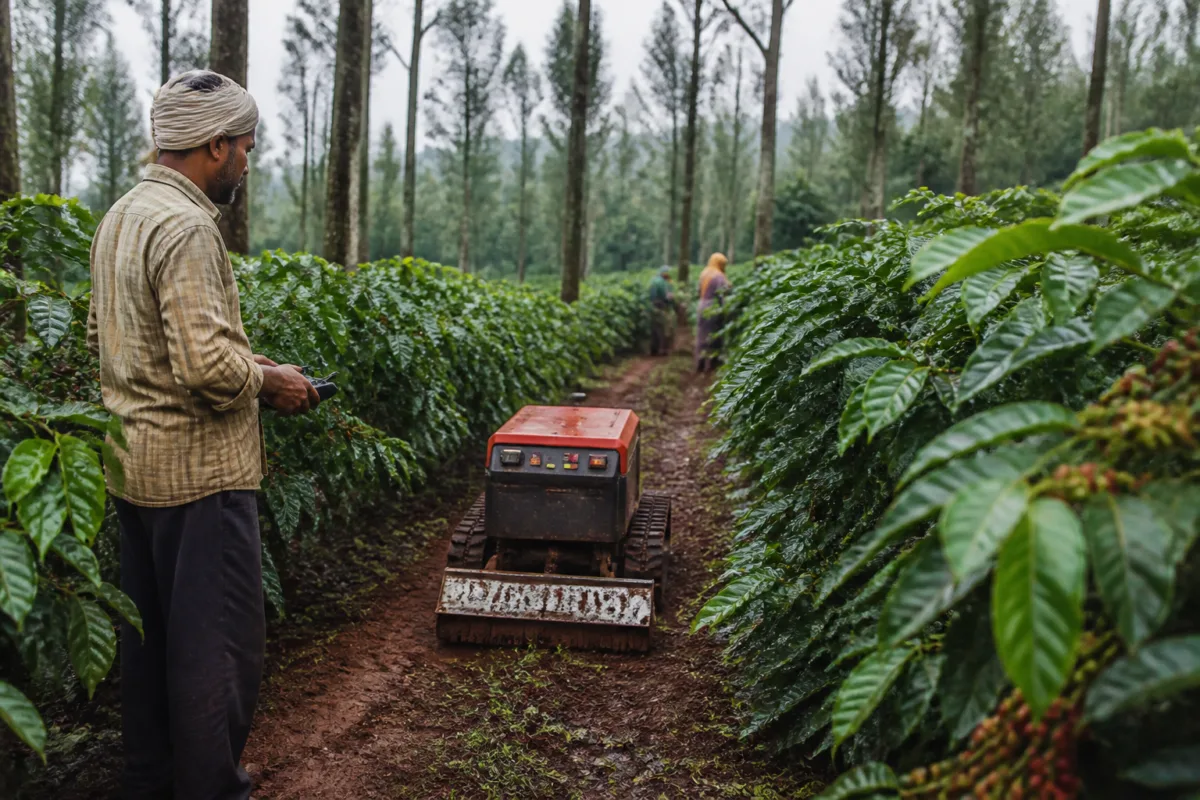
The remote-operated weeding machine tested at the Central Coffee Research Institute is being considered against this background. Developed by a Tamil Nadu-based agritech company, the machine can be controlled from a distance and is intended to reduce manpower requirements, operating time and cost compared with conventional brush cutters. A CCRI scientist said it chops weeds into fine pieces that can decompose into nutrient-rich organic manure, creating a possible cultivation benefit beyond weed removal.
The trial also shows why technology adoption cannot be treated as an automatic solution. Dinesh said the machine showed promise but required modifications for plantation terrain. A researcher said several improvements were needed before it could prove effective. Regional planter Shivanna, who had trialled the machine, said it made weeding easier and was simple to operate and maintain. These assessments are not identical, but together they establish that the equipment has moved beyond a purely conceptual proposal while remaining under evaluation.
The Board will assess the feedback before deciding whether to recommend the machine to growers. That decision is important because a device that works on a research campus or in one plantation may not perform equally across different terrain and operating conditions. The supplied report does not establish the machine’s purchase price, maintenance costs, productivity, safety record or performance across plantations. Without those details, its potential contribution can be identified, but its commercial viability cannot yet be measured.
The technology trial also places the labour question within the Board’s larger production target. Doubling annual output to seven lakh tonnes would require the sector to manage cultivation across its existing four lakh hectares while considering expansion into non-traditional areas. If labour shortages already affect routine plantation operations in established regions, the Board’s production ambition will depend not only on additional cultivation but also on the capacity to maintain farms through seasonal peaks.
This is where the branding and technology initiatives intersect. A unified global brand may help Indian coffee communicate its value more effectively, but the credibility of that value depends on consistent quality and reliable supply. Plantation technology may help reduce some operational pressure, but machinery alone cannot establish the regional identity, speciality standards or export relationships that the branding initiative seeks to build. The two initiatives address different weaknesses and therefore cannot substitute for one another.
The policy landscape described in the report is led by the Coffee Board, with support or participation from the external affairs system, Indian embassies, the CCRI, growers and a private agritech company. This institutional spread reflects the nature of the problem. International branding involves trade and diplomatic representation, while productivity improvements require research, field testing and adoption by growers. The Board’s role is consequently both promotional and technical: it is shaping market identity while evaluating tools for cultivation.
What remains uncertain is how these efforts will be financed, governed and assessed. The supplied material identifies the Vision 2047 production and foreign-exchange targets, but not the budgets, milestones or monitoring framework behind them. It also does not say when INDICOF could be launched, which markets would receive priority or how growers would participate in the brand. Similarly, the machine trial has not yet resulted in a recommendation.
The evidence currently supports a measured conclusion. Indian coffee has a sizeable production and export base, but the Coffee Board believes it lacks a unified international identity. At the plantation level, growers in important coffee regions face labour shortages and rising wages that complicate essential seasonal work. INDICOF and the weeding-machine trial respond to these two pressures, but both remain works in progress.
The next meaningful developments will be the Board’s decision on the proposed brand after receiving embassy feedback and its assessment of the machine’s field performance. Those decisions will show whether the strategy can move from broad ambition to an implementable system linking India’s regional coffee identity, production targets and the everyday economics of plantation work.

