


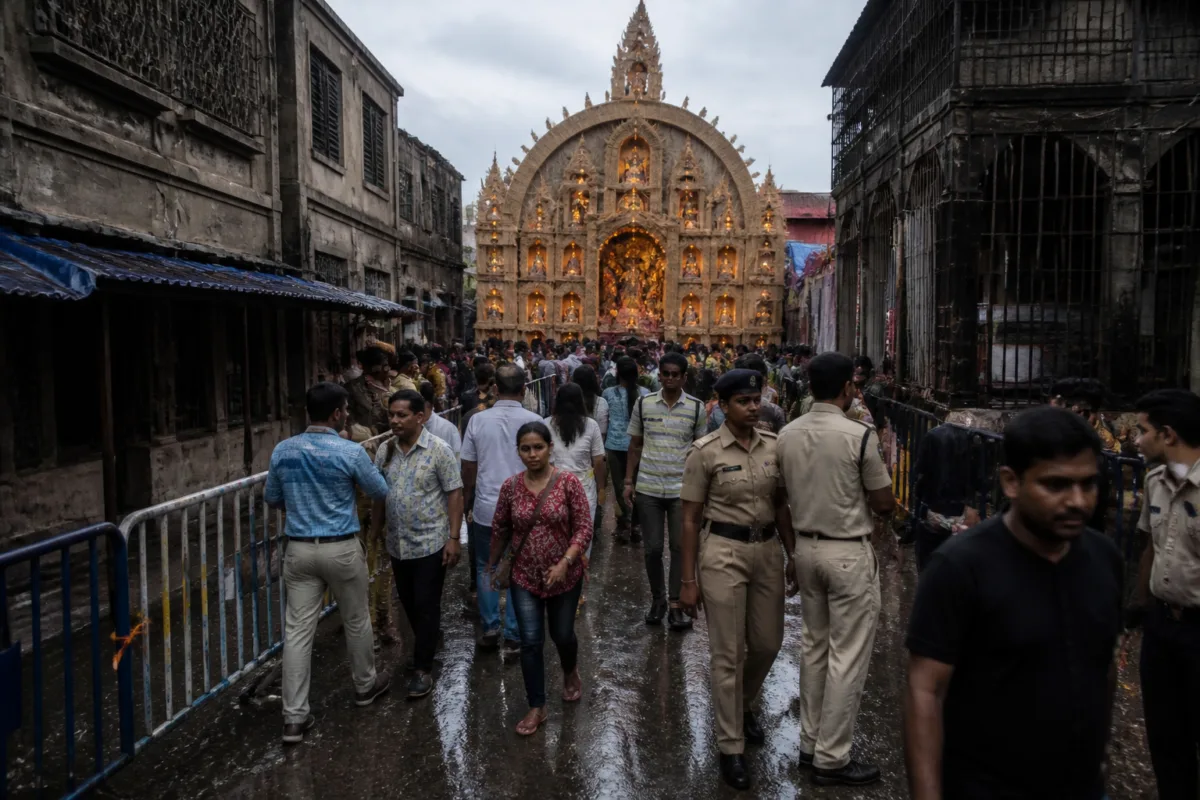
A political demand for action against senior organisers of a north Kolkata Durga Puja pandal has brought the investigation into the 19-death stampede back to the question that often determines whether urban tragedies lead to institutional reform: who is accountable for managing crowds in spaces that regularly attract more people than their streets and safety systems can handle?
Diamond Harbour MP Abhishek Banerjee on Thursday questioned why police had not acted against senior members of the Chorebagan community Durga Puja organising committee, even though nine people had been arrested in connection with the October 17 incident. In a social media post, he named BJP MLA Vijay Ojha, BJP district president Tamoghna Ghosh and Devdeep Adhikari, identified as the committee’s chairman, chief advisor and chief patron respectively.
Banerjee demanded that the committee’s top functionaries be taken into custody for questioning and asked what progress had been made in examining their roles. He also questioned whether political connections were influencing the investigation and called for the Special Investigation Team, or SIT, to conduct an impartial and transparent probe.
The allegations are political in their immediate form, but the underlying issue is an urban safety problem. Large religious and cultural gatherings are not held in abstract spaces. They occupy lanes, junctions, temporary structures and neighbourhood streets, often creating conditions in which a sudden change in movement can turn an orderly crowd into a dangerous surge. The Chorebagan event, according to the report, attracted large crowds every year despite being located in a narrow lane in north Kolkata. That fact places the design and management of the event at the centre of the inquiry.
The available account does not establish that political influence affected the investigation, nor does it establish the culpability of the individuals named by Banerjee. It does, however, show why the SIT’s terms of inquiry matter. A probe limited to the people present at the immediate point of the stampede may not explain how the event was planned, how crowd numbers were assessed, who was responsible for safety and security, or how emergency instructions were communicated.
Police have arrested nine people so far. One of those arrested is an announcer whose messages over the public-address system, asking visitors to leave the pandal immediately during a sudden downpour, are suspected to have contributed to the crowd surge. The reported sequence highlights the importance of communication in crowd safety. An instruction intended to protect visitors can have the opposite effect if thousands of people receive it at once, without controlled exits, phased movement or sufficient space outside the venue.
That question is particularly significant in a narrow-lane setting. The report does not provide the lane’s width, the number of visitors present at the time, the number of exits, the location of barricades or the deployment pattern of police and volunteers. Those details will be essential to understanding whether the risk was created by crowd density, the physical layout, the weather response, the public-address announcement, inadequate access control, or a combination of these factors.
The distinction between immediate actors and institutional responsibility is central to the case. Arresting people who may have contributed directly to the crowd movement addresses one layer of the incident. Examining the committee’s senior functionaries, the police response and the safety plan addresses another. Banerjee argued that responsibility for 19 deaths could not be avoided through the arrest of what he described as “some minions”. His demand is an assertion, not a finding of the investigation, but it identifies the accountability gap that the SIT will need to address.
The state government has constituted a six-member SIT headed by retired Calcutta High Court judge Justice Anindita Roy Saraswati. The team has been asked to inquire into the incident and make appropriate recommendations. Its composition and mandate indicate that the case is being treated as more than a routine criminal investigation. The reported involvement of a retired High Court judge also places emphasis on examining the sequence of decisions and the conduct of institutions, not only the actions of individuals at the venue.
For urban governance, the case raises a recurring administrative problem: responsibility for public safety at large gatherings is distributed across organisers, police, local administration, emergency services and the physical environment. When those responsibilities are not clearly documented, an investigation can become focused on the final visible failure rather than the chain of decisions that made the failure possible.
The report does not specify which authority approved the event’s arrangements, whether a formal crowd-management plan existed, whether attendance limits were set, or whether the organisers had been required to demonstrate emergency access and evacuation routes. It also does not state whether prior years’ crowd levels had triggered changes in the layout or policing arrangements. These are not peripheral questions. They determine whether a tragedy was unforeseeable or whether known risks were left unmanaged.
The annual nature of the Chorebagan event is important in this context. Banerjee said the pandal drew large crowds every year despite its location in a narrow lane. Repeated gatherings create an opportunity for authorities and organisers to learn from past crowd behaviour, identify pressure points and change arrangements. The supplied report does not establish whether such reviews took place. The SIT’s recommendations will therefore be significant in determining whether future events are managed through documented risk assessment or continue to rely primarily on experience and last-minute deployment.
The incident also shows how weather can alter the safety conditions of a public event within minutes. The report says a sudden downpour preceded the announcement directing visitors to leave the pandal immediately. Weather itself may not be preventable, but its effect on movement can be planned for. A safe response requires more than informing people that they should move; it requires authorities to know where they can go, how quickly they can move there and how opposing flows will be separated.
This is where the built environment and event management become inseparable. A temporary religious structure may be compliant in isolation but unsafe when surrounded by a dense crowd, narrow access roads and competing movement routes. Similarly, a police deployment may appear adequate until an emergency instruction causes thousands of people to move simultaneously. The investigation will need to connect these elements rather than treat them as separate administrative files.
Banerjee also warned that people attempting to shield those accused through political power would eventually face legal scrutiny. His statements increase public pressure on the police and the SIT, but they do not replace due process. The central institutional test is whether the investigation can identify responsibility through evidence, question senior organisers where the evidence warrants it, and distinguish verified findings from political allegations.
That test is especially important because the named organisers include political figures. The presence of political affiliations does not by itself establish wrongdoing, just as the arrest of nine people does not by itself establish that responsibility ends with them. A credible investigation must apply the same standard to organisers, officials, police personnel, announcers and other participants whose decisions may have affected crowd safety.
The available evidence confirms four important facts: 19 people died in the October 17 stampede; nine people have been arrested; the incident occurred at a crowded pandal in a narrow north Kolkata lane; and the state has formed a six-member SIT headed by a retired High Court judge. It also records a political demand for senior organisers to be questioned and for the investigation to remain free from external influence. What remains unresolved is the precise chain of decisions that produced the dangerous crowd movement and whether preventive systems were adequate.
The next stage of the case should therefore be judged by the completeness of that chain being established. The SIT’s inquiry and recommendations will need to clarify the roles of the organising committee, police, crowd-control personnel and those responsible for public announcements, along with the safety arrangements inside and around the pandal. Until those findings emerge, the Kolkata stampede investigation remains both a criminal case and a test of how the city assigns responsibility when public celebrations occupy constrained urban spaces.

