


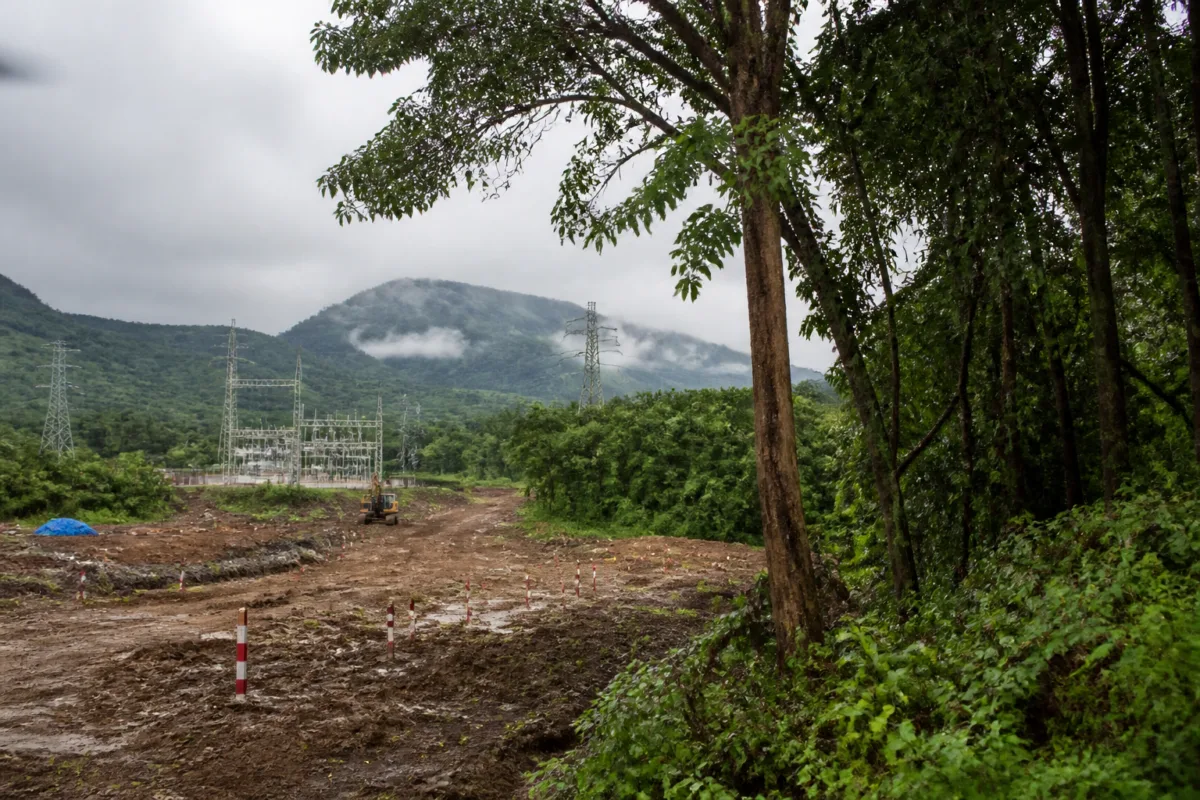
The controversy over tree cutting for Torrent’s proposed 3,000 MW pumped-storage hydropower project in Karjat has exposed a difficult question for Maharashtra’s energy and forest governance: can a project described as clean energy justify the diversion of a large forest area and the removal of tens of thousands of trees? The answer depends not only on the electricity the project may generate, but also on how the state measures ecological loss, public consent and the credibility of its compensation commitments.
According to a report by Navbharat Times – Mumbai, the project is planned at Saydongar in Karjat taluka. The report says that 32,490 trees are being cut for the project, while the company’s environmental report estimates that nearly 48,000 trees may eventually be affected. The difference between these two figures is itself important. It suggests that the scale of the intervention depends on how the project boundary, construction requirements and environmental assessment are defined.
The project would use 233 hectares of reserved forest land and protected forest areas, according to the report. That places the dispute beyond a routine debate over a private power investment. Forest diversion in the Western Ghats involves questions about habitat continuity, water systems, slope stability and the long-term character of the landscape. The supplied report does not provide the full environmental assessment, the conditions attached to approval, the exact land-use map or the monitoring framework. Those documents would be necessary to establish the project’s complete ecological footprint.
The government’s argument rests primarily on energy capacity and the project’s stated environmental advantage over thermal generation. Chief Minister Devendra Fadnavis has defended the tree cutting, saying the project will provide 3,000 MW of electricity for irrigation. He has also said that 90,000 trees will be planted in place of the 32,000 trees identified for removal. The chief minister further argued that producing the equivalent power through thermal generation would create pollution requiring the planting of 28 crore trees to offset it, and described the pumped-storage project as environmentally friendly.
This reasoning places the project within a wider shift in how energy infrastructure is presented. A pumped-storage hydropower facility can be described as a clean-energy support system because it stores and releases electricity, although the supplied report does not provide technical details about the proposed system’s operating cycle, energy source, water requirements or emissions profile. The government’s public case therefore focuses on the contrast with thermal power, while critics are focusing on the immediate forest intervention. These are different accounting systems: one measures electricity and avoided pollution; the other measures forest loss and ecological disturbance.
The disagreement over tree numbers shows why a simple plantation-versus-cutting comparison may not resolve the dispute. The government’s stated plan to plant 90,000 trees treats replacement primarily as a matter of quantity. Environmental experts cited in the report argue that new plantations cannot fully compensate for the loss of old forest. The difference is not only numerical. A mature forest and a newly planted area may differ in age, species composition, soil conditions, water retention, habitat value and ability to support existing ecological relationships. The source material does not provide a biodiversity assessment or survival data for the proposed plantations, so the effectiveness of compensation cannot be independently evaluated from the report alone.
The project has also become part of Maharashtra’s political contest. Opposition leaders including Sharad Pawar faction MLA Rohit Pawar, Uddhav Thackeray, Aaditya Thackeray and Maharashtra Navnirman Sena chief Raj Thackeray have criticised the tree cutting. Actor and environmental campaigner Sayaji Shinde has also opposed the project and visited the site, according to the report. Their involvement has widened the visibility of the issue, but it also means that the environmental dispute is being conducted through a political lens.
The report says government supporters view the opposition as an attempt to target the administration over investment and development. It compares the current conflict with earlier opposition to the proposed Saudi Aramco green refinery in Ratnagiri, where concerns were raised about land acquisition. That comparison shows a recurring pattern in large infrastructure proposals: the state presents the project as an economic or strategic opportunity, while opponents focus on land, livelihoods and ecological costs. It does not, however, establish whether the concerns in the current case are justified or whether the project’s approvals were legally or technically flawed.
That distinction matters for public accountability. Political opposition can draw attention to a project, but it cannot substitute for a transparent environmental record. Similarly, a government’s claim that a project is necessary cannot by itself settle whether the chosen site is appropriate or whether alternatives were adequately examined. The central institutional question is whether citizens can access the documents needed to test both sides: the environmental impact assessment, forest diversion approval, tree inventory, compensatory afforestation plan, water and catchment studies, construction timetable and compliance conditions.
The location has added another layer of concern. Environmentalists cited by Navbharat Times – Mumbai have warned that the project could damage the Bhimashankar sanctuary and the surrounding Sahyadri forests. They have also raised concerns about possible effects on the Bhimashankar temple. The government’s response is that the project lies 16 kilometres from the Bhimashankar forest and 20 kilometres from the temple. Distance is a relevant administrative measure, but it does not by itself establish whether there are connected habitats, shared drainage systems, wildlife movement routes or indirect construction impacts. The supplied report does not include the technical evidence used to assess those possibilities.
The reported 18-month hearing process is also significant. The government says the project was approved only after a lengthy hearing and on a proper basis. That statement indicates that the project passed through an assessment and consultation process, but the report does not specify which authorities conducted the hearings, how many objections were recorded, what issues were raised, or which conditions were imposed in response. Without that information, the existence of a long process cannot be treated as proof that the process resolved the underlying ecological questions.
For Maharashtra’s urban and regional infrastructure planning, the dispute reflects a broader challenge. Electricity demand is not confined to the site of generation. Power supports irrigation, homes, industry and cities, while the ecological cost of generation is often concentrated in rural and forest landscapes. A project can therefore produce widely distributed benefits while imposing immediate and localised risks. Governance becomes credible only when both sides of that equation are measured and disclosed with comparable precision.
The project’s stated capacity of 3,000 MW is large, but capacity alone does not describe how much electricity will be available, when it will be available or how the facility will interact with the wider power system. The report does not provide the project’s expected annual generation, construction cost, completion schedule, reservoir design, water source or tariff structure. Those details would be needed to assess whether the forest diversion is proportionate to the public benefit claimed by the state.
The same gap applies to the plantation commitment. The government has cited 90,000 replacement trees, but the supplied material does not identify the planting sites, species, maintenance period, survival benchmarks or agency responsible for verification. It also does not clarify whether the 90,000 figure relates only to the 32,490 trees identified for cutting or whether it accounts for the larger estimate of nearly 48,000 trees in the company’s environmental report. Until those questions are answered, the compensation claim remains a stated commitment rather than a demonstrated ecological outcome.
The controversy therefore cannot be reduced to a choice between development and environmental protection. The immediate evidence shows a major energy project, a proposed forest diversion, competing estimates of tree loss, a government defence based on clean power and plantation, and opposition based on the ecological value of the Sahyadri landscape. It does not yet establish the project’s full environmental impact, the adequacy of its approvals or the likely success of compensatory afforestation.
The next stage of public scrutiny should focus on the documents and conditions governing implementation. The tree inventory, forest-use approval, environmental assessment, hearing record, mitigation plan and plantation monitoring reports will determine whether the project’s clean-energy claim is matched by a credible ecological safeguards system. Until those details are publicly examined, the Sahyadri dispute remains less a settled argument about one power project than a test of whether Maharashtra can expand energy infrastructure without making forest protection a matter of assertion rather than evidence.

