


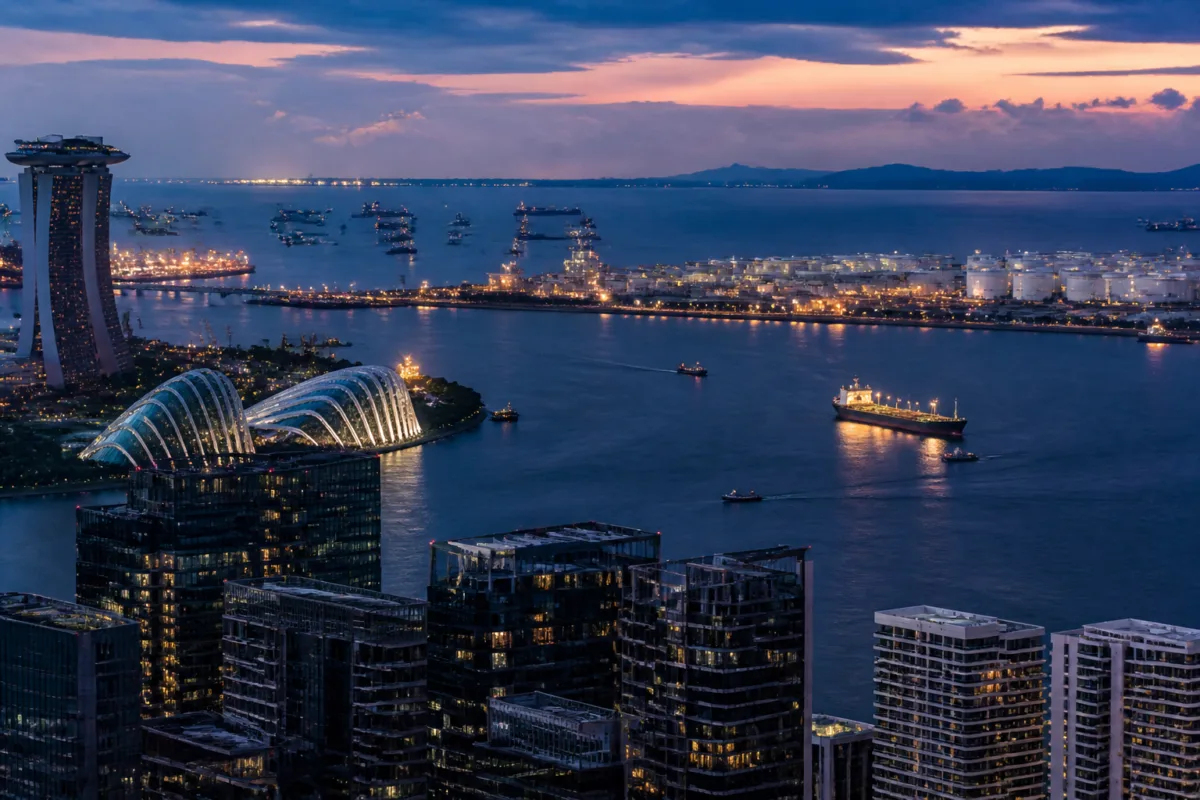
Singapore’s energy security is being tested by the same geography that made the city-state prosperous. Its location at one of the world’s busiest maritime chokepoints helped it become a global centre for shipping, refining, aviation and finance. But that compact, trade-dependent model also leaves essential supplies exposed to decisions made by larger neighbours and to disruptions across regional infrastructure networks.
The latest warning came after Singapore announced measures against 10 Indonesian companies over fires that contributed to haze affecting the city-state. Days later, Indonesia began cutting pipeline natural-gas supplies to Singapore. The reduction represented less than 2% of Singapore’s daily demand, according to the report, and may have reflected Indonesia’s changing domestic requirements rather than retaliation. Yet comments from Indonesia’s energy distribution minister, who warned neighbouring countries to be careful about actions that could affect their exports, made the episode more consequential than its immediate volume would suggest.
The incident illustrates a central problem for small, highly connected cities: diversification can reduce dependence without eliminating vulnerability. Singapore has shifted aggressively towards liquefied natural gas and away from piped energy from Malaysia and Indonesia. That change was driven partly by an expectation that neighbouring economies would consume more of their own gas. A key connection allowing Indonesia to redirect gas domestically was completed only weeks before the reported supply reduction.
In practical terms, Singapore is not dependent on a single pipeline in the way it once was. It has developed LNG capacity and is considering a third import terminal. But imported LNG still arrives through maritime routes that can be affected by conflict, blockades or wider interruptions to shipping. The infrastructure may be more geographically diverse while remaining exposed to the same underlying condition: Singapore does not control most of the resources and routes on which its urban economy depends.
That distinction matters because urban resilience is often measured through installed capacity rather than through control of supply chains. A city may have enough generating equipment, storage or transmission capacity under normal conditions and still face serious risks if fuel, shipping access or cross-border electricity links are disrupted. For Singapore, the question is therefore not only how much energy it can buy, but how many political and physical choke points stand between that energy and the city’s power system.
Singapore’s experience with water offers a useful institutional comparison. After its separation from Malaysia in 1965, concerns about the security of water supplies encouraged a long programme involving desalination, water recycling, rainwater harvesting and reservoirs. The report says those investments now allow Singapore to approach near-self-sufficiency in a crisis. Water security was treated as a long-term national infrastructure project rather than as a problem to be addressed only when a supply interruption occurred.
Energy is more difficult to localise. The physical scale of the city-state limits the amount of land available for large power projects, while its dense urban form creates additional safety and environmental constraints. Nuclear power has been considered at different times, but the report notes that the mandatory evacuation zone established after the Fukushima Daiichi disaster would cover almost the entire country. That does not settle the question of nuclear power, but it shows why technologies that may be viable elsewhere present unusual spatial and governance challenges in Singapore.
Solar power offers another partial solution. Plans to install 4 gigawatts of solar panels by 2035 could require about 5% of the country to be covered by silicon and glass, while supplying barely a tenth of electricity demand. The figures indicate both the scale of Singapore’s ambition and the limits imposed by land scarcity. Solar can reduce imported-fuel exposure, but it cannot by itself replace the energy system that supports a dense city, major port, industrial facilities and globally connected commercial districts.
Singapore is therefore pursuing a wider regional approach. Plans for renewable-energy projects and transmission lines involving Vietnam, Laos, Cambodia, Malaysia, Indonesia and Australia would diversify electricity suppliers. The city-state has also played a role in developing the regional power grid associated with the Association of Southeast Asian Nations. The logic is straightforward: a network of multiple suppliers may be more resilient than dependence on one or two bilateral arrangements.
But regional interconnection creates a second-order vulnerability. Cross-border electricity is not simply a technical matter of building cables and transmission capacity. It depends on political relationships, regulatory coordination, commercial agreements and the continued operation of infrastructure beyond Singapore’s jurisdiction. A connection that diversifies supply during normal conditions could become another point of pressure during a diplomatic dispute or regional crisis. Interdependence spreads risk only when the institutions governing it remain stable.
This is the contradiction at the heart of Singapore’s development model. The city-state became wealthy by positioning itself as a reliable node in networks that linked producers, consumers, ships, airlines, capital and information. Its ports, refineries and other infrastructure converted geographic constraint into economic advantage. Yet the same networks expose Singapore to events that occur outside its borders and beyond the direct control of its authorities.
The historical comparison with Venice helps clarify the concern. Venice also built prosperity around maritime commerce and the management of trade routes. Its wealth, however, could not protect it when Europe’s political order shifted towards revolution, mass armies and nationalism. Napoleon ended the Venetian Republic in 1797, and the territory was subsequently exchanged between larger powers before becoming part of Italy in 1866. The lesson is not that Singapore is following an identical path. It is that commercial centrality offers limited protection when the rules governing power and access change.
The current global environment places greater value on control over chokepoints. The report identifies computer chips, critical minerals, intellectual property and trade flows as areas where states can exercise leverage over rivals. Energy routes are part of the same pattern. A pipeline, port, shipping lane, transmission line or processing facility can become strategically important far beyond its immediate commercial purpose.
For cities, this changes the meaning of infrastructure planning. Resilience cannot be reduced to protecting roads, substations or buildings from local hazards. It also requires understanding external dependencies: where fuel originates, which jurisdictions control the route, whether alternative suppliers can respond quickly, and how many systems depend on the same corridor. Singapore’s reported gas episode shows that a supply interruption need not be large to expose a larger strategic weakness.
The city-state’s policy response has so far combined domestic investment with regional integration. LNG imports, possible additional terminal capacity, solar expansion, renewable projects and cross-border transmission are all attempts to reduce concentration risk. None removes dependence altogether. Instead, they rearrange it across different fuels, technologies, suppliers and political relationships.
That approach may be the only realistic option for a dense city with limited land and few domestic resources. The key institutional challenge is to ensure that diversification is measured against actual failure scenarios rather than against a simple count of suppliers. A system with several sources can still be fragile if they share the same maritime route, financing structure or geopolitical exposure.
Singapore’s energy security debate therefore extends beyond one reported reduction in Indonesian gas supplies. It raises a broader question for urban economies built around openness: how much dependence can a city safely carry when trade routes are becoming instruments of state power? Singapore’s experience confirms that prosperity through connectivity requires constant investment in alternatives, but it also shows that alternatives remain embedded in the same regional and global systems that create the original vulnerability. The next milestones are the city-state’s LNG and solar expansion, its proposed regional transmission links and the way governments manage the political relationships on which those projects depend.

