


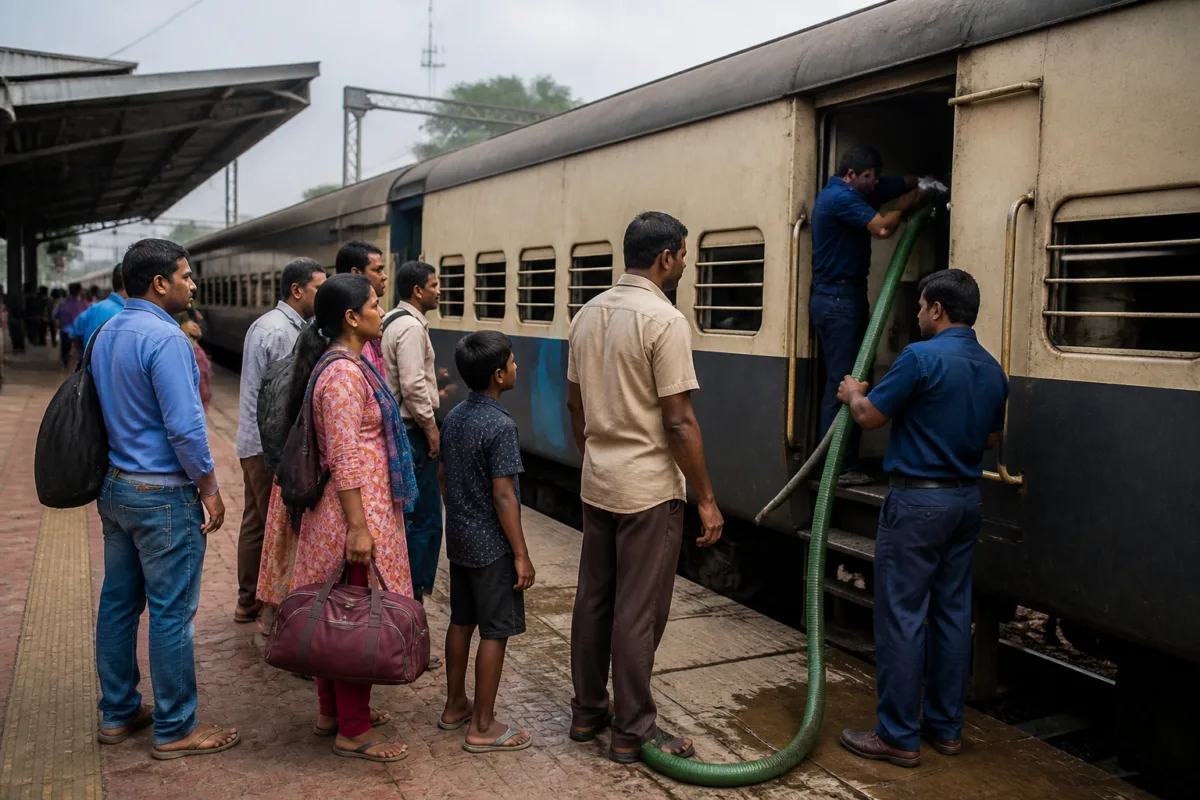
A consumer commission’s order directing South Western Railway to pay ₹16,000 after 24 passengers abandoned a journey because train toilets lacked water puts a basic question at the centre of railway service: when an essential facility fails, what does accountability look like for passengers? The Shivamogga district commission treated the incident not as a minor inconvenience but as a deficiency in service, linking the onboard failure with the absence of assistance at Tumakuru station.
The case involved Nagendra, a resident of Shivamogga, travelling with 23 family members and relatives. The group was travelling from Yeshwantpur towards Shivamogga on train number 66575. They had purchased general tickets worth ₹1,000 in total. During the journey, the passengers complained that the train toilets had no water. At Tumakuru, the family sought help from the station master, but, according to the complaint reported by Aaj Tak Business, the problem was not resolved.
The immediate operational consequence was significant for a relatively basic service failure. The 24 passengers got off the train and bought fresh tickets on another train, spending an additional ₹1,760 to continue their journey. The dispute therefore moved beyond the condition of a single toilet. It became a question of whether passengers should bear the financial and logistical burden when an essential facility fails and no effective response is available at an intermediate station.
That distinction matters in a railway system where service is delivered across several linked points. A passenger’s experience is shaped not only by the train itself but also by the response available at stations, the ability to report a problem, and the mechanism for obtaining timely assistance. In this case, the commission’s reasoning, as reported, connected the absence of water with the failure to provide help at Tumakuru. The journey was interrupted because the passengers could not secure a workable resolution within the service system.
The commission’s order also shows how a routine passenger complaint can acquire institutional weight when it is documented through the consumer-dispute process. After the incident, Nagendra sent a legal notice to railway authorities. The notice, according to the report, received no response. He then approached the Shivamogga District Consumer Disputes Redressal Commission, raising both the inconvenience caused during the journey and the additional expenditure incurred to travel on another train.
The commission passed its order on 23 October. The bench, comprising president T Shivanna and member B D Yogananda Bhandya, directed the railway authorities associated with Bengaluru and Tumakuru to return the original ticket fare with interest. The order required the railway to refund ₹1,000, the value of the original tickets, with annual interest of 6 per cent calculated from 15 April 2025.
The financial award had two additional components. The commission ordered ₹10,000 as compensation for the family’s hardship and ₹5,000 towards litigation expenses. Together with the ₹1,000 fare refund, this brought the immediate amount payable to ₹16,000, with interest applying separately to the original fare as specified in the order.
The order also created a compliance deadline. The railway was given 45 days to make the payment. If it failed to comply within that period, the payable amount would attract annual interest of 10 per cent until the full payment was made. This provision shifts the order from a finding of deficiency to a time-bound administrative obligation. It also makes non-compliance more expensive for the service provider.
The case is important because it identifies water in train toilets as a basic service component rather than an optional amenity. The report does not establish how long the water shortage lasted, whether it affected every toilet on the train, what caused the failure, or which operational unit was responsible for replenishment and inspection. Those details remain absent from the available account. What the order does establish is that the commission considered the lack of this facility, combined with the failure to assist passengers at the station, sufficient to constitute a deficiency in service.
That finding raises an administrative issue that extends beyond this particular journey: the difference between infrastructure provision and infrastructure maintenance. A train may have toilets designed for passenger use, but the public value of that infrastructure depends on water availability during the journey. The case illustrates how a facility can exist physically while failing functionally. For passengers, the distinction is immaterial if the toilet cannot be used when needed.
It also highlights the importance of the response layer in public transport. The passengers did not simply report a defect and continue normally. They approached the station master after reaching Tumakuru, but the problem was not resolved according to their complaint. The eventual decision to leave the train and purchase new tickets indicates that, from the passengers’ perspective, the available response did not restore confidence in completing the journey on the original service.
The additional ₹1,760 spent on new tickets is particularly relevant to the accountability question. The commission’s reported award did not simply reimburse that precise expense. Instead, it ordered a refund of the original fare, compensation for the hardship and litigation costs. This structure separates three kinds of loss: the price paid for the disrupted service, the inconvenience experienced by the passengers, and the expense of pursuing relief. The award therefore recognises both the financial and procedural dimensions of the dispute.
The case also demonstrates the gap between a passenger’s immediate need and a later legal remedy. The family required water and assistance during the journey. The consumer process provided compensation after the event, but it could not restore the interrupted trip or remove the need to buy replacement tickets. The order can address accountability after a failure; it cannot substitute for a reliable operational response when the failure first occurs.
The available report does not indicate whether the railway disputed the passengers’ account before the commission, whether any internal inquiry was conducted, or whether corrective action was taken on train number 66575. It also does not provide the railway’s response to the order. These omissions limit what can be concluded about the underlying cause or the possibility of recurrence. The central finding is narrower: in this reported case, the commission held that the lack of water and the absence of effective assistance amounted to deficient service.
For railway administration, the institutional lesson is therefore about traceability. A passenger complaint needs to reach a person or unit capable of resolving it, and the response needs to be recorded well enough for the service provider to demonstrate what happened. The case, as reported, contains no details of such a resolution record. The lack of a response to the legal notice further became part of the passenger’s route to the consumer commission.
The order also places a value on the ordinary conditions of travel. Public transport discussions often focus on timetables, fares, speed and network expansion. Yet a journey is experienced through smaller systems: sanitation, water, information, station assistance and the ability to continue travelling when something goes wrong. A failure in one of these systems may appear minor when viewed as an isolated maintenance issue, but it can impose costs on passengers, particularly when they are travelling in a large group.
What the case confirms is that essential passenger facilities are connected to service responsibility. What it does not establish is whether the problem was caused by a maintenance lapse, a supply failure, a communication breakdown or another operational issue. It also does not show whether the order has been complied with. Those questions will determine whether the case remains an individual compensation dispute or becomes evidence of a wider maintenance and grievance-redress problem.
The immediate milestone is the 45-day payment period set by the Shivamogga district consumer commission. If the railway does not comply within that period, the order provides for 10 per cent annual interest on the payable amount until payment is completed. That deadline, and any subsequent compliance action, will show whether the compensation order produces only post facto relief or also prompts a documented response within the railway’s service system.

