


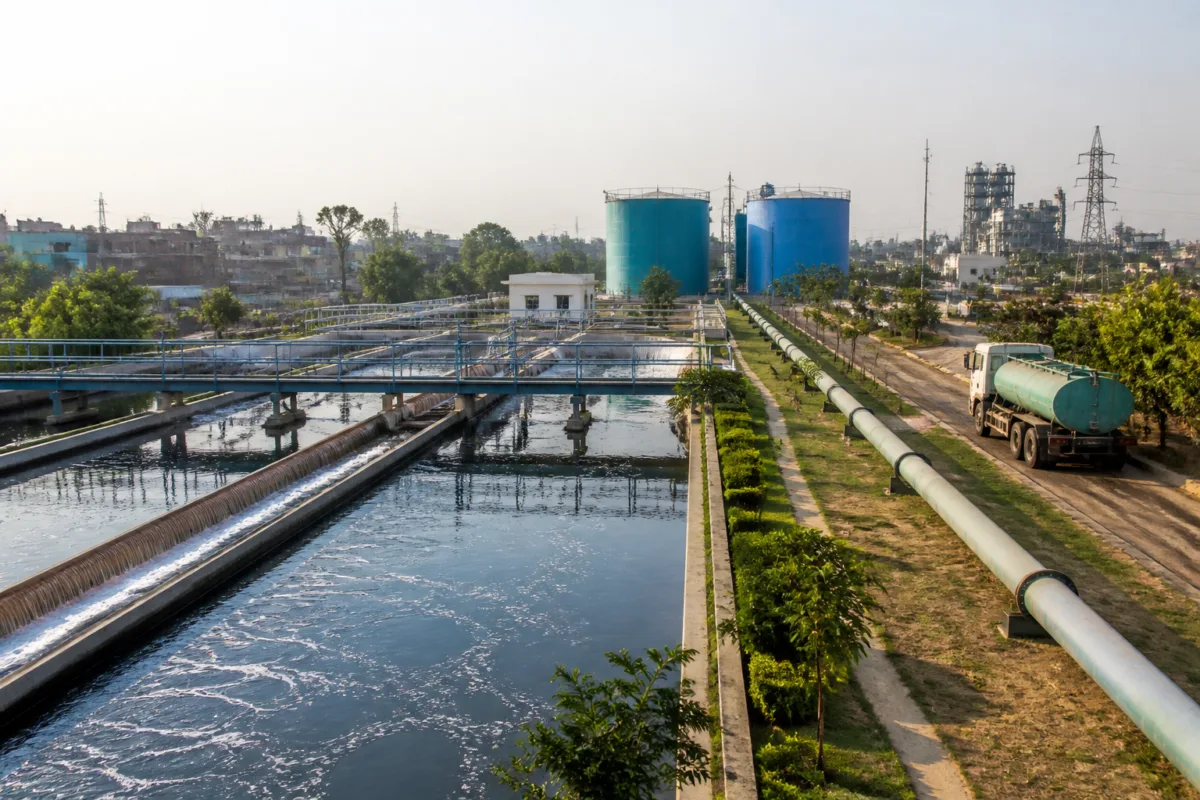
Madhya Pradesh’s draft treated wastewater policy proposes a major shift in how cities use water: sewage treatment plants would no longer be viewed only as sanitation infrastructure, but also as sources of supply for industry, construction, municipal services and selected urban uses. The proposal sets reuse targets of 20% by 2027, 30% by 2030 and 50% by 2037, while placing fresh water and groundwater use under tighter scrutiny.
The draft State Level Policy for Recycle and Reuse of Treated Waste Water, 2026, was released for consultation by Chief Minister Mohan Yadav. Its central premise is that treated wastewater should become a usable commodity wherever its quality is technically suitable and economically viable. That approach addresses a structural weakness in the state’s urban water system: sewage is being collected and treated in some locations, but the resulting water is often discharged rather than returned to productive use.
According to the report, sewerage schemes exist in only 64 of Madhya Pradesh’s 418 urban local bodies. Operational sewage treatment plants have a combined installed capacity of about 1,656 million litres a day, but roughly 1,105 MLD is currently being used. The draft therefore begins with an uneven infrastructure base. Reuse cannot expand uniformly when most urban local bodies do not yet have sewerage schemes, and when existing treatment capacity is not fully connected to reliable users.
This gap is important because wastewater reuse is not only a treatment question. It requires collection networks, treatment plants, quality monitoring, storage, pipelines or tanker systems, pricing arrangements and users willing or required to purchase the treated supply. The Madhya Pradesh proposal attempts to address these links through mandatory-use rules, institutional oversight and financial incentives.
The proposed mandates cover several major categories of urban and industrial demand. Thermal power plants located within 50 kilometres of a sewage treatment plant would have to use treated water, following the Centre’s 2016 tariff policy. Construction activity within five kilometres of a treatment plant or filling station would be required to use treated water supplied through tankers at fixed charges. New industrial estates, new units in Special Investment Regions and large units using more than 10 kilolitres a day of fresh water for non-potable purposes would also have to use treated water where technically suitable and viable.
The draft further proposes linking an industry’s consent to operate with the purchase of treated water. This would move reuse from a voluntary environmental measure into the compliance framework for certain users. The effectiveness of that mechanism would depend on whether treatment plants can deliver consistent quality, adequate volumes and dependable supply at the locations where industries operate.
Municipal bodies would be expected to use treated water for parks, lake rejuvenation, firefighting and vehicle cleaning. New townships may need dual plumbing systems so that treated water can be used for flushing. These provisions distinguish between potable and non-potable demand and could reduce the use of drinking-quality water for activities that do not require it. They also imply additional planning requirements for new urban development, particularly where separate networks need to be designed before construction is completed.
The groundwater provisions are among the draft’s strongest interventions. Fresh water and groundwater would not be allowed for parks, green belts and non-essential landscaping. In water-stressed areas, borewells used for these purposes may be sealed wherever treated water can be supplied. A State High-Powered Steering Committee, chaired by the chief secretary, would be empowered to notify “No Freshwater Zones”, allocate supplies and penalise users who draw fresh water when treated water is available.
This framework places wastewater reuse within the state’s broader water-security administration. It also creates a potential conflict between policy ambition and local implementation capacity. The draft identifies the state-level committee and a technical cell under the commissioner of Urban Administration and Development as the main coordinating institutions. The technical cell would handle approvals, monitoring and quarterly reviews. Urban local bodies, however, would remain central to collection, treatment, distribution and municipal use.
The policy’s implementation challenge is visible in the treatment standards themselves. Additional tertiary treatment will be needed for many uses beyond gardening, road cleaning and basic municipal applications. Sanjay Dubey, additional chief secretary for urban development and housing, told The Times of India that the state already has secondary treatment facilities and would need to develop tertiary ones. He said treated water could be sold to industries facing water shortages at a price below the cost of fresh water.
The draft proposes differential pricing rather than a single uniform tariff. Treated water would cost less than fresh water, while industrial and commercial users would pay more than other categories. Users requiring higher-grade water would bear the additional treatment cost. The approach recognises that treated wastewater is not a uniform product: quality requirements vary between park irrigation, construction, cooling, industrial processing and other uses.
The report cites different quality categories, labelled A to F, ranging from park irrigation to industrial process use. It also records existing supply arrangements that could serve as models. In Gwalior, treated water flows into an irrigation canal network. In Sagar, an agreement has been signed with the Madhya Pradesh Industrial Development Corporation to supply 10 MLD to industry. These examples show that reuse depends on matching treatment output with a defined end user and a distribution arrangement.
Financing is another critical component. The draft proposes combining central schemes such as AMRUT 2.0 and Namami Gange with state grants, corporate social responsibility funds, viability gap funding and a dedicated State TUW Fund. It also encourages private participation through design-build-operate and hybrid annuity models. This expands the possible funding base, but it also creates a need for clear performance standards, tariff rules and responsibility for long-term operations.
The proposed incentives include property tax rebates for on-site recycling, construction permit fee rebates, leased land for tertiary treatment plants and tradeable reuse certificates. These measures are intended to create demand and reduce the cost of adopting recycling systems. Their practical effect will depend on how the state defines eligibility, verifies actual reuse and prevents certificates or rebates from becoming disconnected from measured water savings.
Safety provisions are designed to prevent treated water from entering the potable supply. The draft requires red-coded pipes and covers, “not fit for drinking” markings in English and Hindi, no cross-connections with drinking-water systems and clearly marked tankers. These details matter because a reuse system can create public-health risks if separate networks are poorly designed, inadequately maintained or not clearly identified.
The policy also reveals the limits of treating wastewater as a commodity without first strengthening the underlying urban infrastructure. With sewerage schemes present in only 64 of 418 urban local bodies, the state will need to expand collection and treatment before reuse targets can apply across a broad urban population. Even where treatment plants exist, the current difference between installed capacity and water being used indicates that capacity alone does not guarantee reuse.
The targets therefore function as both environmental goals and infrastructure tests. Reaching 20% reuse by 2027 would require more than issuing mandates. It would require treatment upgrades, users within viable distances, reliable quality, transport or pipeline networks, prices that attract buyers and enforcement against avoidable fresh-water use. The higher targets for 2030 and 2037 would place those requirements on a longer administrative and investment timetable.
The larger urban question is whether Madhya Pradesh can turn wastewater management into a circular urban utility rather than a disposal function. The draft provides a policy architecture for doing so: mandatory users, groundwater restrictions, differentiated quality and pricing, institutional monitoring, public funding and private participation. What remains uncertain from the supplied material is how many treatment plants will receive tertiary upgrades, which cities will be designated as priority zones, how tariffs will be notified and how compliance will be measured.
The consultation draft is therefore significant not because it immediately changes water use across the state, but because it proposes to connect sanitation, industrial supply, construction regulation, groundwater protection and urban finance within one framework. The next decisive steps will be the policy’s finalisation, the identification of eligible treatment plants and users, and the creation of the monitoring and pricing systems needed to make treated wastewater a dependable urban supply.

