


The reported sight of a catering worker carrying tea bags in a trouser pocket on the Mangala Superfast Express is more than an isolated service lapse. It exposes a basic contradiction in Indian Railways: passengers may receive improved trains and upgraded interiors, while the workers responsible for food and beverage service continue to operate without the equipment, sanitation facilities and rest arrangements needed to deliver safe and reliable service.
The incident, reported from Thiruvananthapuram, drew public attention after MP John Brittas shared a video on social media. The video was recorded by Supreme Court lawyer P V Dinesh, according to the report. Brittas urged Railway Minister Ashwini Vaishnaw to examine the matter and referred to the need for strict enforcement of Food Safety and Standards Authority of India protocols for passenger health.
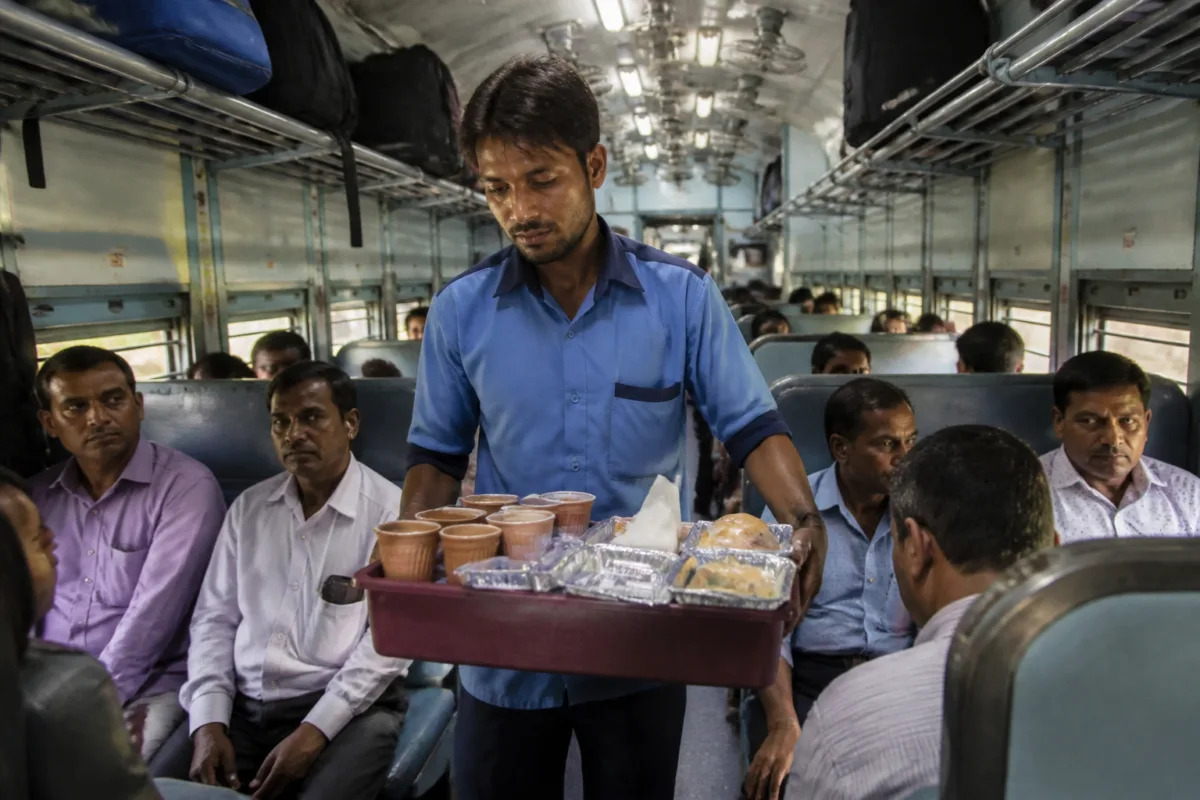
The central issue is not simply the absence of a trolley. It is the way a mobile workplace has been organised. Catering staff on long-distance trains are expected to carry food packets, snacks, tea and coffee through moving coaches, often using plastic trays because proper food trolleys are unavailable. When the trays become difficult to carry, they are reportedly placed wherever space is available, including near doors and toilets. The same constraint affects workers serving hot beverages, who lack an appropriate way to carry their supplies.
This creates a direct connection between labour conditions and passenger-facing hygiene. Food safety on a train is not determined only by the quality of ingredients or the presence of a kitchen. It also depends on how food is stored, transported and handled between preparation and sale. If workers do not have designated equipment or clean storage spaces, the burden of maintaining standards shifts onto individuals working in an inadequate system.
The report also describes a wider lack of basic facilities. On long-distance services, catering teams travel with the rake and return with it when the train completes its journey. They stay in pantry cars where those facilities exist. On trains without pantry cars, they reportedly sleep wherever space is available. Designated accommodation is available only to coach attendants in AC coaches, according to the report.
Sources cited in the report said catering workers sometimes go without bathing and are forced to use facilities at railway yards where rakes are parked. A member of the Divisional Railway Employees Union said workers on long-distance trains may work for up to 19 consecutive days without adequate bathing, food-storage or resting facilities. The account points to a work arrangement in which the train is treated as both a workplace and a temporary living space, without the infrastructure normally associated with either.
The union’s proposed remedy is rotation. Staff, it said, should be rotated every eight hours. Such a system would address fatigue and provide opportunities for workers to leave the rake, access basic facilities and return to duty. The union member also argued that rotation could make it easier to offer regional varieties of food on trains. The immediate importance of the proposal, however, is that it links service quality to the length and structure of shifts rather than treating catering as a simple retail activity.
Pay is another part of the system described in the report. Many workers are said to receive between Rs 8,000 and Rs 12,000, with some also earning commissions. The commission structure can encourage workers to sell more products, particularly when their fixed income is low. That does not establish misconduct by individual workers. It does show how the employment model can place commercial pressure on staff who already lack proper equipment and rest arrangements.
The contracting structure has also changed over time. According to the union member cited by the report, catering contracts were initially awarded for individual trains. The system later moved towards base kitchens and has now shifted to an overall contract model. Yet the report says service quality has not improved because work is often sub-contracted. It further cites sources who said one enterprise handles close to 90% of the contract, while arguing that the arrangement has not produced sufficient improvements.
This is the institutional question at the heart of the matter: who is responsible when service is delivered through several layers of contracting? The passenger sees one catering worker, one tray and one packet of food. The operational chain may involve the Railways, a primary contractor, a sub-contractor, a kitchen operator and workers employed under different terms. If responsibility is dispersed, enforcement can become equally fragmented.
The report says pantry and food-and-beverage staff can be fined for failing to maintain hygiene. A railway official also said instructions had been issued for routine checks of pantry cars. These measures address the visible end of the problem, but the report indicates that contractors are not held accountable in the same way. Penalising frontline staff without examining whether they were given trolleys, storage areas, bathing facilities and reasonable shifts risks treating a structural failure as an individual failure.
The distinction matters for both worker welfare and passenger safety. Hygiene instructions cannot be implemented consistently if workers have nowhere to store supplies, rest or wash. A routine inspection may identify a dirty pantry or an improperly handled item, but it may not explain why a worker was carrying supplies in unsuitable conditions or why staff remained on board for extended periods. Effective accountability would have to examine the full chain of responsibility, including the resources made available by contractors and the oversight exercised by the Railways.
The contrast with Vande Bharat trains makes the gap more visible. The report notes that food trolleys have been introduced in executive class on Vande Bharat services, but that the Railways has not yet formulated a policy allowing food trolleys on all trains. This suggests that a passenger-facing improvement exists within one part of the network without being treated as a common operational standard.
The difference is not only about appearance. A trolley can reduce the physical burden on staff, make food and beverage movement more orderly and limit the need to place trays in unsuitable locations. Extending such equipment across services would still not resolve the problems of bathing, sleeping, storage, pay or shift rotation, but its limited availability shows that the network already recognises the operational value of better service equipment in at least some trains.
The report therefore connects three layers of the railway system. The first is the passenger interface: food and beverages being sold inside coaches. The second is the labour system: wages, commissions, shifts, accommodation and access to sanitation. The third is the governance system: contracts, sub-contracting, inspections, penalties and the absence of a network-wide trolley policy. The incident became visible at the first layer, but the causes described in the report extend across all three.
This is also why catering should not be treated as a minor amenity compared with trains, stations or tracks. Food service is a routine part of long-distance travel, and its quality depends on infrastructure that is often less visible than the rolling stock. A modern coach does not automatically create a modern service environment if the people working inside it lack basic facilities.
The evidence supplied in the report does not establish how widespread every cited practice is across the railway network, nor does it provide a complete audit of catering contracts, worker conditions or hygiene violations. It does, however, identify specific gaps: the reported absence of trolleys on many trains, inadequate rest and bathing facilities, extended periods of work, low reported pay, sub-contracting and limited contractor accountability. These are sufficient to frame the issue as an institutional service problem rather than a single embarrassing video.
The immediate official response described in the report is routine pantry-car checks and penalties for staff who fail to maintain hygiene. The larger question is whether those checks will be accompanied by changes to equipment, staffing, worker rotation, accommodation and contract oversight. Until those elements are addressed together, the responsibility for delivering quality rail catering will continue to rest heavily on workers who, according to the report, are not being given the conditions required to meet that expectation.

