


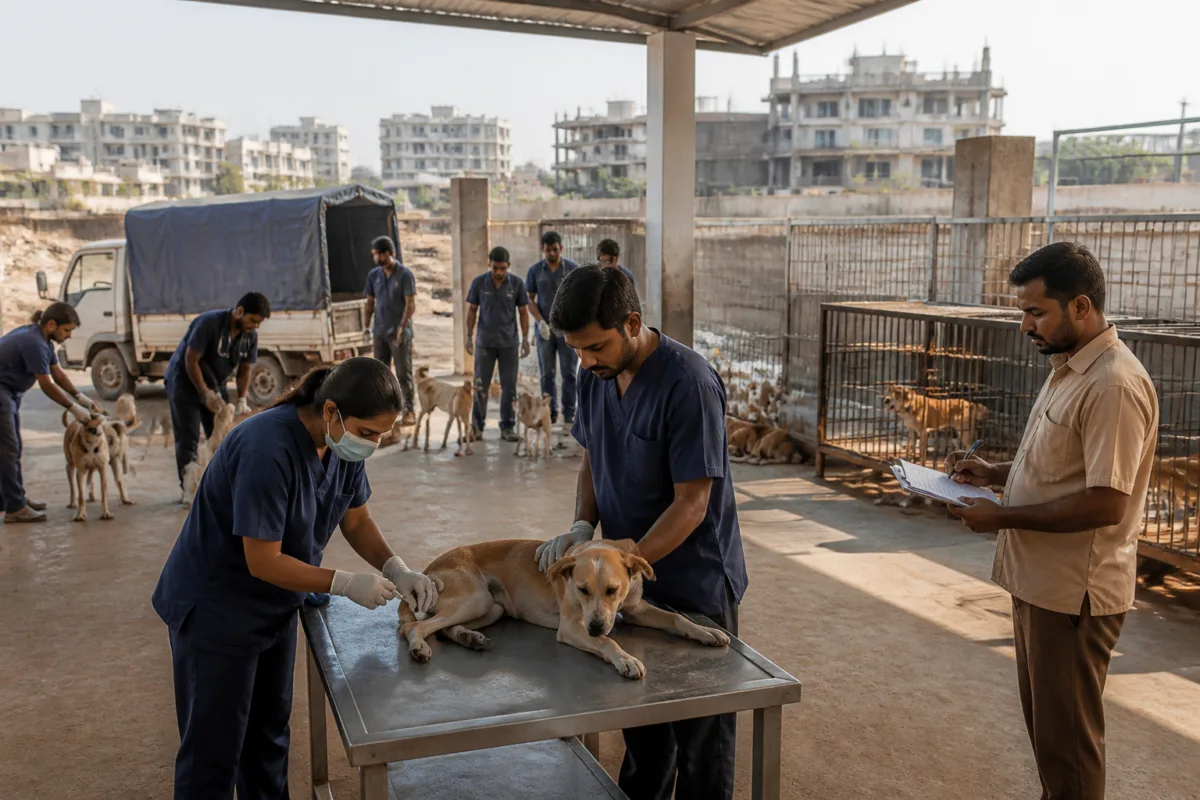
The Gujarat High Court’s review of stray dog control has exposed a basic administrative problem: 13 of the state’s 34 districts do not have an Animal Birth Control (ABC) centre, while sterilisation and vaccination data has been submitted for only 17 districts. The figures suggest that the challenge before the state is not limited to controlling the stray dog population, but also to building the district-level system needed to measure and deliver that control.
The disclosure came during a suo motu public interest litigation being heard by the Gujarat High Court after directions from the Supreme Court. The apex court has asked high courts to monitor compliance with measures intended to address stray dogs in public places and institutional premises, including sterilisation and vaccination programmes. Gujarat’s high court is required to submit a report on the state’s compliance, bringing municipal operations, veterinary capacity and data reporting under judicial scrutiny.
The case is significant because the court’s review is testing whether the state’s response exists as a functioning network or only as a collection of local interventions. The state government, ABC centres, municipal corporations and other authorities have been furnishing details of their actions. Those details, as placed before the court, show uneven coverage across districts and gaps in the information needed to assess results.
According to the state government’s affidavit, 13 of Gujarat’s 34 districts have no ABC centre. Twelve other districts have only one centre each, although proposals have been made to establish an additional centre in each of those districts. Senior counsel Megha Jani, acting as amicus curiae in the matter, told the court that having an ABC centre was “the first requirement to start with”.
The point goes to the administrative foundation of the programme. Sterilisation and vaccination cannot be carried out at scale without facilities, veterinary arrangements, trained personnel and systems for tracking the animals treated. Where a district has no centre, the state must either create one or demonstrate how a nearby facility can reliably serve that district. The affidavit indicates that the first option is not yet available across the state.
Government pleader GH Virk told the court that the state did not have a facility in every district, but that larger centres served the requirements of nearby districts. He also said efforts were under way to create facilities in every district. The court record, as reported, does not establish the capacity of each existing centre, the distance travelled by animals from uncovered districts, or the frequency with which those centres serve neighbouring areas.
That missing operational detail matters. A centre located in one district may technically serve several others, but its effectiveness depends on capacity, transport, staffing, treatment throughput and the ability of local bodies to identify and bring animals for sterilisation and vaccination. The material placed before the court, as summarised in the report, does not provide a consolidated state-level picture on those measures.
The data gap is equally important. Information on the sterilisation and vaccination of stray dogs has been furnished for only 17 districts. The court was therefore given a partial account of programme activity, even as it considers compliance across all 34 districts. Without comparable information from every district, it is difficult to determine whether low coverage reflects a lack of activity, a failure to report, or both.
This is not simply a statistical weakness. District-wise data is the basis for identifying areas with inadequate coverage, allocating veterinary resources and setting timelines for corrective action. It also allows the court and the state administration to distinguish between the existence of a facility and the delivery of a functioning public programme. The current information, according to the report, does not yet provide that complete comparison.
The hearing also brought attention to adoption. The number of dog adoptions recorded was four, and the details submitted related only to Ahmedabad. That figure is not enough to establish the wider role of adoption in Gujarat’s stray dog management system, but it does show that adoption data is currently limited in both scale and geographic coverage in the material presented to the court.
The court was also given figures on action involving institutional premises. Authorities inspected 79,150 institutions and removed 754 stray dogs, according to the government pleader. A total of 7,130 institutional premises were described as having been cleared of stray dogs, while 6,478 nodal officers had been appointed to monitor and deal with the issue.
These figures demonstrate that the state has created an administrative response beyond ABC centres. Inspections, removals and nodal officers are components of a broader compliance structure for schools, hospitals, government buildings and other institutional premises. But the figures do not, by themselves, show how inspections were prioritised, what standards were used to declare premises clear, where removed dogs were taken, or how follow-up monitoring is being conducted.
That distinction is central to the policy problem. Removing dogs from an institutional premises is different from managing the population through sterilisation and vaccination. The former addresses an immediate location-specific concern; the latter is a continuing municipal and veterinary function. The court’s focus on ABC centres, district coverage, vaccination and sterilisation indicates that both types of intervention are being considered as part of the compliance framework.
The suggestion from the bench that the government maintain a buffer stock of anti-rabies vaccine in every district adds another layer to the system. The proposal, made by the bench of Acting Chief Justice MR Pathak and Justice Nirzar Desai, recognises that vaccine availability has to be organised geographically rather than treated only as a central or urban supply issue. The report does not state the proposed quantity, storage arrangements, replenishment mechanism or agency responsible for maintaining the stock.
Those implementation details will determine whether a district-level buffer becomes a usable public-health measure. A stock can be counted as available while still being difficult to access if storage, distribution, cold-chain management or responsibility for release is unclear. The court’s suggestion therefore places attention on the operational chain connecting state authorities, districts, municipal bodies and institutional premises.
The legal framework has also changed the nature of routine municipal reporting. The Gujarat High Court is not hearing the issue solely as a local complaint about stray dogs. It is monitoring compliance with directions issued by the Supreme Court, while seeking affidavits and supporting documents from the authorities involved. This requires the state to present evidence that is not only action-oriented but also complete, district-wise and time-bound.
The amicus curiae specifically noted that timelines for actions should be mentioned. That request addresses one of the most persistent weaknesses in infrastructure and governance programmes: announcements of proposals do not establish when facilities will be built, when services will begin or how progress will be measured. In Gujarat’s case, proposals for additional ABC centres and efforts to create facilities in uncovered districts will need to be connected to dates, responsibilities and documentary progress if they are to be assessed meaningfully.
The court has ordered advocates representing the respondents to file necessary affidavits along with all relevant documents on or before November 3, 2026. Those filings are expected to provide the next formal stage in the court’s review. Based on the material currently reported, it remains uncertain whether the additional documents will contain complete data for all districts, detailed capacity information for existing centres, and implementation timelines for proposed facilities.
The evidence available so far confirms three connected facts: district-level ABC infrastructure is incomplete, sterilisation and vaccination reporting is partial, and the state is using multiple administrative measures to respond to concerns in institutional premises. It does not yet establish the overall effectiveness of the programme or allow a district-by-district comparison of outcomes.
That is the larger urban question raised by the hearing. Stray dog control depends on the coordination of municipal administration, veterinary services, public-health preparedness, institutional monitoring and reliable data. Gujarat’s compliance review shows that the first challenge is still to make those functions available and measurable across the state. The affidavits due before the high court will indicate whether the response is moving from scattered capacity and partial reporting towards a complete district-level system.

