


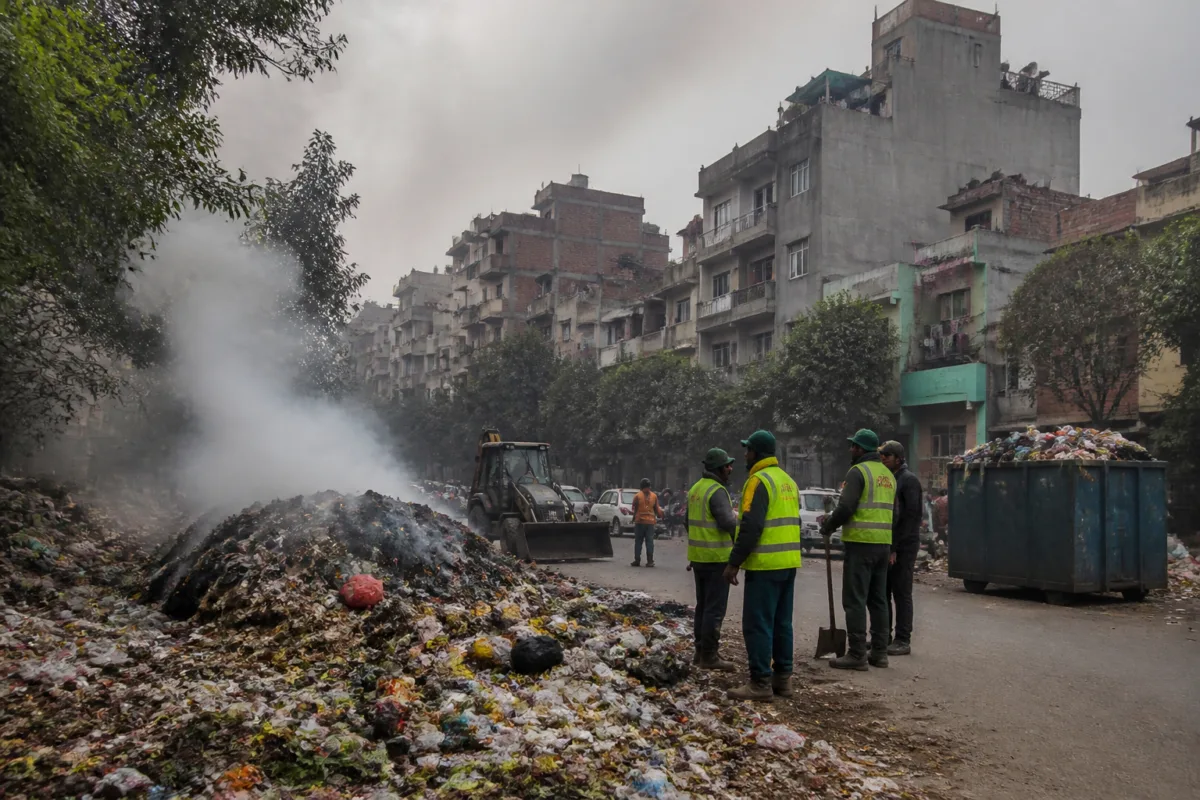
New real-time source apportionment data has placed waste burning at the top of Delhi’s air-pollution sources, but the significance of the finding extends beyond a daily ranking. It shows how failures in collection, segregation, processing and enforcement can become an atmospheric problem, particularly when winter conditions make local emissions more difficult to disperse.
Waste burning contributed 20.4% of Delhi’s air pollution on Tuesday, according to the new data, overtaking vehicles at 19.6%. The share of waste burning was 18.4% on Monday, when it ranked second behind vehicular emissions. Between October 22 and 26, its daily contribution was below 5%, before rising sharply over the following two days.
That rapid change is important because it connects pollution levels with an urban service that is expected to operate continuously: the handling of municipal waste. The category includes the burning of municipal, plastic and rubber-containing waste. The data also separately recorded roadside or open biomass burning at 2.6%, wood burning at 2.5% and dung-cake burning at 2.2%.
The figures come from real-time source apportionment data provided through the Indian Institute of Tropical Meteorology’s new Integrated Atmospheric Chemistry and Aerosol Toxicity Analysis Laboratory. The laboratory was inaugurated on October 24 at New Rajendra Nagar and is intended to provide more immediate information on the sources contributing to Delhi’s pollution.
This changes the administrative question facing the city. Instead of treating every pollution episode primarily as a question of traffic, construction dust or regional emissions, authorities now have a more visible way to track how much pollution is linked to waste being burned within the city. The source data does not by itself identify every location or explain every cause, but it makes the waste-management chain central to the response.
Delhi’s waste-burning problem is not new. Burning garbage, wood, garden waste and plastic waste has long been identified as a major source of winter pollution. What the latest data adds is a real-time indication of how quickly the contribution can rise. A source that accounted for less than 5% on several days reached 20.4% within the same reporting period, showing that pollution-control plans cannot rely only on seasonal advisories or occasional inspections.
Sunil Dahiya, founder of think tank Envirocatalyst, described the data as confirmation that waste burning is a consistent contributor to Delhi’s winter air pollution. He said the emissions were local and preventable, and argued that implementation, rather than additional advisories, was required.
Dahiya proposed that the Municipal Corporation of Delhi publish ward-level daily mass balances showing how much waste is generated, collected and processed. Such accounting would make the gaps between generation and final treatment visible. If waste is generated but not collected, it may accumulate in public spaces. If it is collected but not processed, it can be diverted, dumped or burned. Without ward-level data, these stages remain difficult for residents and administrators to compare.
He also called for segregation and decentralised composting to be enforced, beginning with bulk generators. His position points to a practical distinction in municipal management: preventing burning requires more than penalising the final act. It requires ensuring that different waste streams are separated, collected and sent to facilities or uses that can handle them.
Anumita Roychowdhury, executive director of research and advocacy at the Centre for Science and Environment, linked Delhi’s waste burning to incomplete implementation of the Swachh Bharat Mission’s objectives. Those objectives include universal segregation, collection, material recovery and remediation of legacy waste sites.
Roychowdhury said unsegregated waste accumulates in public spaces vulnerable to open fires when these systems do not fully mature. She called for stronger accountability for city-wide collection and segregation in both formal and informal settlements, material recovery facilities that integrate informal recyclers, industrial off-takers for processed fractions, clean winter heating for low-income groups and proactive neighbourhood monitoring.
This institutional chain matters because waste burning is often visible only at its endpoint. A fire on a roadside can be treated as an enforcement incident, but the conditions that allowed the waste to reach that site may involve household segregation, collection schedules, contractor performance, transfer stations, processing capacity and the availability of buyers for recovered material. A narrow enforcement response risks recording fires without resolving the service failures that repeatedly produce them.
The enforcement numbers show that the Municipal Corporation of Delhi has increased action. In 2025, the civic body issued 784 challans for open or biomass burning and imposed penalties of Rs 8.7 lakh. In 2024, it issued 191 challans and imposed penalties of Rs 4.4 lakh. The increase indicates a stronger enforcement effort, but challan counts and penalty totals do not establish whether the volume of waste burning has fallen. They measure administrative action, not necessarily environmental outcomes.
The MCD has constituted joint enforcement teams under its winter action plan. These teams monitor and inspect biomass burning, dust pollution from construction and demolition activities, the use of unauthorised fuels, illegal dumping of construction and demolition waste or garbage, and construction and demolition waste storage or dumping sites. A civic official said 623 staff had been deployed in enforcement teams and another 600 in ward-level teams.
The deployment gives the city a larger enforcement presence, but the new source-apportionment data raises a further question: how will enforcement be connected to measurable reductions in emissions? Dahiya argued that open burning should be penalised throughout the year rather than only under the Graded Response Action Plan, and that National Clean Air Programme funds should be linked to measurable reductions in burning incidents.
That question is particularly relevant because winter action plans tend to concentrate attention during periods of severe air pollution. Yet the waste system operates throughout the year, and the causes of burning may develop well before pollution levels trigger emergency measures. Seasonal enforcement can respond to visibility and public pressure, while continuous monitoring would be better suited to identifying recurring gaps in collection, segregation and processing.
The data also complicates the idea that Delhi’s air pollution can be addressed through a single dominant intervention. Vehicles ranked second on Tuesday, contributing 19.6%, while different forms of biomass and solid-fuel burning added further shares. The source profile changed from day to day, with waste burning moving from below 5% during October 22 to 26 to the leading source two days later. This variability means that policy must be capable of responding to changing local sources rather than applying one fixed explanation to every pollution episode.
For residents, the issue is experienced at street level. Uncollected or mixed waste can remain in public spaces, while smoke from burning affects nearby homes, markets, streets and workers. The supplied data does not establish how many neighbourhoods were affected or identify the specific sites responsible for the latest increase. It does, however, show that a municipal waste-management failure can register across the city’s pollution profile.
The new laboratory creates an opportunity for a more accountable approach, provided the information is connected to action. Real-time source apportionment can show when waste burning rises, while ward-level records could help show where waste was generated, collected, processed or left unaccounted for. Together, these systems could move the discussion from broad seasonal warnings towards measurable municipal performance.
The evidence currently confirms three points. Waste burning can become Delhi’s leading recorded pollution source within a short period; the activity is closely connected to gaps in urban waste management; and the MCD has expanded enforcement but still needs outcome measures that show whether burning is actually declining. The next test will be whether the city uses real-time pollution data to strengthen daily collection, segregation, processing and year-round enforcement before winter conditions intensify the consequences.

