


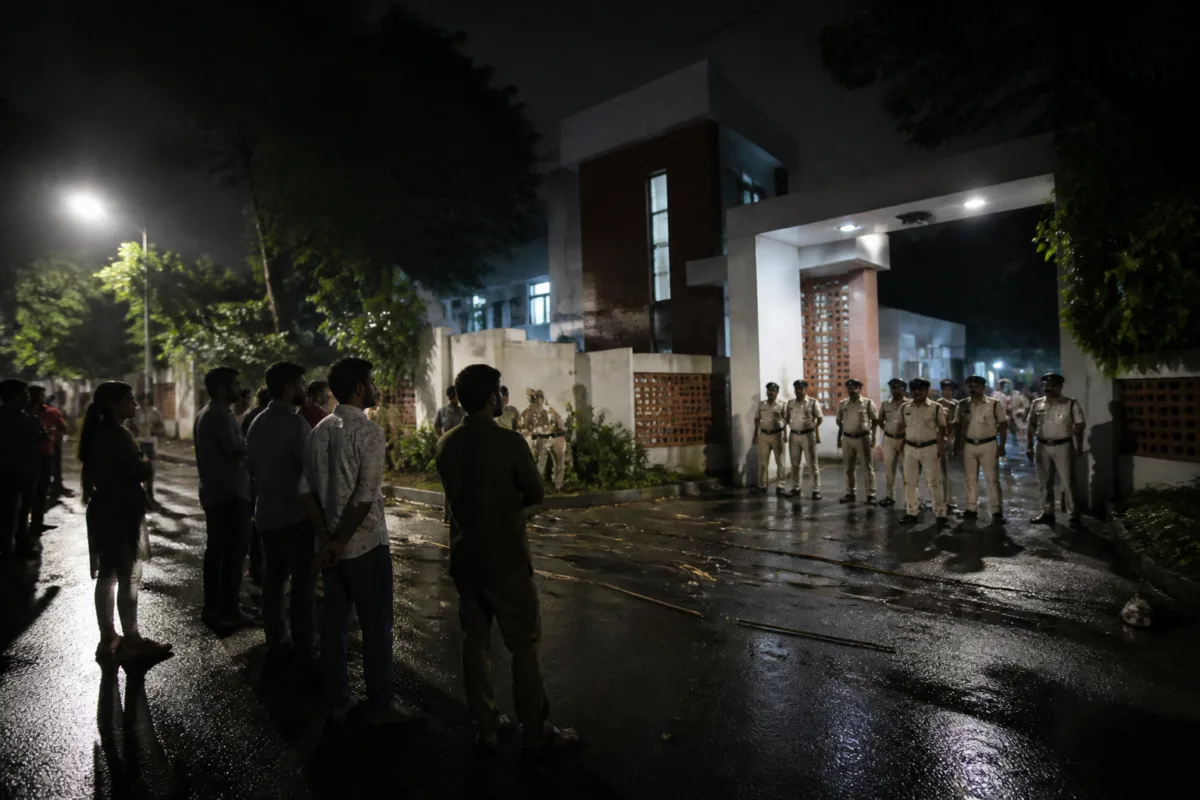
The entry of around 60 police personnel into the Satyajit Ray Film and Television Institute campus in Kolkata after a torchlight march and effigy burning has turned a dispute over student protest into a wider institutional conflict over safety, dissent and administrative control. The episode, reported by the Times of India, is significant not only because police entered the campus at around 11.30 pm on Tuesday, but also because the administration, students and faculty now appear to be operating with sharply different understandings of what campus security should mean.
According to the report, the police entry was the first such incident in SRFTI’s 30-year history. It followed reports that students had held a torchlight march and burned an effigy. The administration viewed the events as a potential threat to people and institutional property. The students’ union, however, described the police presence as an attempt to frame democratic dissent as a security problem and to normalise surveillance and what it called the militarisation of the institute.
That disagreement is the central issue. A campus can require protection from violence, intimidation and damage, while still needing procedures that do not treat all protest as an operational threat. The SRFTI dispute shows how quickly the boundary between preventing harm and restricting dissent can become contested when an institution lacks a commonly accepted process for dealing with protests, disciplinary action and security deployment.
Vice-chancellor Santosh Ajmera defended the decision to bring police inside the campus. He said the event could not be considered a peaceful protest because students were joined by others and claimed there was a possibility of major damage to institutional property and danger to people on campus. Ajmera also referred to earlier incidents of vandalism, intimidation and physical abuse involving him, saying that six students had been rusticated as a result.
His account places the police deployment within a longer sequence of reported tensions rather than presenting it as an isolated response to one night’s protest. The administration’s stated concern is therefore not simply the torchlight march or the burning of an effigy, but the cumulative question of whether it can ensure the safety of students, faculty and staff when tensions escalate. The available report does not provide independent findings on the earlier incidents or details of the disciplinary proceedings, so the basis and process of those actions remain important parts of the unresolved dispute.
The students’ union has offered a fundamentally different interpretation. It condemned the midnight entry and rejected the administration’s description of student resistance as a threat used to justify surveillance and militarisation. The union argued that film schools must remain spaces for critical thought, artistic experimentation, political debate and democratic dissent. It also accused the administration of failing to respond adequately when students had previously faced attacks and safety threats, while demanding equal protection and accountability.
These positions reveal an institutional gap that cannot be settled by security deployment alone. The administration is concerned with immediate risk and the protection of people and property. Students are questioning who defines that risk, how security decisions are authorised and whether police presence can become permanent. Both concerns are connected to the same governance problem: the absence, at least in the reported account, of an accepted framework that distinguishes between lawful protest, unsafe conduct, intimidation, violence and property damage.
Faculty members have attempted to occupy that space between the two sides. More than 30 faculty members issued a written appeal to the registrar seeking the withdrawal of police personnel. On Wednesday, faculty held a day-long meeting with the vice-chancellor to discuss campus safety and student welfare. The meeting reportedly included altercations and walkouts, but ended with faculty urging dialogue, withdrawal of the police and restoration of all hostel amenities.
The faculty response is important because it does not simply reject the administration’s safety concerns. Its reported appeal seeks both campus security and a different method of addressing the crisis. At the same time, faculty members did not refer to the students’ demand for the reversal of the rustication of six students. That omission leaves one of the dispute’s most consequential issues outside the immediate faculty intervention. For the students, the disciplinary orders appear to be a core grievance; for the administration, they are linked to earlier incidents that it considers serious enough to justify action.
The conflict has also begun to affect SRFTI’s institutional representation. In their letter to the registrar, faculty members said they would defer representing the institute at external forums until the concerns had been addressed. This includes rejecting plans to represent SRFTI at the International Film Festival of India in Goa. The decision connects an internal campus dispute to the institute’s public and professional role: an unresolved governance crisis can affect not only daily campus life but also how an institution participates in the wider film and education ecosystem.
The reported protest methods have created another layer of disagreement. Some faculty members viewed torchlight marches and effigy burning as common forms of dissent, while others considered the use of fire dangerous. One faculty member quoted in the report said that protest was acceptable but that the act could injure someone, adding that parents would hold the administration responsible if a student were hurt.
This distinction matters. Protecting the right to protest does not remove the responsibility to prevent avoidable injury. Conversely, the possibility that a protest method is unsafe does not by itself establish that all participants pose a threat or justify an indefinite police presence. The institutional task is to establish proportionate rules, communicate them clearly and apply them consistently. The supplied report does not indicate that such a framework has been publicly agreed upon at SRFTI.
The episode therefore raises three linked questions about campus governance. First, what threshold should trigger police deployment inside an educational institution? Second, who independently reviews whether that threshold has been met? Third, what mechanisms allow students, faculty and administrators to contest security decisions without escalating the confrontation? The report records competing claims but does not identify a formal campus security protocol, an independent inquiry or a negotiated resolution to these questions.
The timing and location of the police entry have intensified the dispute. It occurred late at night, after a protest involving fire, and inside an institute that the students’ union defines as a space for critical and political expression. For the administration, the same setting created a heightened risk requiring urgent intervention. Because the event involved both an immediate safety concern and a contested political meaning, any response was likely to be judged not only by whether it prevented damage, but also by whether it preserved trust in the institution.
The available evidence confirms that the administration, students’ union and faculty are not merely disagreeing over one incident. They are contesting the terms under which safety, discipline and dissent are managed at SRFTI. The vice-chancellor has cited previous incidents and the need to protect people and property. The union has challenged the use of police and demanded accountability. Faculty members have called for withdrawal of the police, dialogue and the restoration of hostel amenities, while holding back from endorsing the demand to revoke the rustication orders.
What remains unresolved is whether the institute can convert these competing positions into a transparent process. The next significant developments will be the administration’s response to the faculty appeal, the status of police personnel on campus, the handling of the six rustication orders, the restoration of hostel facilities and any further action connected to the proposed IFFI representation. Until those questions are addressed, the police entry will remain a symptom of a deeper breakdown in institutional trust rather than a settled solution to campus safety.

