


United Breweries’ latest results point to a shift in India’s beer market that is as much about manufacturing geography and state policy as it is about consumer preference. The company’s 24 per cent year-on-year rise in net sales to ₹2,536 crore and 190 per cent increase in profit after tax to about ₹135 crore in the second quarter of FY27 were accompanied by a 16 per cent increase in volumes, a 38 per cent rise in premium beer volumes and a substantial improvement in operating margins. But the company’s account of that performance also reveals the infrastructure and governance conditions required to make beer more widely available across India.
In an interview with The Hindu BusinessLine, United Breweries Managing Director and Chief Executive Officer Vivek Gupta attributed the quarter’s performance to premiumisation, improved price and state mix, policy changes in some markets and better local production. He said the company expanded gross margins by nearly 200 basis points despite what he described as a ₹300-350 crore impact from the West Asia conflict and related cost pressures.
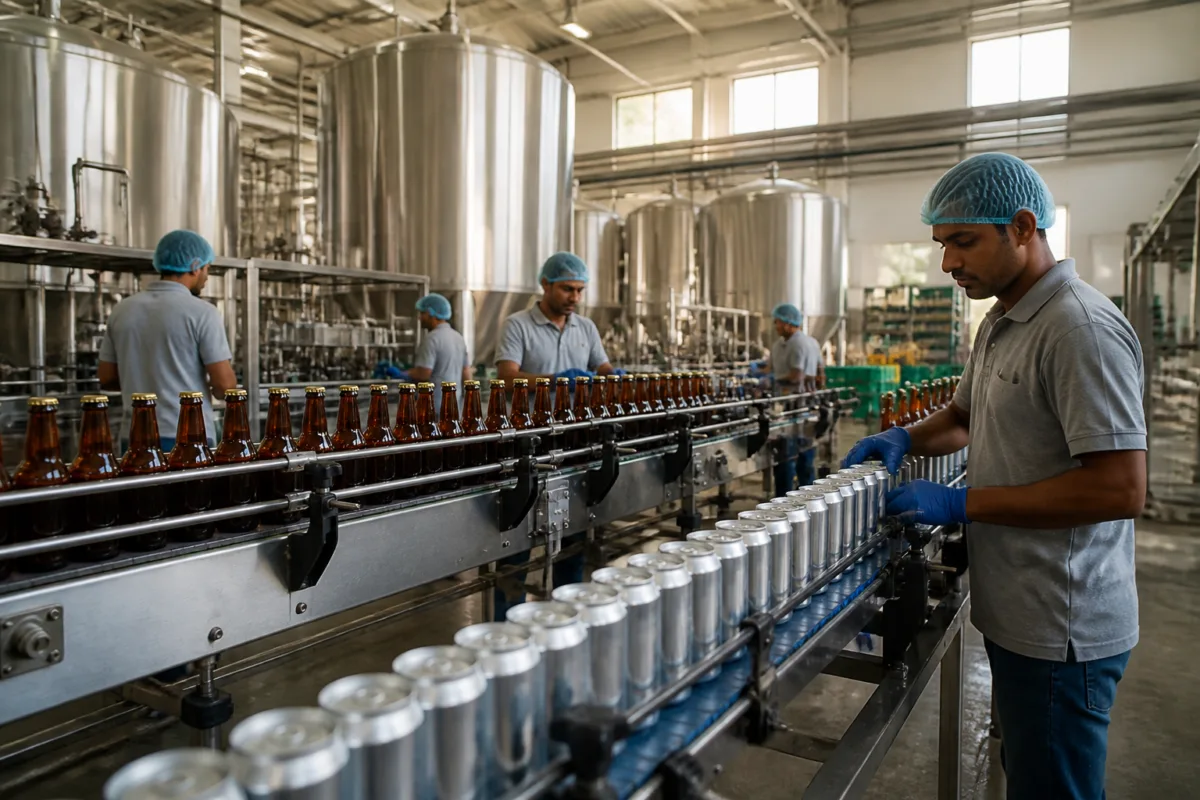
The central message from the interview is that beer is being treated by the company as a local manufacturing business. That has implications for where breweries, canning lines, malting units, packaging suppliers, cold-storage infrastructure and distribution networks are located. It also places state governments at the centre of category growth because alcohol policy, pricing, availability and payment systems are administered largely through state-level frameworks.
The shift towards local production is particularly important for premium brands. Gupta said that, two years ago, UBL’s premium margins were nearly 1,000 basis points behind because premium products were being transferred from one state to another. The company has since localised production of Kingfisher Ultra, Ultra Max and Heineken products in its breweries. According to the company, Kingfisher Ultra grew 47 per cent after production was localised, while Heineken Silver grew 67 per cent, with the brand being produced locally in Karnataka breweries.
This does not simply reduce the distance between a brewery and a consumer. It also changes the economics of the supply chain. Gupta described beer as a local business with high logistics costs when products are moved between states. The company plans to invest in a new brewery in Uttar Pradesh, expected to become operational in September next year, where it will produce Heineken. UBL is also investing in a can line in Maharashtra and Telangana.
The interview does not provide the capacity of the Uttar Pradesh brewery, the investment value of the projects or their expected employment impact. It does, however, establish the company’s rationale: local production is intended to improve availability, reduce the burden of inter-state movement and support the growth of premium products. For a country where manufacturing capacity and consumption markets are often separated by administrative borders, the location of production becomes an operational and policy question rather than a purely corporate one.
The policy dimension is equally significant. Gupta credited policy changes in Karnataka and Maharashtra, along with improved beer availability in Jharkhand and Assam, for contributing to category growth. He said 70 to 80 per cent of the quarter’s growth, after isolating the impact of weather in the previous year, was linked to policy interventions and the company’s premiumisation strategy. That is a statement from the company and not an independently verified assessment, but it shows how directly industry performance is tied to state-level decisions.
Pricing is another point of institutional dependence. Gupta said pricing was critical in Tamil Nadu, Andhra Pradesh and Telangana, where the company was “on the borderline of losses” if price increases did not reflect cost conditions. He also said UBL was working with the new Tamil Nadu government for what it described as a fair policy on beer. In Telangana, he referred to overdue payments to manufacturers and argued that delayed payments make it difficult for companies to continue investing in the category.
These remarks highlight a governance issue that is often less visible in consumer-market reporting: a product may be locally manufactured, but its commercial viability can still depend on the terms under which state systems regulate prices, distribution and payments. The company’s comments do not establish the size or duration of the alleged overdue payments, nor do they include responses from the state governments named in the interview. They do show that private investment decisions are being made within a framework shaped by state policy and public-sector payment practices.
The supply chain pressures described by UBL extend beyond breweries. The company said it sources almost 98 per cent of its ingredients locally, while also pointing to the need for more malting units, canning units and packaging units in India. Glass bottles and aluminium cans have become a specific concern amid fluctuating oil prices, higher sugar and rice prices and wider commodity-cost pressures. Gupta said UBL had expanded its supplier base over the past three years and could use the global scale of its parent group, Heineken, with some suppliers, but added that more work was required.
This creates a broader industrial ecosystem around beer production. A brewery alone is not sufficient to support a growing category. It requires agricultural inputs, malt processing, bottles, cans, logistics, return systems and retail-level cooling. UBL’s reference to locally sourced ingredients and the need for additional packaging capacity suggests that category expansion will depend on the depth of domestic manufacturing networks, not only on the demand for finished products.
The company’s work on return bottles is another example of how margins and resource systems overlap. Gupta said return-bottle percentages had improved over the previous six months and that this was reflected in gross margins. The interview does not provide the volume of bottles recovered, the recovery rate or the environmental impact of the programme. It does indicate, however, that packaging reuse is being considered within the company’s margin-recovery efforts, alongside pricing, premiumisation and supply-chain management.
The urban distribution question becomes clearer in the company’s description of Tier 2 and Tier 3 markets. Gupta said beer was available through about 1,00,000 stores and that UBL wanted its brands to be present in smaller towns and tourist locations as well as major cities. He identified the availability of cold beer and cold infrastructure as a major opportunity in smaller towns and said the company’s three-year plan included placing more coolers in those markets.
That point connects consumption growth to a form of distributed urban infrastructure. A cooler at a retail outlet is a small asset, but its availability depends on electricity, retail investment, replenishment systems and a reliable distribution network. The source does not provide information on power demand, the number of planned coolers or the towns that will receive them. Still, the company’s emphasis shows that market access is not only about opening stores. It also depends on the physical conditions required to keep the product available at the point of sale.
The financial results show why UBL is prioritising this model. EBITDA margin expanded by 480 basis points to 11.9 per cent, while EBIT margin rose by 441 basis points to 8.4 per cent. The company reported a 194-basis-point improvement in gross margin, which it attributed to structural margin-recovery initiatives, revenue management, pricing in some states, a higher premium mix, a changing state mix and improved return-bottle performance.
Premium beer volumes grew 38 per cent in the quarter, compared with almost 7 per cent growth in the previous quarter, according to Gupta. He said the premium portfolio had become margin accretive to the mainstream portfolio after localising production and addressing cost and pricing opportunities. The data supplied does not establish whether this rate of growth will continue, and Gupta himself cautioned against drawing conclusions from one quarter of profit or revenue. That caution matters because the company continues to face commodity inflation, packaging pressures and uneven policy conditions across states.
The difference between states is central to the story. Maharashtra and Karnataka were described as moving in the right direction on policy, while Tamil Nadu, Andhra Pradesh and Telangana were identified as markets where pricing and payment issues remain important. Gupta also pointed to further work in West Bengal and Madhya Pradesh. The result is not a uniform national market but a collection of state-level operating environments, each with different rules, costs and administrative conditions.
For cities and smaller towns, the implications are practical. The growth of a locally produced premium beer portfolio requires manufacturing investments outside the largest consumption centres, more efficient movement of goods, packaging capacity and retail infrastructure. It also requires companies and state authorities to align on pricing, availability and payments. The company’s planned brewery and can-line investments show where it is placing capital, while its comments on overdue payments and policy reform indicate the limits that institutional conditions can place on that investment.
The evidence supplied by UBL confirms a strong quarter and a strategy built around premiumisation and localisation. It does not establish the wider market share of the company, the comparative performance of other brewers, or the precise economic impact of the announced investments. What it does show is that India’s beer category is being shaped by a network of state policies, local production facilities, packaging systems, logistics costs and retail infrastructure. The next developments to watch are the commissioning of the Uttar Pradesh brewery, the progress of the Maharashtra and Telangana can lines, pricing decisions in the states identified by the company, and whether improved local capacity translates into more consistent availability beyond the metros.

