


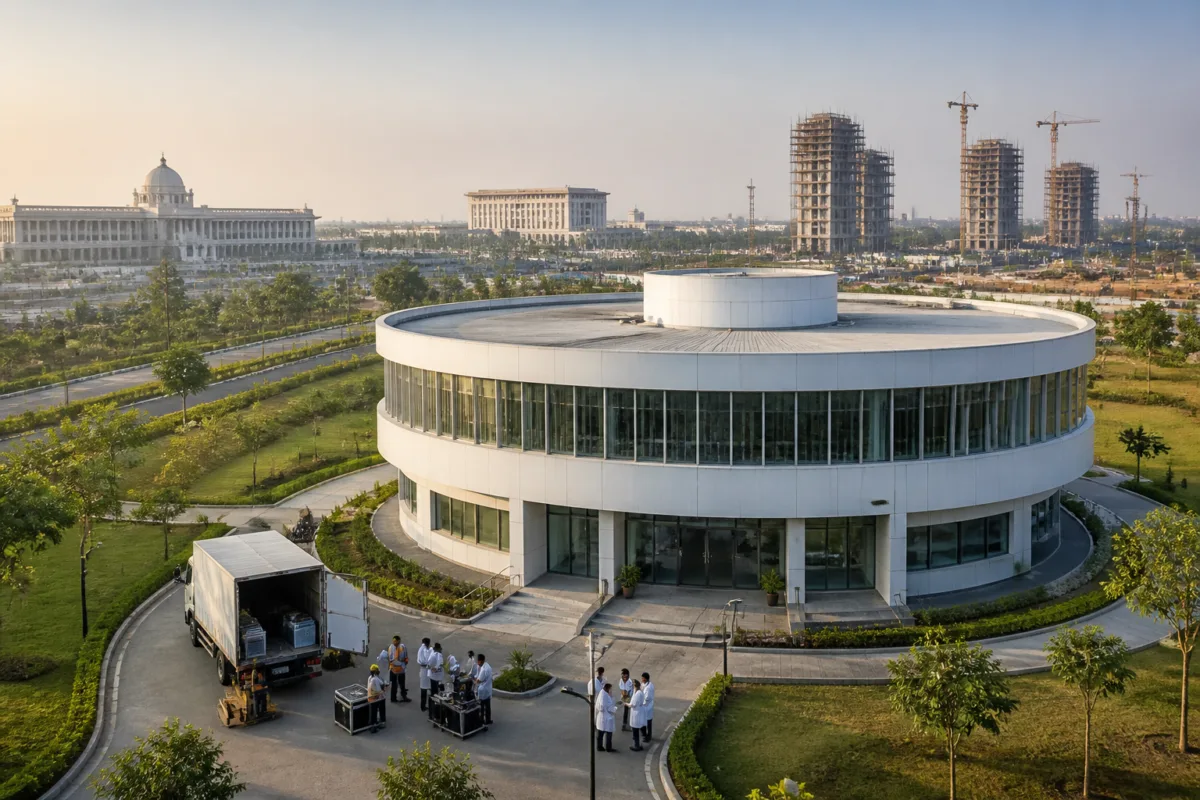
Amaravati’s planned quantum computing facility is being built as more than a specialised laboratory. With an IBM Quantum System Two expected to be installed by early 2027, the project will test whether a new capital city can turn high-end technology infrastructure into a functioning research, enterprise and public-service ecosystem.
The Andhra Pradesh government is expected to hand over the Quantum Computer Centre building to IBM by the end of October. Parts of the machine have already reached India from the United States, with commissioning targeted for December 2026 or January 2027. The facility is expected to be formally inaugurated in the first week of February 2027, according to the timeline reported by the Times of India.
That sequence matters because the project’s significance lies not only in the presence of an advanced computer, but also in the institutional arrangements around it. IBM will own and operate the machine, while researchers, universities, startups, enterprises and government agencies in India are expected to access it through a service model. The arrangement places the emphasis on access and applications rather than on transferring ownership of the hardware to the state.
The proposed centre will be located near the upcoming Andhra Pradesh legislature complex. It is planned as a circular, two-storeyed building on a two-acre site and will anchor the Amaravati Quantum Valley project. The initiative brings together IBM, TCS, L&T and academic institutions including IIT Madras and IIT Tirupati.
In urban terms, the project represents a particular kind of infrastructure: a physical facility designed to support a digital and scientific capability. Its performance will therefore depend on more than construction completion. The building must accommodate specialised equipment, the machine must be commissioned, and the participating institutions must be able to use the system for sustained research and problem-solving. The supplied information establishes the construction and commissioning timeline, but not the facility’s final operating capacity, staffing structure or long-term funding model.
The equipment is also not being treated as a conventional computer installation. IBM Research India director and IBM India and South Asia chief technology officer Amith Singhee said the company intends to install its most advanced available quantum processor. The exact configuration has not yet been finalised. Current IBM systems operate with roughly 120 to 150 or more qubits per chip, but the report does not establish the final specifications of the Amaravati machine.
That distinction is important in understanding what the facility can and cannot represent. Quantum computers use qubits rather than conventional bits, allowing them to process certain kinds of calculations in a different way. Scientists hope such systems can eventually assist with difficult problems in areas such as drug discovery and materials research. Current quantum machines, however, remain largely research tools. The Amaravati centre should therefore be understood as an effort to create access to advanced experimental infrastructure, not as an immediate replacement for conventional computing systems.
The project’s strongest public-interest dimension is the attempt to connect this research infrastructure with practical administrative problems. Andhra Pradesh has launched a programme to develop 100 quantum computing use cases, drawing on challenges identified by government departments, industry and startups. One proposed application examines whether quantum-based optimisation can improve the deployment and routing of the state’s 731 ambulances operating under the 108 emergency service. Four startups are participating in that effort.
The ambulance example shows why the application layer may be more consequential than the machine itself. A quantum computer located in Amaravati will not automatically improve emergency response. The relevant question is whether a real operational problem can be translated into a computational model, whether the available data is usable, and whether the resulting approach can improve decisions made by the emergency system. The report confirms that the use case is being explored, but it does not provide results demonstrating that quantum methods have already improved ambulance deployment or routing.
Other proposed applications include electricity distribution, factory scheduling, drug discovery and materials research. Together, these areas span public utilities, industrial operations and scientific research. They also indicate the breadth of the state’s ambition: the facility is being positioned as a platform that can serve government agencies, companies, startups and academic institutions rather than as a single-purpose research centre.
This breadth creates an institutional challenge. The participating users will need more than physical access to the processor. They will require researchers who understand quantum algorithms, organisations capable of defining suitable problems and systems for evaluating whether an application produces a useful outcome. Andhra Pradesh has begun the use-case programme, but the supplied report does not specify how the 100 projects will be selected, funded, measured or moved from experimentation into routine deployment.
The partnership structure attempts to address part of that challenge. IBM provides the hardware and operational role, while TCS, L&T, IIT Madras and IIT Tirupati are part of the wider Amaravati Quantum Valley initiative. The arrangement links a global technology company, Indian industry and academic institutions. It may also allow users who cannot independently acquire such equipment to work with an advanced system located within India.
For Indian researchers and companies, domestic access could reduce dependence on machines located overseas. The report describes this as a way to develop Indian expertise in quantum algorithms and applications. However, the installation alone cannot establish a national capability. That would require continued access, trained personnel, research programmes and a pipeline connecting university work with industry and public-sector requirements. The available information confirms the infrastructure and partnership, while the scale and durability of the ecosystem remain to be demonstrated.
The project also fits into Amaravati’s larger question of how a capital city creates an economic and institutional identity. The centre is being built close to the legislature complex, placing advanced research infrastructure within the emerging administrative landscape. Its location symbolically connects governance with technology, but the practical relationship between the two will depend on whether government departments become active users and whether the facility remains connected to the city’s universities, businesses and workforce.
That is a different proposition from constructing an office complex or a transport link. A quantum facility has a visible physical form, but much of its value is generated through collaboration, data, research capability and repeated use. The two-acre site and circular building are measurable project components. The harder-to-measure assets are the networks of researchers, startups, officials and enterprises that must use the centre over time.
The schedule supplied by the Andhra Pradesh State Quantum Mission indicates that approvals for shipment were secured and the shipment process began in September. Components are being sent from the United States in parts, with some already delivered to an IBM warehouse in Bengaluru. Mission director CV Sridhar said basic testing and commissioning would take place in India after the remaining systems arrived, with the overall process expected to take no more than three months and a buffer included in the schedule.
These milestones provide a clear sequence for monitoring the project: completion and handover of the building, arrival of the remaining components, installation, local testing, commissioning and inauguration. Each stage will reveal whether the project is progressing from announcement to operation. The report does not indicate that the facility has begun functioning, and its final processor configuration is still pending.
The most important measure will ultimately be whether the centre produces usable knowledge and applications. The proposed ambulance-routing project offers a direct public-service test, while electricity distribution and factory scheduling could connect the facility to infrastructure and industrial operations. Drug discovery and materials research would test its value for scientific and commercial research. At this stage, these remain proposed or developing applications rather than verified outcomes.
Amaravati’s quantum computing facility therefore carries two linked promises. The first is physical: India will have advanced quantum hardware on its own soil, with the machine expected to be installed by early 2027. The second is institutional: the hardware could provide a base for Indian research, startups, enterprises and government agencies to build expertise and applications. The first promise can be assessed through construction and commissioning milestones. The second will depend on access, skills, use-case development and evidence of results.
The next decisive developments are the planned October handover, the arrival and testing of the remaining equipment, confirmation of the final processor configuration and the expected February 2027 inauguration. Beyond those dates, the progress of the 100-use-case programme—and whether any of its projects move from experimentation to measurable public or commercial value—will show whether Amaravati has created a working quantum ecosystem or only a high-profile facility.

